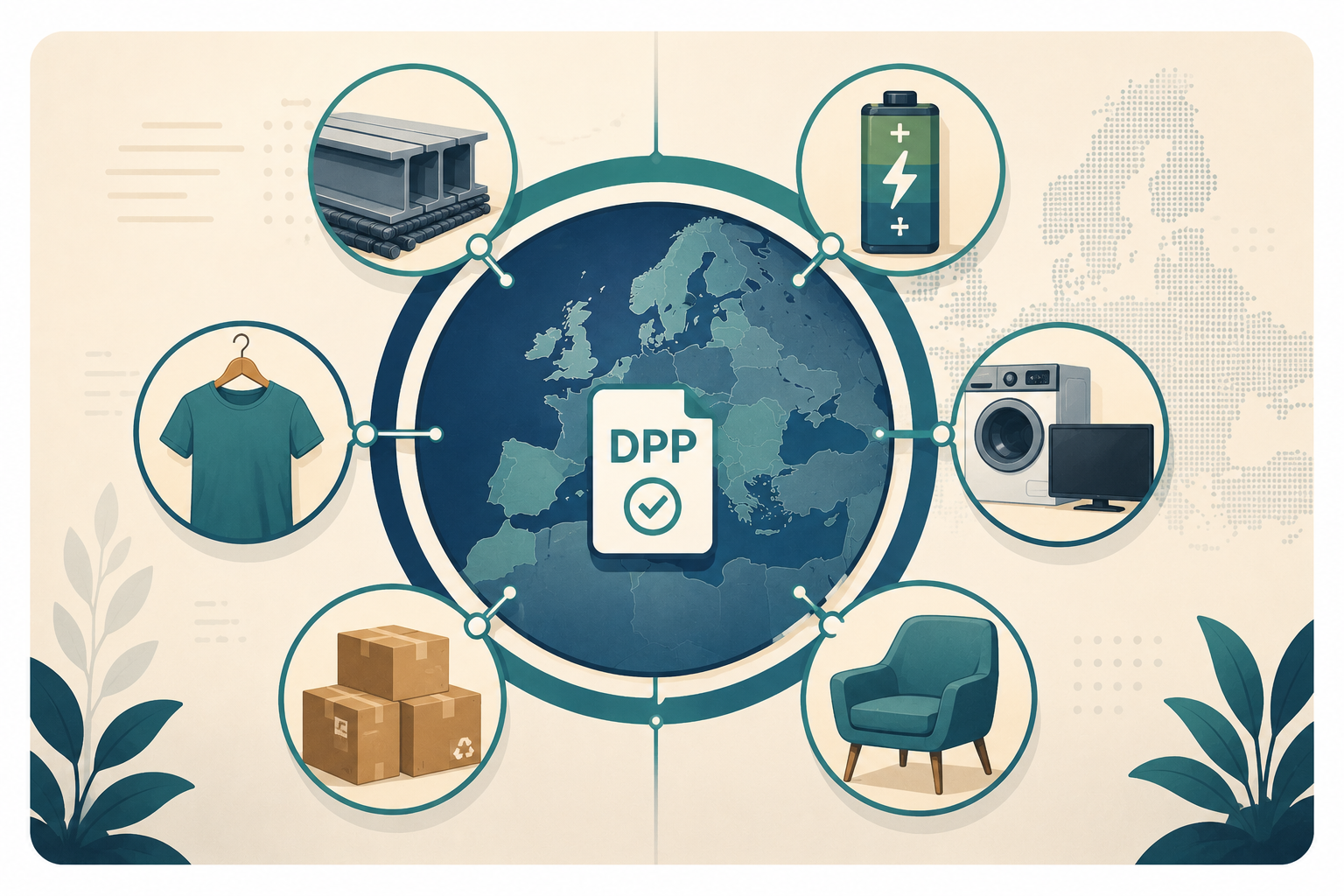
The Digital Product Passport is not arriving all at once. It is arriving sector by sector, with different deadlines, under different regulatory frameworks and with different content requirements.
What all European DPPs have in common is the same underlying infrastructure: the European Commission’s Central Registry, unique identifiers, trust services that guarantee the authenticity of the data, and the same logic of differentiated access: public information for consumers, restricted information for authorities, and technical information for repairers and recyclers.
What they do not have in common is urgency. For some sectors, the DPP is an obligation arriving in eighteen months. For others, there is a window until 2029 or beyond 2030. Knowing where your sector stands is the difference between planning calmly and arriving late for a fixed deadline.
This article is the map. One sector, its date, its regulation, its real urgency.
Concepts for better understanding
DPP (Digital Product Passport)
A traceability tool that gathers technical, environmental and sustainability information about a product throughout its life cycle, accessible through a physical data carrier. It is mandatory for regulated product groups, with different deadlines depending on the sector.
DPP Central Registry
A digital registry created and managed by the European Commission, operational from 19 July 2026, where the unique identifiers of all products with a DPP are stored.
ESPR delegated act
A Commission regulation that specifies the ecodesign requirements, and the DPP content, for a specific product group. The application date cannot be earlier than eighteen months after its adoption.
ESPR Working Plan 2025–2030
A Commission communication adopted on 16 April 2025 that defines the priority product groups for delegated acts and their estimated timelines over the next five years.
DPP interoperability
A requirement established in both the ESPR and the CPR: all sectoral DPPs must be interoperable with each other at technical, semantic and organisational levels. The battery passport is the initial technical reference.
How the system works: why the deadlines are what they are
Before looking at the map, it is useful to understand the mechanism that explains why some sectors arrive earlier than others.
The DPP does not exist autonomously: it is always anchored to a regulatory act that defines its content, including what information it must contain, at what level of granularity, and who can access what. This may be a specific sectoral regulation, such as the Batteries Regulation, or an ESPR delegated act for a specific product group.
The ESPR establishes that there must be a minimum of eighteen months between the adoption of a delegated act and its date of application. This means that the DPP for a sector arrives at least eighteen months after the Commission publishes the corresponding delegated act. The ESPR Working Plan 2025-2030 provides the estimated adoption dates for those acts: this is how DPP deadlines are calculated.
The sectors that reach the DPP first are those with an already approved sectoral regulation, such as batteries, or those placed by the Working Plan in the first cycle of delegated acts, such as iron and steel, textiles, aluminium and tyres. Those that arrive later are the ones placed by the Plan in the second cycle, such as furniture and mattresses, or those that fall outside the first plan altogether and will be addressed in the next one.
There is also a special group: products with energy labels registered in EPREL. For these, the ESPR provides that the Commission may exempt them from the DPP if it considers that EPREL already covers equivalent information objectives. This is not an automatic exemption: the Commission must expressly declare it in the delegated act for each group. But it is likely for most product groups already active in EPREL.
The practical rule: your sector’s DPP arrives 18 months after the delegated act. The delegated act arrives according to the Working Plan. And the Working Plan has already been adopted since 16 April 2025. The dates are not merely indicative: they are the official calendar of the European Commission.
Sector 1: Batteries, the first and most advanced
Legal framework: Regulation (EU) 2023/1542, Chapter IX
DPP mandatory date: 18 February 2027
Affected categories: electric vehicle (EV) batteries, light means of transport (LMT) batteries and industrial batteries with a capacity above 2 kWh
The battery passport is the only DPP with a fixed date already published in its own sectoral regulation. It does not depend on any pending delegated act: Article 77 of the Batteries Regulation directly establishes that, from 18 February 2027, none of these batteries may be placed on the EU market without an operational digital passport.
Its content is already defined in Annex XIII of the same Regulation: material composition, carbon footprint, recycled content of key materials, battery state of health, usage history, dismantling and end-of-life instructions, with three differentiated levels of access.
The Commission’s DPP Central Registry opens in July 2026: the unique battery identifiers are registered there. The QR code on all batteries, including portable batteries, is also mandatory from 18 February 2027.
Urgency: maximum. Less than nine months remain.
Sector 2: Iron and steel, the first under the ESPR
Legal framework: Regulation (EU) 2024/1781 (ESPR) + delegated act in preparation
Estimated date of adoption of the delegated act: ~2026
Estimated DPP mandatory date: ~2027/2028
Iron and steel are the number one priority group in the ESPR Working Plan 2025–2030. The Plan places their delegated act as the first to be adopted, with an estimated adoption date during 2026. Eighteen months after that adoption, the DPP will become mandatory for steel and iron products placed on the European market.
The iron and steel market represents €152 billion per year in the European market, the largest of all the groups in the first Working Plan. The DPP requirements will focus on recycled content, carbon footprint and end-of-life circularity.
CEN CWA 18186:2025 includes iron and steel as one of the groups for which a mandatory DPP is expected in the 2028–2033 period.
Urgency: high. The delegated act may be published at any time from July 2025 onwards. Once published, the eighteen-month clock starts ticking.
Sector 3: Textiles and apparel, the most politically visible
Legal framework: Regulation (EU) 2024/1781 (ESPR) + delegated act in preparation
Estimated date of adoption of the delegated act: ~2027
Estimated DPP mandatory date: ~2028/2029
Textiles are the sector with the greatest visibility in the DPP ecosystem for one reason: they already have obligations in force before the DPP arrives. The ban on the destruction of unsold clothing, clothing accessories and footwear for large companies entered into force on 19 July 2026. That is a real obligation already, without a delegated act, without a DPP: it is Article 25 of the ESPR applying directly.
The ecodesign delegated act for garments is estimated for ~2027, and the textile DPP would arrive eighteen months later, in ~2028/2029. The EU clothing market exceeds €78 billion per year, with high potential for improvement in lifespan, materials and waste reduction.
Footwear is treated differently: instead of a direct delegated act, the Plan mandates an exploratory study by the end of 2027 to determine whether footwear will enter the next cycle. The destruction ban, however, already also applies to footwear from July 2026.
Urgency: medium-high. The DPP arrives in 2028–2029, but the data architecture of the textile supply chain requires years of preparation.
Sector 4: Aluminium
Legal framework: Regulation (EU) 2024/1781 (ESPR) + delegated act in preparation
Estimated date of adoption of the delegated act: ~2027
Estimated DPP mandatory date: ~2028/2029
Aluminium shares the same estimated timeline as textiles: a delegated act expected around ~2027 and mandatory DPP in ~2028/2029. The Working Plan positions it as the fourth priority, with a €40 billion market and high potential for improvement in CO₂ emission reductions through secondary materials: one tonne of recycled aluminium generates up to eleven times fewer emissions than primary production.
The aluminium DPP will cover both aluminium as a final product and aluminium as an intermediate product used in the manufacture of other goods. This has cascading implications for all manufacturers that use aluminium as a material.
Urgency: medium-high. Same horizon as textiles: 2028–2029.
Sector 5: Tyres, already in EPREL, now also under the ESPR
Legal framework: Regulation (EU) 2020/740 on labelling + Regulation (EU) 2024/1781 (ESPR) + delegated act in preparation
Estimated date of adoption of the ESPR delegated act: ~2027
Estimated DPP mandatory date: ~2028/2029
Tyres are the only sector in this map that already has a presence in two regulatory frameworks at the same time: they have been in EPREL since 1 March 2020 under Regulation (EU) 2020/740, and they are now included in the ESPR Working Plan as a priority group for additional sustainability requirements that go beyond fuel efficiency.
The tyre DPP will arrive around ~2028/2029, adding a layer of information on circularity, including recycled content, end of life and material traceability, which the current energy label does not cover.
Urgency: medium. Tyre manufacturers already registered in EPREL have a basic digital infrastructure, which reduces part of the preparation work.
Sector 6: Electronics and small household appliances
Legal framework: Regulation (EU) 2024/1781 (ESPR), horizontal repairability measure
Estimated date of adoption of the delegated act: ~2027
Estimated DPP mandatory date: ~2028/2029
The horizontal repairability measure is cross-cutting: it applies to consumer electronics and small household appliances as a generic category, not to one specific product. It introduces a repairability score from A to E, already operational for smartphones and tablets since June 2025, which will be extended to a much wider range of electronic products and household appliances.
The DPP associated with this horizontal measure would arrive in ~2028/2029, at the same time as those for textiles and aluminium.
Products with energy labels registered in EPREL, such as washing machines, dishwashers, refrigerators and displays, will probably not need an additional DPP if EPREL is considered an equivalent system. The horizontal repairability measure may have a greater impact on electronics categories without a current energy label.
Urgency: medium. Same horizon as textiles and aluminium, but electronics manufacturers already registered in EPREL have an infrastructure advantage.
Sector 7: Furniture, the longest timeline in the first Working Plan
Legal framework: Regulation (EU) 2024/1781 (ESPR) + delegated act in preparation
Estimated date of adoption of the delegated act: ~2028
Estimated DPP mandatory date: ~2029/2030
Furniture is included in the first Working Plan, but with the longest timeline: the delegated act is estimated for ~2028 and the DPP would arrive in ~2029/2030, eighteen months later.
CEN CWA 18186:2025 includes furniture among the groups for which a DPP is expected in the 2028–2033 period. The foreseeable requirements for the furniture DPP include information on materials, such as the composition of boards, fabrics, metals and plastics, durability, repair instructions and end-of-life options.
Urgency: low-medium. There is room for planning, but furniture product design cycles are long and the supply chain is complex. This is not the time to ignore it.
Sector 8: Mattresses, the last group in the first Working Plan
Legal framework: Regulation (EU) 2024/1781 (ESPR) + delegated act in preparation
Estimated date of adoption of the delegated act: ~2029
Estimated DPP mandatory date: ~2030/2031
Mattresses are the group with the longest horizon in the first Working Plan: delegated act estimated for ~2029 and mandatory DPP in ~2030/2031. Although this may seem reassuring, it should be noted that the mid-term review of the Working Plan in 2028 could bring deadlines forward.
Urgency: low for now, with a review in 2028.
Sector 9: Construction products, under the CPR, not the ESPR
Legal framework: Regulation (EU) 2024/3110, the new Construction Products Regulation
Estimated DPP mandatory date: ~2029/2030
Construction products have their own DPP under the new Construction Products Regulation, Regulation (EU) 2024/3110, published in December 2024, not under the ESPR. The construction DPP must be compatible and interoperable with the ESPR DPP: Article 78 of the CPR expressly establishes that it will be based on the ESPR DPP.
CEN CWA 18186:2025 estimates the DPP for construction products at ~2029/2030, eighteen months after the CPR system is expected to become operational in 2026/2027. Annex VII of the CPR lists 35 families of affected products, from precast concrete to doors, windows, insulation products, flooring and many others.
Urgency: medium-low. The timelines are longer, but the sector has a high level of technical complexity when it comes to implementing traceability.
Sector 10: Toys, under the new Toy Safety Directive
Legal framework: new Toy Safety Directive, currently under review
Estimated DPP mandatory date: ~2029/2030
The toy DPP does not come from the ESPR, but from the revision of the Toy Safety Regulation. CEN CWA 18186:2025 estimates the toy DPP for ~2029/2030, approximately 54 months after the publication of the new regulation, expected in 2025. The focus of the toy DPP is substance safety, not ecodesign.
Urgency: low.
The visual map: DPPs by sector and estimated year
| Sector | Legal framework | Delegated act / source | Estimated mandatory DPP | Urgency |
|---|---|---|---|---|
| EV, LMT and industrial batteries >2 kWh | Batteries Reg. (EU) 2023/1542 | Already published (Art. 77) | 18 Feb 2027 | 🔴 Maximum |
| Iron and steel | ESPR (EU) 2024/1781 | Delegated act ~2026 | ~2027/2028 | 🔴 High |
| Textiles / apparel | ESPR (EU) 2024/1781 | Delegated act ~2027 | ~2028/2029 | 🟠 Medium-high |
| Aluminium | ESPR (EU) 2024/1781 | Delegated act ~2027 | ~2028/2029 | 🟠 Medium-high |
| Tyres | ESPR (EU) 2024/1781 | Delegated act ~2027 | ~2028/2029 | 🟠 Medium |
| Electronics / small household appliances (repairability) | ESPR (EU) 2024/1781 | Delegated act ~2027 | ~2028/2029 | 🟠 Medium |
| Furniture | ESPR (EU) 2024/1781 | Delegated act ~2028 | ~2029/2030 | 🟡 Low-medium |
| Construction products | CPR (EU) 2024/3110 | CPR system ~2026/2027 | ~2029/2030 | 🟡 Low-medium |
| Toys | New Toy Safety Regulation | Regulation ~2025 | ~2029/2030 | 🟡 Low |
| Mattresses | ESPR (EU) 2024/1781 | Delegated act ~2029 | ~2030/2031 | 🟡 Low |
| Horizontal EEE measure (recyclability/recycled content) | ESPR (EU) 2024/1781 | Delegated act ~2029 | ~2030/2031 | 🟡 Low |
| Detergents | New Detergents Regulation | ~2025/2026 | ~2027/2028 | 🟠 Medium |
Which sectors are excluded from this map?
The most important exclusion is food products, feed, medicinal products and products of human or animal origin: the ESPR expressly excludes them from its scope.
Motor vehicles are also excluded from the first ESPR Working Plan: they have their own specific regulatory frameworks, including the Regulation on end-of-life vehicles.
Footwear, detergents, paints, lubricants and chemicals are outside the first ESPR Working Plan, but they are not permanently excluded: they are expected to be addressed in the next post-2030 regulatory cycle, and footwear has an exploratory study scheduled for the end of 2027 that could bring its inclusion forward.
Energy-related products with labels in EPREL, such as household appliances, displays, light sources and smartphones, will probably not need an additional DPP under the ESPR if EPREL is considered an equivalent system. But this requires the Commission to expressly declare it in each delegated act.
Why eighteen months are not enough
The ESPR guarantees eighteen months between the adoption of the delegated act and its date of application. But building the technical infrastructure for the DPP in eighteen months is a difficult project, even for well-prepared companies.
CWA 18186:2025 identifies fifteen design decisions that the party responsible for implementing the DPP must make: type of passport, identifiers, data carrier, IT architecture, access rights, longevity, security and supply chain traceability.
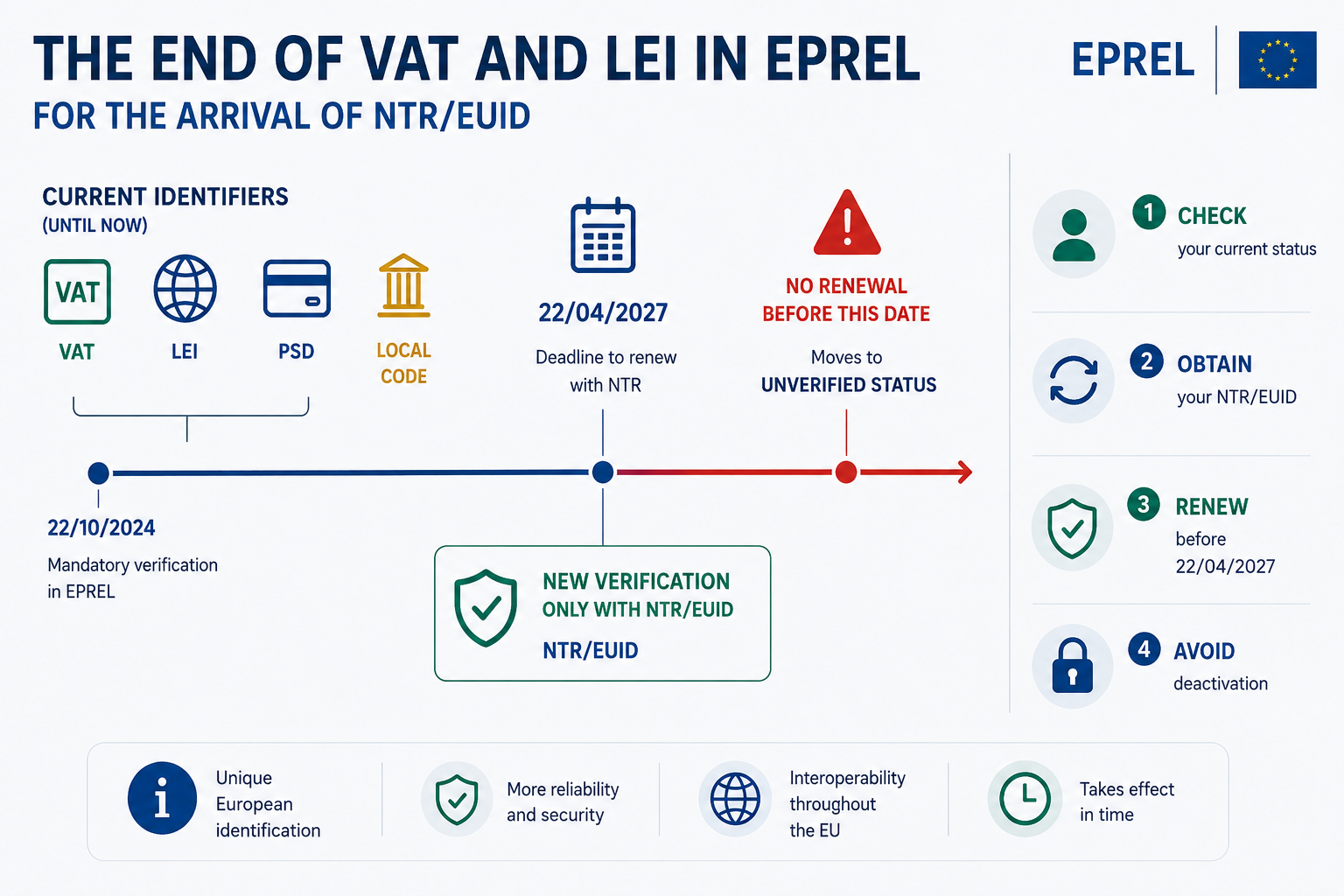
Companies already operating in EPREL with a qualified NTR seal have a real advantage: they already understand the logic of European digital registries, they already have the authentication infrastructure, and they have already worked with unique identifiers and Commission systems. The DPP will likely extend that logic to the full product life cycle. For companies arriving at the DPP without that foundation, the preparation work is greater.
Frequently asked questions
Probably not an additional DPP, but there is no automatic guarantee either: the Commission must expressly declare the exemption in the delegated act for each group. For groups already active in EPREL, this is the most likely scenario. Registration obligations in EPREL and verification with an NTR seal remain in place in any case for those delegated acts.
Yes. Article 78 of the Batteries Regulation establishes that the battery passport must be fully interoperable with other DPPs required by Union law on ecodesign. The DPP Central Registry will already store the unique identifiers of batteries from July 2026.
Prepare the data architecture. The DPP requires collecting information from the supply chain that only exists if supplier contracts include data delivery obligations, and building the systems to manage that information. Waiting until the delegated act is published to start this work means assuming that eighteen months are enough to build everything from scratch. In most cases, they are not.
For now, this is not 100% certain. The authentication, integrity and qualified electronic seal infrastructure that currently enables verification in EPREL may be the same infrastructure the DPP will need to guarantee the authenticity of the data entered into the passport. A QTSP included in the EU Trusted List that issues NTR seals for EPREL is in the same position to provide the trust services required for the DPP.
Does your sector already know when the DPP is coming?
The map is clear. What varies is the level of preparation. Companies in the battery sector have months. Those in the textile or aluminium sectors have until 2028–2029, but they need years to build the supply chain traceability that the DPP will require.
Furniture or construction companies have until 2029–2030, but the technical complexity is no lower. At EADTrust, we are a qualified trust service provider included in the EU Trusted List.
The same certificates that today allow companies to verify themselves in EPREL may be the basis of the trust infrastructure that the DPP will likely require: qualified electronic seals to authenticate who enters the data, timestamps for event traceability, and archiving services for the long-term availability required by the Regulation.
Subscribe to our newsletter to receive all the information or regulatory changes related to the DPP of your choice.