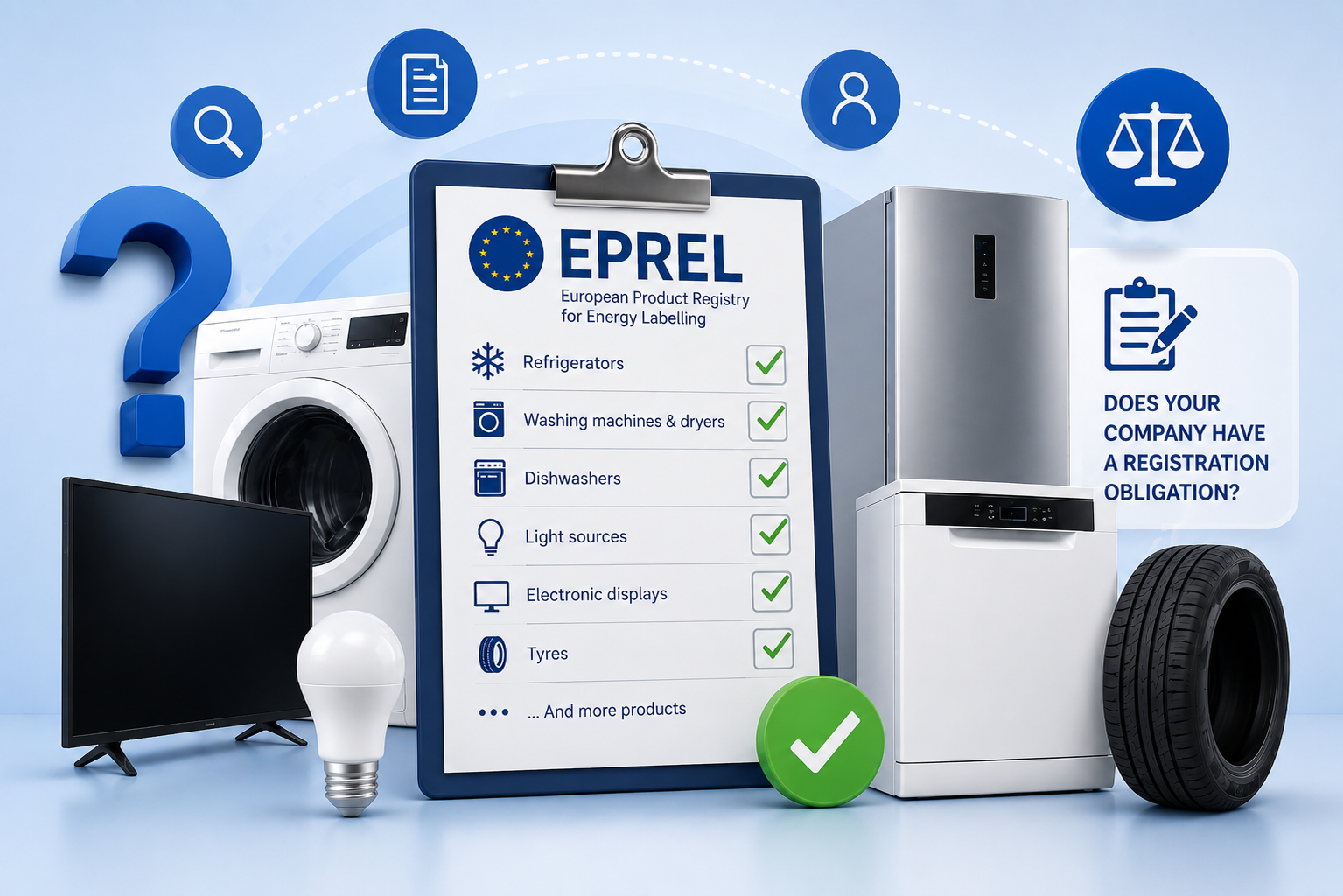
Some of the products that require EPREL registration include: light sources, smartphones and tablets, household dishwashers, tyres, and others.
But there is one question that reaches compliance departments far more often than it should: “Does our product fall within EPREL or not?” The answer is not always obvious because the system does not operate as a closed catalogue of individual models. Instead, it functions through product groups regulated by delegated acts.
Understanding which product groups are covered, when they entered into force, and which products remain outside the scope is the first step before doing anything within the platform.
If you manufacture, import, or represent products in the European Union market, here you will find which product groups are currently active in EPREL, when they were incorporated, which delegated regulations apply to them, and which exclusions you should be aware of — all updated for 2026.
Key concepts for understanding which products require EPREL registration
Understanding which products must be registered in the EPREL database requires analyzing the European rules on energy labelling and ecodesign. Registration is mandatory for those devices that significantly affect energy consumption during their use.
What is Regulation (EU) 2017/1369?
The framework regulation of the European Parliament and of the Council establishing the EU energy labelling system, repealing Directive 2010/30/EU, and entrusting the European Commission with the creation and maintenance of EPREL.
What is rescaling?
The process by which the European Commission replaces the energy efficiency scale of a product group with a new one, maintaining the A-to-G structure while redefining the thresholds of each class to reflect technological progress within the market.
What is a supplier?
For the purposes of Regulation (EU) 2017/1369, the supplier is the manufacturer established within the EU, the authorized representative of a manufacturer not established in the EU, or the importer placing the product on the European market. The supplier is the party responsible for EPREL registration.
How is it determined which products fall within EPREL?
Article 1 of Regulation (EU) 2017/1369 establishes the framework: the system applies to energy-related products placed on the market or put into service within the European Union. According to Article 2 of the same Regulation, an “energy-related product” means any good or system whose use has an impact on energy consumption.
However, this does not mean that every product consuming energy must automatically be registered in EPREL. Registration only becomes mandatory when there is a specific delegated act applicable to that product group, adopted under Regulation (EU) 2017/1369 (or, in the case of tyres, under Regulation (EU) 2020/740). Without an applicable delegated act, there is no registration obligation, even if the product carries some form of energy-related information.
Think of it as a lock-and-key system: EPREL is the lock, but it only opens with a specific key — the delegated act. If your product group does not have that key, the obligation does not apply. But the European Commission can create new keys at any time.
Implementing Regulation (EU) 2024/994 adds another layer: suppliers of regulated products are required to complete electronic verification in EPREL using a qualified electronic seal. Without verification, registration is impossible. Without registration, lawful commercialization is impossible.
The rule is simple: EPREL does not regulate a product in the abstract. It regulates a product group for which the European Commission has issued a delegated regulation containing specific labelling requirements. If there is no delegated act, there is no obligation. If there is one, there is no escape.
Which product groups are active in EPREL in 2026?
The product groups available in EPREL are organized according to the delegated regulation governing them. As of 2026, these are the active groups, divided according to the legal framework supporting them.
Groups under Regulation (EU) 2017/1369 — new A–G scale
These are the groups that have already completed the rescaling to the new A-to-G energy efficiency scale, without the former A+, A++, and A+++ classes.
Household refrigeration appliances
Refrigerators, freezers, and fridge-freezer combinations for household use. Regulated by Delegated Regulation (EU) 2019/2016, applicable since 1 March 2021, which repealed the previous framework. These products were among the first affected by the major rescaling: the A+, A++, and A+++ classes disappeared for this group on that date.
Refrigerating appliances with a direct sales function
Commercial refrigeration cabinets, display cases, and refrigerated counters used in retail environments. Regulated by Delegated Regulation (EU) 2019/2018, also applicable since 1 March 2021.
Household washing machines and household washer-dryers
A single delegated regulation — Delegated Regulation (EU) 2019/2014 — covers both categories. Applicable since 1 March 2021. Non-household washing machines (professional or industrial use) remain outside the scope of this regulation.
Household dishwashers
Regulated by Delegated Regulation (EU) 2019/2017, applicable since 1 March 2021. As with washing machines, professional or commercial dishwashers are subject to a different regulatory framework.
Electronic displays
Televisions, monitors, and digital signage displays. Regulated by Delegated Regulation (EU) 2019/2013, applicable since 1 March 2021. Digital signage displays have specific categories within the regulation.
Light sources
All types of lamps: LED, compact fluorescent, halogen, and others. Regulated by Delegated Regulation (EU) 2019/2015, applicable since 1 September 2021.
Smartphones and tablets
This was the latest product group added to EPREL under the new A–G scale. Delegated Regulation (EU) 2023/1669, published in August 2023, introduced for the first time the obligation to provide an energy label for smartphones and tablets. Since 20 June 2025, no new model of these devices may be commercialized within the EU without being registered in EPREL with an energy label compliant with the regulation.
Their label goes beyond energy efficiency and incorporates parameters relating to free-fall reliability, reparability, battery endurance cycles, and ingress protection ratings.
Household tumble dryers
Tumble dryers have a two-stage regulatory history. The former Delegated Regulation (EU) No 392/2012 was repealed and replaced by Delegated Regulation (EU) 2023/2534.
The new regulation applies the rescaling to the A–G scale for this group, with an application date of 11 August 2026. Until that date, models registered under the previous regulation remain valid. If you manufacture or import tumble dryers, that deadline is already approaching rapidly.
Groups under Regulation (EU) 2020/740 — tyre labelling
Tyres in categories C1, C2, and C3
Tyres have their own dedicated labelling regulation — Regulation (EU) 2020/740 — which entered into force on 1 March 2020 and amended Regulation (EU) 2017/1369 in order to include this group within EPREL.
Category C1 corresponds to passenger vehicle tyres; C2 to light commercial vehicle tyres; and C3 to heavy commercial vehicle tyres.
Tyre labels include parameters different from traditional energy labelling: fuel efficiency (rolling resistance), wet grip performance, and, where applicable, external rolling noise and snow or ice traction performance.
Groups under Directive 2009/125/EC — transitional period
Certain product groups continue to be registered in EPREL under delegated acts adopted pursuant to Ecodesign Directive 2009/125/EC (the predecessor of the ESPR). These groups are undergoing gradual revision under the new regulatory framework. They include:
- Air-conditioning equipment (domestic air conditioners)
- Water heaters (including heat pump water heaters)
- Boilers and space heating equipment (Delegated Regulation (EU) 811/2013)
- Water heaters and hot water storage tanks (Delegated Regulation (EU) 812/2013)
- Household ovens and range hoods (Regulation (EU) No 65/2014, currently under review)
- Residential ventilation units (Delegated Regulation (EU) 1254/2014)
- Solid fuel boilers (Delegated Regulation (EU) 2015/1187)
- Local space heaters (Delegated Regulation (EU) 2015/1186)
- Professional refrigerated storage cabinets (Delegated Regulation (EU) 2015/1094)
These groups remain active in EPREL while their delegated acts continue in force. Article 75 of Regulation (EU) 2024/1781 (ESPR) establishes that delegated regulations adopted under the former directive remain applicable during the transitional period. The ESPR 2025–2030 Working Plan already foresees the revision of some of these delegated acts.
Which products are outside the scope of EPREL?
Regulation (EU) 2017/1369 establishes two explicit exclusions in Article 1(2).
Second-hand products are excluded unless they are imported from a third country. A used appliance sold within the European market is not subject to EPREL registration obligations. However, if that same appliance is imported from outside the EU for sale, it may fall within the scope of the Regulation. This also applies to refurbished smartphones: they are excluded when commercialized within the European market.
Motor vehicles, trucks, buses, ships, and aircraft are excluded from the scope of Regulation (EU) 2017/1369, although they remain regulated under other legislative frameworks relating to energy efficiency and emissions.
In addition, even where a product belongs to a regulated group, it may still fall outside the scope of a specific delegated regulation due to its use or technical characteristics.
For example, non-household washing machines are excluded from Delegated Regulation (EU) 2019/2014, which expressly applies only to household appliances. Tumble dryers operating exclusively on batteries without grid connection capability are also excluded from Regulation (EU) 2023/2534.
And smartphones with rollable displays are expressly excluded from the scope of Regulation (EU) 2023/1669.
What appears to fall within EPREL may ultimately not be covered. Before assuming that your product requires registration in EPREL, always verify the scope of the specific delegated regulation applicable to that product group. Exclusions based on usage type, technology, or context matter.
Product groups, delegated regulation, and applicable scale
| Product group | Delegated regulation | Applicable scale | Key date |
|---|---|---|---|
| Household refrigeration appliances | (EU) 2019/2016 | A–G | 1 March 2021 |
| Refrigerating appliances with direct sales function | (EU) 2019/2018 | A–G | 1 March 2021 |
| Washing machines and washer-dryers | (EU) 2019/2014 | A–G | 1 March 2021 |
| Household dishwashers | (EU) 2019/2017 | A–G | 1 March 2021 |
| Electronic displays | (EU) 2019/2013 | A–G | 1 March 2021 |
| Light sources | (EU) 2019/2015 | A–G | 1 September 2021 |
| Smartphones and tablets | (EU) 2023/1669 | A–G | 20 June 2025 |
| Household tumble dryers | (EU) 2023/2534 | A–G (rescaled) | 11 August 2026 |
| C1, C2, and C3 tyres | Regulation (EU) 2020/740 | Specific scale | 1 March 2020 |
| Heating appliances (space heaters + combination heaters) | (EU) 811/2013 | With A+++ classes | Under ESPR review |
| Water heaters | (EU) 812/2013 | With A+++ classes | Under ESPR review |
| Solid fuel boilers | (EU) 2015/1187 | With A+++ classes | Under ESPR review |
| Household ovens and range hoods | (EU) No 65/2014 | With A+++ classes | Under ESPR review |
| Professional refrigerated storage cabinets | (EU) 2015/1094 | With A+++ classes | Under ESPR review |
| Local space heaters | (EU) 2015/1186 | Specific scale | Under ESPR review |
| Residential ventilation units | (EU) 1254/2014 | Specific scale | Under ESPR review |
What about rescaling? The deadlines still ahead
Most of the product groups currently active in EPREL have already completed the transition to the new A–G scale. But there are still important deadlines affecting all suppliers and distributors operating within the European market.
The most immediate is 11 August 2026: the application date of Delegated Regulation (EU) 2023/2534 for household tumble dryers. If you manufacture or import tumble dryers, the process of updating models within EPREL is not immediate and requires preparation.
And there is one overarching deadline that encompasses the entire system: 2 August 2030. This is the date established by Regulation (EU) 2017/1369 by which no product may display classes above A within the European market — meaning that labels using the former A+, A++, or A+++ classifications must disappear completely from all product groups that have not yet completed rescaling.
For product groups already rescaled in 2021, this date simply confirms that there is no return to the previous system. For groups that have not yet completed the process (certain heating, air-conditioning, and other products currently within the ESPR transitional period), 2 August 2030 is the real final deadline.
At the same time, the ESPR 2025–2030 Working Plan foresees the review and update of the delegated acts relating to dishwashers, washing machines, and professional laundry equipment during 2026, which may result in new energy classification thresholds for these product families in the next regulatory cycle.
Do you need to verify your company in EPREL to register your products?
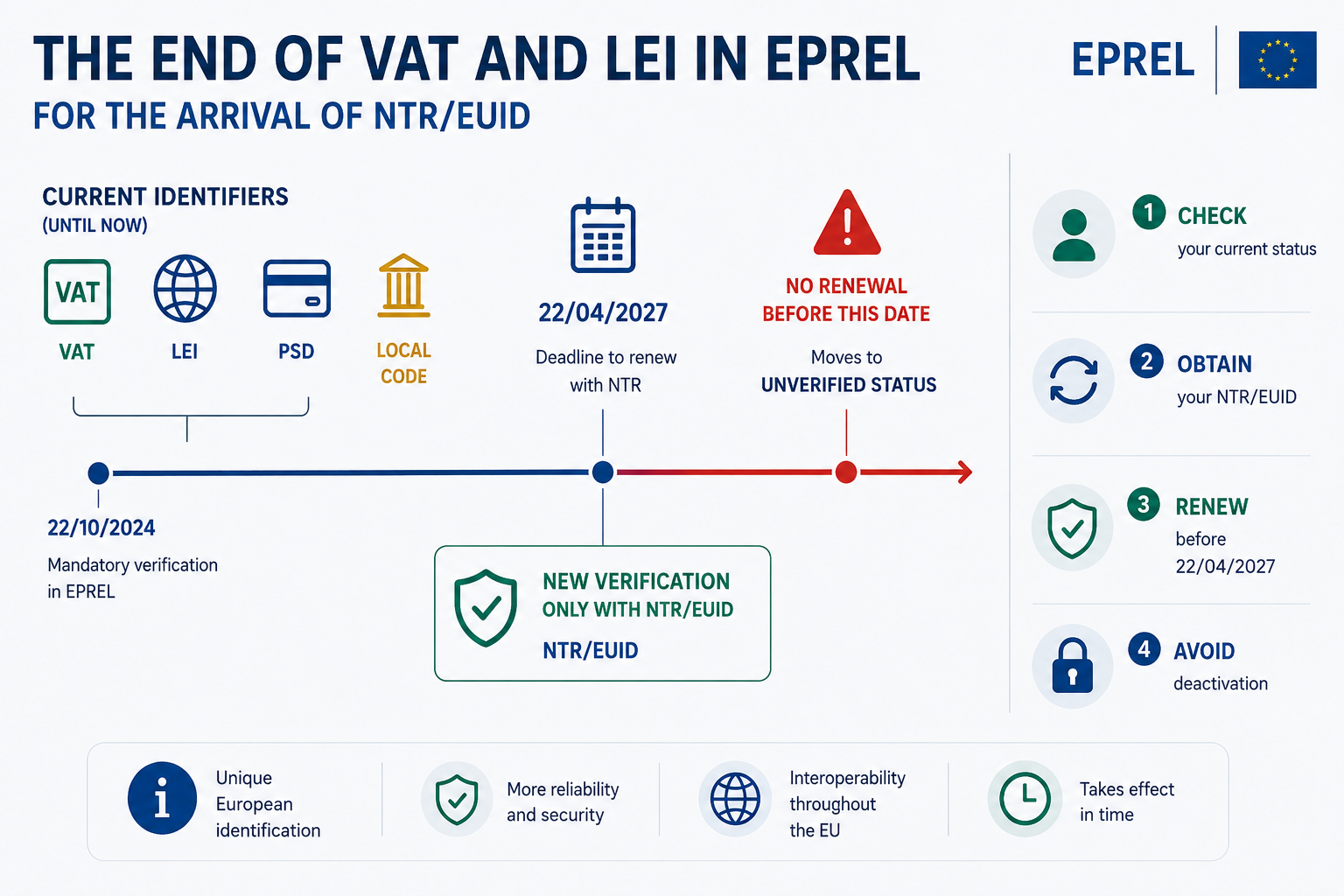
Yes. Since 22 October 2024, Implementing Regulation (EU) 2024/994 requires all suppliers to be verified in EPREL in order to register new models or modify existing ones. Verification requires a qualified electronic seal (QSealC) containing the supplier’s trade register number (NTR), issued by a Qualified Trust Service Provider (QTSP) included in the EU Trusted List.
Since 22 April 2025, only seals containing an NTR identifier are accepted for new verifications and renewals. Suppliers that completed verification before that date using other identifiers (VAT, LEI, PSD) have until 22 April 2027 to renew using an NTR-based seal. After that date, they automatically become classified as “unverified.”
An unverified supplier cannot register models, cannot edit existing registrations, and its products disappear from EPREL public searches and APIs. The practical consequence is straightforward: without verification, there is no lawful commercialization.
Frequently Asked Questions (FAQ) about products that require EPREL
La oHow do I know whether my product requires QSealC verification in EPREL?
The obligation to verify using a qualified electronic seal (QSealC) containing the NTR identifier applies to all suppliers of product groups regulated under Regulation (EU) 2017/1369 and Regulation (EU) 2020/740. If your product falls within any of the groups described in this article, you must be a verified supplier in order to operate within the EPREL compliance system.
If there is no specific delegated act applicable to that product group adopted under Regulation (EU) 2017/1369 or Regulation (EU) 2020/740, there is no obligation to register in EPREL. However, it is important to verify this carefully: the list of active groups may expand through new delegated acts, and the ESPR foresees the extension of energy labelling obligations to additional product groups.
No. Each model is registered within a single product group corresponding to its main function. A combined appliance serving as both a refrigerator and a freezer is registered within the household refrigeration group; it is not duplicated across multiple groups.
Household ovens and extractor hoods are subject to ecodesign requirements under Regulation (EU) No 66/2014, but their treatment within EPREL differs from that of the product groups already operating under the A–G label system. This situation may change through future ESPR delegated acts.
Second-hand products, including refurbished products, are excluded from the scope of Regulation (EU) 2017/1369 when commercialized within the European market. If they are imported from third countries, the situation may be different.
Do you need to know whether your product falls within EPREL, or do you already know that it does but have not yet completed verification?
EPREL is not a system that companies should only consult when a specific doubt arises: it is the reference registry for any business placing energy-labelled products on the European market, from refrigerators to smartphones. Understanding the active product groups, the delegated regulations governing them, and the applicable exclusions is the first step toward managing compliance properly — without surprises and without unnecessary risk.
At EADTrust, we have spent years issuing qualified electronic seals for suppliers operating within EPREL. The process is more straightforward than most companies expect.
Contact us — we will confirm whether your product requires registration and help you complete verification using an NTR-based seal.