The European energy label is a comprehensive regulatory system that determines what you are allowed to market, how you must present it, what documentation you are required to generate, and for how long you must retain it.
A system that, moreover, continues to evolve constantly: over the last twelve months, the first changes arising from the new Ecodesign for Sustainable Products Regulation (ESPR) have become consolidated, the 2025–2030 Working Plan is already in force, smartphones have been included in the system since June 2025, and this very year there are two compliance deadlines that many companies still do not have on their radar.
If you are a manufacturer or importer (or if you represent a company not established within the European Union), this article provides you with the complete roadmap: the legal framework governing the system, the logic behind the new A–G scale, the products covered, the obligations imposed on you, and what distinguishes compliant operators from non-compliant ones. All updated for 2026.
Key definitions for understanding the European energy label
What is Regulation (EU) 2017/1369?
The framework regulation of the European Parliament and of the Council that establishes the EU energy labelling system, repeals Directive 2010/30/EU, and entrusts the European Commission with the creation and maintenance of EPREL.
What is a delegated act?
A regulation adopted by the European Commission that specifies the technical obligations established under Regulation (EU) 2017/1369 for each product group. Each product family (washing machines, dishwashers, refrigeration appliances, displays, light sources, smartphones, etc.) has its own delegated act.
What is the ESPR (Ecodesign for Sustainable Products Regulation, Regulation (EU) 2024/1781)?
A regulation that repeals the Ecodesign Directive 2009/125/EC and expands sustainability obligations (durability, reparability, carbon footprint, etc.) to virtually all products. It has been in force since July 2024, with its delegated acts being progressively implemented under the 2025–2030 Working Plan.
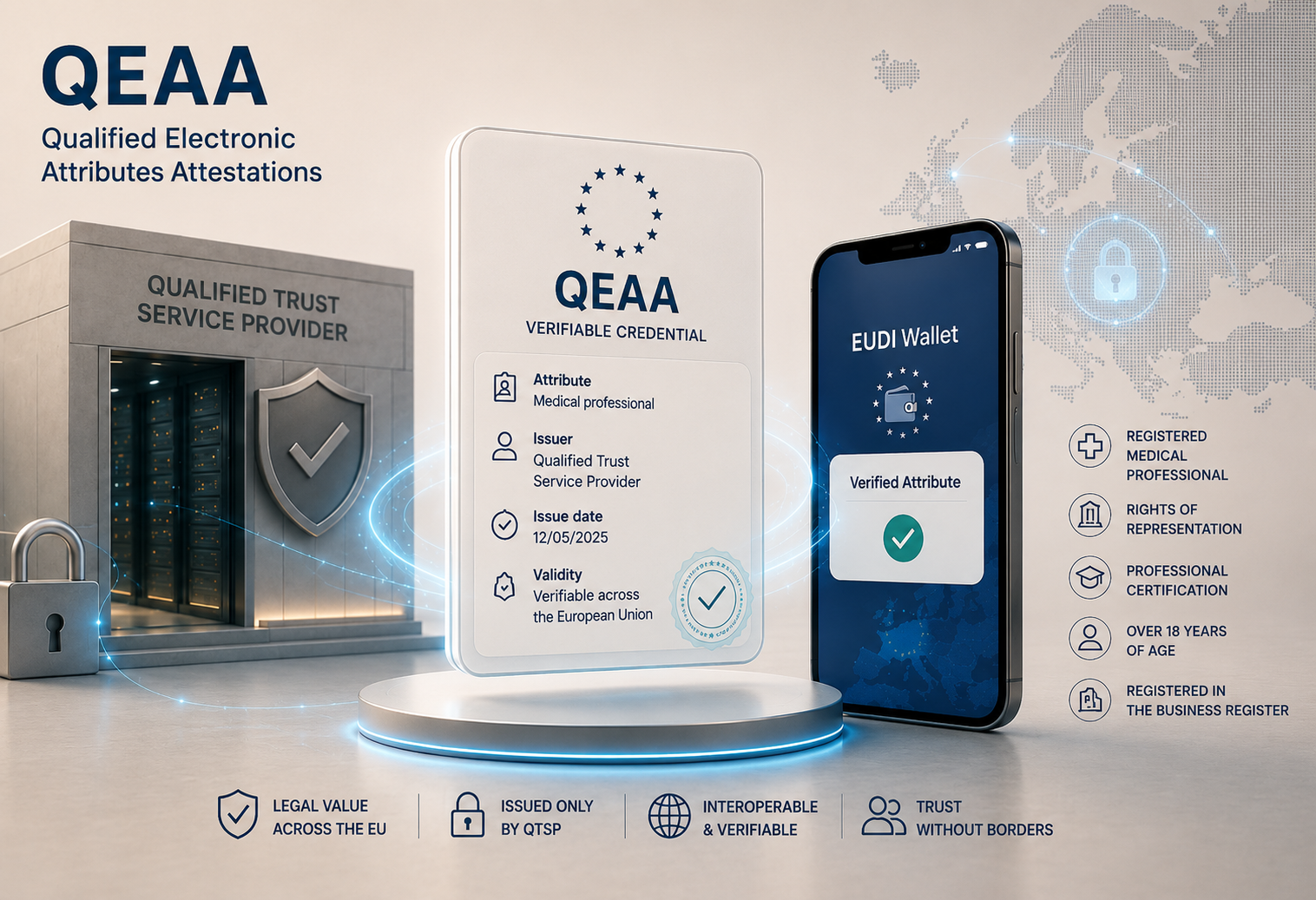
QSealC with NTR
A qualified electronic seal for legal entities that includes the supplier’s trade register number (NTR), issued by a QTSP included in the EU Trusted List, such as EADTrust. It has been mandatory for EPREL verification since October 2024 and is the only valid method for new verifications and renewals since April 2025.
QTSP (Qualified Trust Service Provider)
A Qualified Trust Service Provider, such as EADTrust, included in the EU Trusted List and authorized to issue qualified electronic seals with NTR for EPREL verification.
DPP (Digital Product Passport)
A product lifecycle traceability instrument introduced by the ESPR. The European Commission’s Central DPP Registry will become operational on 19 July 2026.
Why does the European energy label exist? The legal framework behind it
The energy label did not emerge from an industry guideline or a voluntary agreement within the sector. It is a direct legislative creation of the European Parliament and the Council of the European Union. Its central legal instrument is Regulation (EU) 2017/1369 of 4 July 2017, which repealed the previous Directive 2010/30/EU and established a uniform regulatory framework across the European Union.
The stated objective of the Regulation is clear: to ensure that consumers can make informed purchasing decisions regarding the energy impact of the products they buy. But there is an equally important implicit objective: enabling Market Surveillance Authorities to verify that the declared values are accurate and that the system operates as designed.
Regulation (EU) 2017/1369 is the top of the regulatory pyramid, but it does not operate alone. Beneath it lies a layer of delegated acts (European Commission delegated regulations) specifying the obligations applicable to each product group: washing machines, dishwashers, refrigeration appliances, displays, light sources, tumble dryers, tyres, air-conditioning equipment, smartphones, and tablets. Each product family has its own delegated act with its own technical requirements, scale, and compliance deadlines.
At the operational foundation of this system is Implementing Regulation (EU) 2024/994, which establishes how the EPREL database functions — the database where all this information is registered and verified. Without registration in EPREL, a product cannot be lawfully commercialized. Without supplier verification in EPREL, registration itself is impossible. The chain is continuous and leaves no shortcuts.
Since July 2024, this framework has been complemented by Regulation (EU) 2024/1781 on Ecodesign for Sustainable Products (ESPR), which repeals Ecodesign Directive 2009/125/EC and expands its scope to all products, not only energy-related ones. The ESPR operates in parallel with the energy labelling system and reinforces obligations relating to transparency, durability, reparability, and recycled content.
For manufacturers of household appliances and energy-related products, the two frameworks — energy labelling and ecodesign — are inseparable.
The regulatory framework in four layers
Regulation (EU) 2017/1369 (energy labelling framework) → Delegated acts by product group (specific technical obligations) → Implementing Regulation (EU) 2024/994 (EPREL registration operations) → ESPR Regulation (EU) 2024/1781 (ecodesign and sustainability, progressively implemented).
What is the new A–G scale and why did the A+, A++, and A+++ classes disappear?
If you have been in the sector for some time, you will remember the previous scale: a system that eventually included A+, A++, and A+++ categories for several product groups. That scale had a structural problem explicitly acknowledged by Regulation (EU) 2017/1369: the upper classes had become overcrowded, while the lower ones had effectively become empty. The least efficient products had already been removed from the market through ecodesign requirements, meaning that classes E, F, and G no longer contained any products.
At the same time, technological progress had pushed most products into the A+ range or above. The label had therefore lost its discriminatory function.
The solution was the Great Rescaling of 2021: a return to a uniform A-to-G scale, without “plus” suffixes, applied mandatorily to the first six product groups from 1 March 2021 onwards.
The A+, A++, and A+++ classes disappeared from household refrigeration appliances, household washing machines and washer-dryers, household dishwashers, electronic displays, light sources, and refrigerating appliances with a direct sales function.
The logic behind the new system was explicitly designed for long-term durability. The Regulation establishes that when a label is introduced or rescaled, no product may initially be classified in class A, thereby leaving room for future technological progress.
The objective is for at least ten years to pass before the upper end of the scale becomes saturated again. When the lower classes (E, F, or G) become empty because inefficient products have been banned through ecodesign rules, those classes remain visible on the label but appear in grey rather than disappearing entirely.
A product that was previously rated A+++ may now appear as class B or C under the new scale. This does not mean the product has become worse — it means the benchmark has been recalibrated to reflect the real state of the market more honestly.
Which products require an energy label in 2026?
Regulation (EU) 2017/1369 applies to any good or system whose use has an impact on energy consumption and that is regulated by a specific delegated act. There is no fixed or permanent list: the European Commission may extend the scope through new delegated acts whenever the necessary technical and market conditions are met. In addition, the ESPR 2025–2030 Working Plan, adopted in April 2025, already defines the priority product groups for the next five years.
The following table summarizes the main product groups affected and their corresponding reference legal instruments as of 2026:
| Product group | Reference regulation | New A–G scale since |
|---|---|---|
| Household refrigeration appliances | Delegated Regulation (EU) 2019/2016 | 1 March 2021 |
| Household washing machines and washer-dryers | Delegated Regulation (EU) 2019/2014 | 1 March 2021 |
| Household dishwashers | Delegated Regulation (EU) 2019/2017 | 1 March 2021 |
| Electronic displays (TVs and monitors) | Delegated Regulation (EU) 2019/2013 | 1 March 2021 |
| Light sources | Delegated Regulation (EU) 2019/2015 | 1 September 2021 |
| Refrigerating appliances with a direct sales function | Delegated Regulation (EU) 2019/2018 | 1 March 2021 |
| Household tumble dryers | Delegated Regulation (EU) 2023/2534 | 11 August 2026 (upcoming rescaling) |
| C1, C2, and C3 tyres | Regulation (EU) 2020/740 | 1 March 2020 |
| Smartphones and tablets | Delegated Regulation (EU) 2023/1669 | 20 June 2025 (already in force) |
| Space heaters and water heaters | Delegated Regulations (EU) 811/2013 and 812/2013 | A+++ scale still in force |
| Household ovens and range hoods | Delegated Regulation (EU) 65/2014 | A+++ scale still in force |
| Professional refrigerated storage cabinets | Delegated Regulation (EU) 2015/1094 | A+++ scale still in force |
| Local space heaters | Delegated Regulation (EU) 2015/1186 | Specific scale currently in force |
| Solid fuel boilers | Delegated Regulation (EU) 2015/1187 | A+++ scale still in force |
Excluded from the scope are second-hand products (except where they are imported from a third country) and means of transport for persons or goods.
Two recent developments are particularly important to keep in mind. Smartphones and tablets have been included within the energy labelling system since 20 June 2025: their manufacturers and importers are already required to register them in EPREL and provide the corresponding energy label.
And household tumble dryers have an important upcoming rescaling date: on 11 August 2026, Delegated Regulation (EU) 2023/2534 becomes applicable, introducing the new rescaled label for this product family. If you manufacture or import tumble dryers, this deadline leaves no room for delay.
The three roles in the supply chain: manufacturer, importer, and distributor
Regulation (EU) 2017/1369 does not distribute obligations in a generic manner. It establishes a precise hierarchy of responsibilities according to the role each economic operator occupies within the supply chain.
The manufacturer or supplier: the primary party responsible for compliance
The supplier is the party upon whom the majority of the obligations fall. For the purposes of the Regulation, this means the manufacturer established within the European Union, the authorized representative of a manufacturer not established in the EU, or the importer placing the product on the European market.
The supplier’s obligations are specific and leave no room for flexibility. First, the supplier must ensure that all units placed on the market are accompanied, free of charge, by accurate printed labels and Product Information Sheets compliant with the Regulation and the applicable delegated act.
Second, the supplier must register the model in the EPREL database before the first placement on the market (without exception), uploading both the public information and the technical documentation to the compliance section.
Third, the supplier must provide distributors with labels and Product Information Sheets in electronic format.
Fourth, the supplier must maintain the model’s technical documentation within the EPREL compliance section for fifteen years after the last unit has been placed on the market.
Fifth, the supplier must include references to the product’s energy efficiency class and the range of efficiency classes available on the label in any visual advertising or technical promotional material.
The importer: same obligations, different role
When the manufacturer is not established within the European Union and has not appointed an authorized representative, the party that assumes the supplier’s obligations is the importer placing the product on the European market.
In practice, this means that the importer assumes responsibility for EPREL registration, the provision of labels and Product Information Sheets, and the retention of technical documentation. This is not a secondary role: it entails full supplier-level responsibility.
The distributor: specific obligations at the point of sale
The distributor (the physical store, e-commerce platform, or intermediary making the product available to the end consumer) does not register models in EPREL, but it does have its own obligations clearly established by the Regulation.
The distributor must visibly display the labels supplied by the supplier, including in online distance selling. It must also make the Product Information Sheet available to customers, including in physical format if requested at the point of sale.
In online sales, where the displayed label is not the one included in the packaging, the distributor must ensure that the QR code is visible and readable, allowing consumers to access the model information in EPREL. Furthermore, in visual advertising or technical promotional material, the distributor must indicate the model’s energy efficiency class and the range of efficiency classes available.
If the distributor does not possess the label, it is obliged to request it from the supplier. Responsibility does not disappear simply because the supplier failed to provide the material: the distributor must actively request it.
The golden rule of the supply chain is simple: the supplier produces and registers; the distributor displays and communicates. Neither party may shift its responsibility onto the other.
Summary table of obligations by economic operator
| Obligation | Supplier / Manufacturer | Importer | Distributor |
|---|---|---|---|
| Register models in EPREL before the first sale | Yes | Yes | No |
| Verify in EPREL using QSealC/NTR | Yes | Yes | No |
| Supply a printed label with each unit | Yes | Yes | No (must display it) |
| Supply the Product Information Sheet | Yes | Yes | Upon request |
| Provide electronic labels and Product Information Sheets to distributors | Yes | Yes | No |
| Display the label at the point of sale | No (distributor’s obligation) | No | Yes |
| Ensure QR code visibility in online sales | Not directly | No | Yes |
| Indicate energy class in advertising and technical material | Yes | Yes | Yes |
| Retain technical documentation for 15 years | Yes | Yes | No |
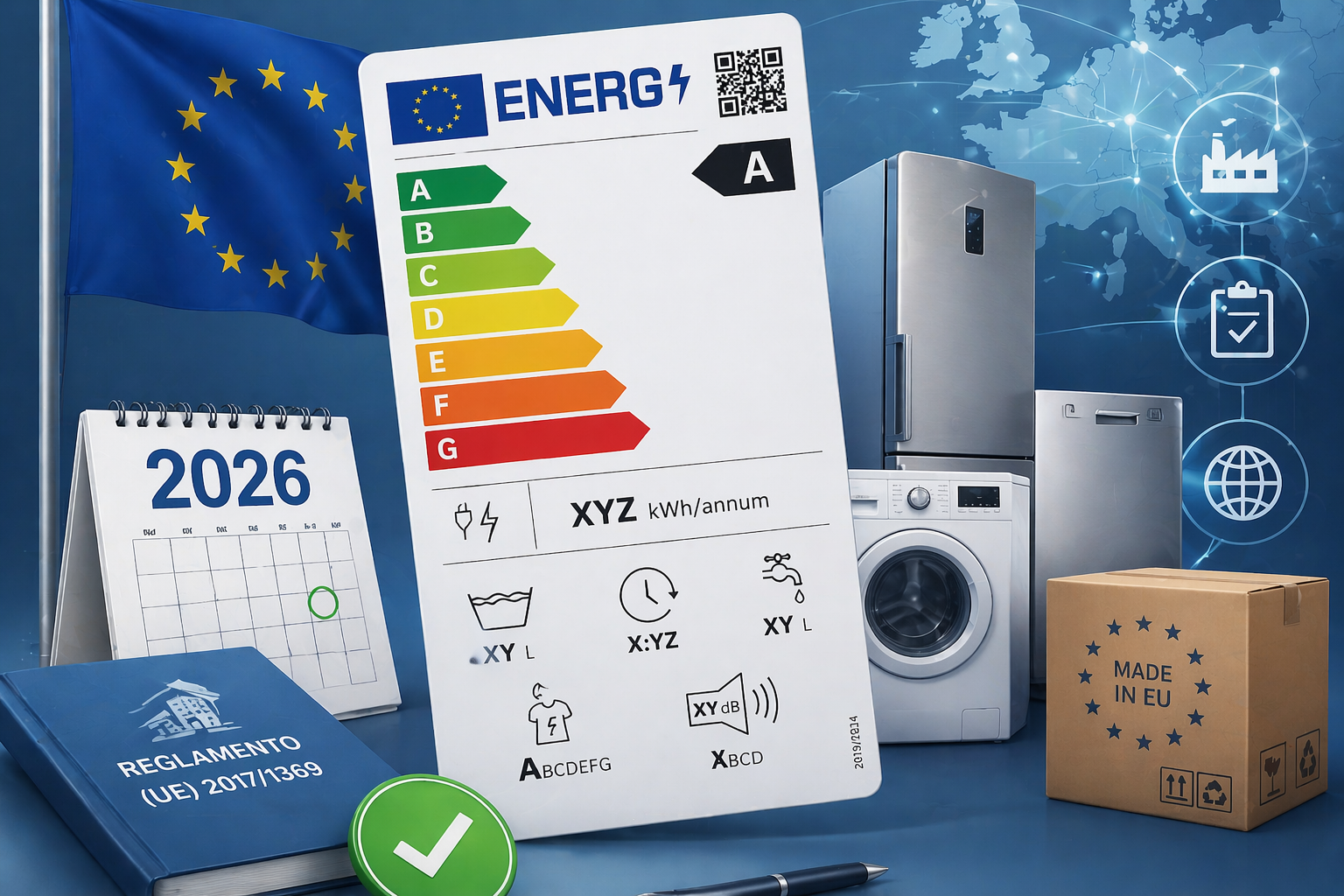
What does the energy label contain? The elements required by the Regulation
The composition of the label is defined in each delegated act, but there are elements common to all product groups rescaled since 2021.
The QR code is the central element of the new system. It appears on all rescaled labels and links directly to the model’s public registration in EPREL, where consumers can access the complete Product Information Sheet in any official language of the European Union. If the QR code does not function properly (for example, because the supplier is not verified in EPREL), the information chain is broken and the model no longer complies with its obligations.
The energy efficiency scale, ranging from A to G with its color gradient from dark green to red, must appear on all labels. Classes that contain no assigned products due to ecodesign restrictions are displayed in grey.
The energy consumption, expressed according to the unit applicable to each category: annual kWh for refrigeration appliances, kWh per 100 cycles for washing machines and dishwashers, among others.
The additional product-specific parameters applicable to each category: volume in liters for refrigeration appliances, place settings capacity for dishwashers, airborne acoustic noise emissions in dB for washing machines, reparability indicators for smartphones, etc.
And finally, the identification details: the supplier’s name or trademark and the model identifier, which is the key linking the physical label to the EPREL registration.
The obligation many companies discover too late: prior registration in EPREL
Article 12 of Regulation (EU) 2017/1369 entrusts the European Commission with maintaining the database in which registration is mandatory before the first placement of a product on the market. This obligation has applied since 1 January 2019 for the product groups active at that time. The order is absolute: first registration, then sale.
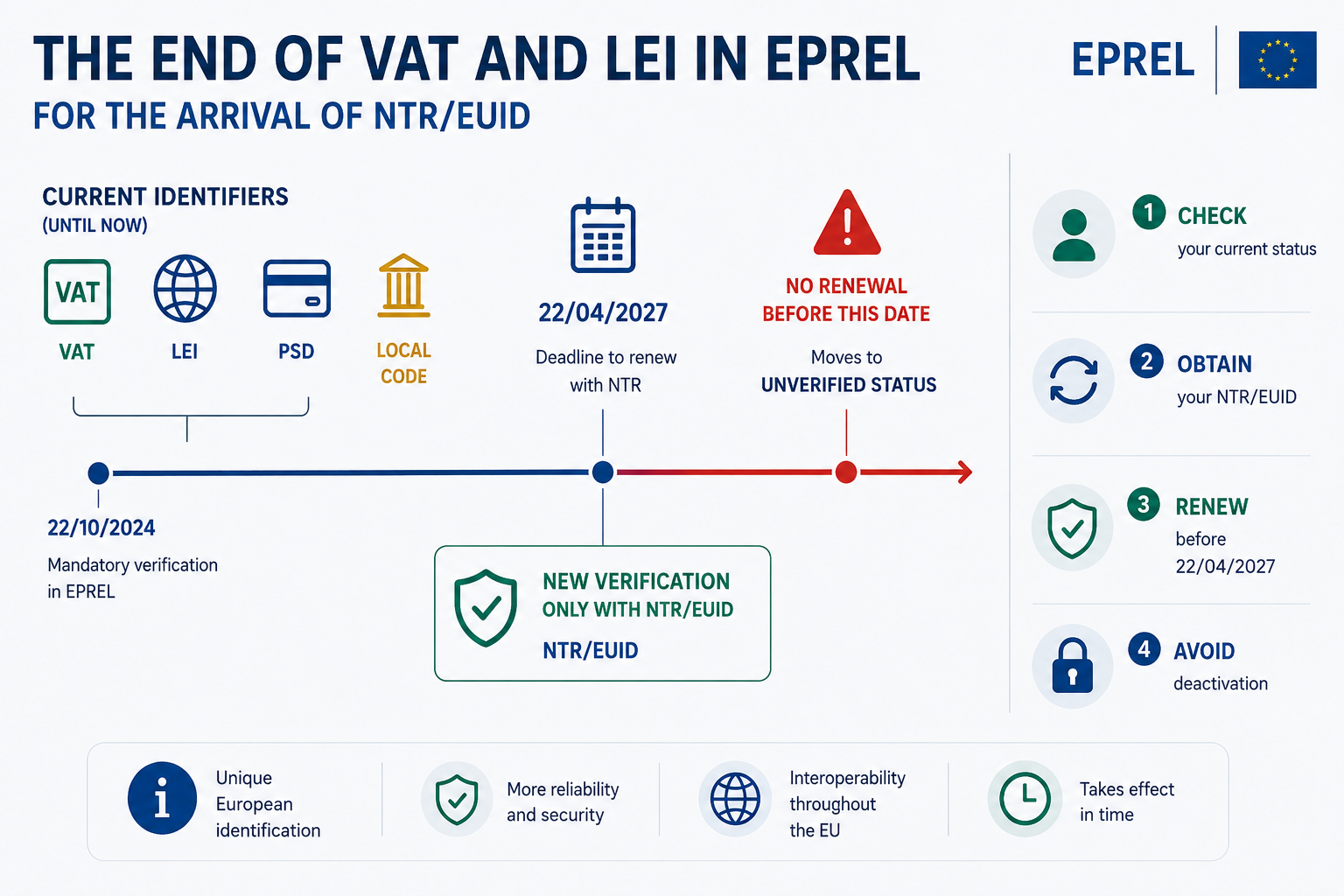
Since 22 October 2024, Implementing Regulation (EU) 2024/994 has additionally required suppliers to be verified in EPREL in order to register models or modify existing ones. That verification can only be completed through a qualified electronic seal containing the supplier’s trade register number (NTR), issued by a Qualified Trust Service Provider (QTSP) included in the EU Trusted List. Without that seal, the supplier is classified as “unverified” and loses the ability to operate within the system.
Since 22 April 2025, this requirement has been fully consolidated: only QSealCs containing an NTR/EUID identifier are accepted for new verifications and renewals. VAT numbers, LEIs, PSDs, and local identifiers ceased to be valid from that date onwards.
Suppliers that completed verification before April 2025 using identifiers other than the NTR have until 22 April 2027 to renew their verification using a qualified electronic seal with NTR. After that date, if the renewal has not been completed, they automatically become classified as “unverified,” together with all the operational consequences that this status entails.
The 2026 deadlines that cannot go unnoticed
If last year the focus was on the consolidation of the NTR requirement and the inclusion of smartphones within the system, 2026 brings its own milestones that are already part of the regulatory calendar and directly affect manufacturers and importers.
11 August 2026 is the application date of Delegated Regulation (EU) 2023/2534, which introduces the new rescaled label for household tumble dryers. While these appliances have until now continued using the previous label format, from that date distributors must display the new label and suppliers must have it properly registered in EPREL. The process of updating models within the database is not immediate: it requires preparation time.
31 December 2026 is the final deadline for updating or replacing the implementing measures under Ecodesign Directive 2009/125/EC for products in Groups A and B: photovoltaic panels, boilers, air-conditioning systems, computers, vacuum cleaners, and others. Although the ESPR has already been in force since July 2024, these product families benefit from this transitional period to adapt their ecodesign requirements to the new framework.
In addition, during 2026 the review and update of the delegated acts relating to dishwashers, washing machines, and professional laundry equipment is also expected under the ESPR framework. This anticipates new technical specifications and potentially new energy classification thresholds for these product families in the next regulatory cycle.
The practical message is simple: rescaling and regulatory updates are not isolated events. They are recurring processes that evolve as the market matures. Keeping track of the regulatory calendar is not optional — it is part of the business operation itself.
The ESPR: the new framework expanding obligations beyond the energy label
Regulation (EU) 2024/1781 (known as the ESPR — Ecodesign for Sustainable Products Regulation) is the most significant legislative instrument adopted within the European product regulatory ecosystem in recent years. In force since July 2024, it repeals Ecodesign Directive 2009/125/EC and extends its scope to virtually all products, not only energy-related ones.
For manufacturers of products already subject to energy labelling requirements, the ESPR introduces an additional layer of obligations that goes beyond energy efficiency classes: durability, reliability, reparability, recycled content, carbon footprint, and remanufacturing capability. These requirements will be implemented through product-specific delegated acts, with the 2025–2030 Working Plan serving as the regulatory roadmap.
What companies should already understand is the relationship between both systems. For products already covered by energy labelling within EPREL (household appliances, displays, tyres, smartphones, etc.), the ESPR will operate in parallel and, in general, will not require an additional Digital Product Passport (DPP), since the EPREL infrastructure already exists.
However, for other product groups that currently do not fall under energy labelling requirements but will enter the scope of the ESPR, the Digital Product Passport (DPP) will become the mandatory traceability instrument. The European Commission’s Central DPP Registry is scheduled to become operational on 19 July 2026.
From that date onwards, the first Digital Product Passports may begin to be registered, although the sector-specific obligations will progressively enter into force in subsequent years as the ESPR delegated acts are adopted.
Verified supplier vs. unverified supplier in EPREL
| Aspect | Unverified Supplier | Verified Supplier |
|---|---|---|
| Registration of new models | Not permitted | Permitted |
| Modification of existing models | Not permitted | Permitted |
| Visibility in public search results | Removed from the system | Visible |
| Functional QR code | Not guaranteed | Yes |
| Distributor access via API | Blocked | Available |
| Lawful commercialization | Impossible without registration | Compliant |
| NTR status | Only NTR valid since April 2025 | Fully verified |
The obligation that does not end when sales end
A common misconception among companies that stop commercializing a model is to assume that regulatory obligations end when sales stop. The Regulation is explicit in stating the opposite.
The supplier is required to retain the model’s technical documentation within the EPREL compliance section for fifteen years from the date on which the last unit was placed on the market. Furthermore, the information contained in the public section of the database (the label, the Product Information Sheet, and the QR code) can never be deleted.
From the perspective of market surveillance, this has a clear rationale: products already in use remain subject to regulatory control. A Market Surveillance Authority may initiate an investigation into a discontinued model if there are indications that the declared values were inaccurate. And if the technical documentation is unavailable because the supplier removed it, the consequences are immediate.
Frequently Asked Questions (FAQ) about the European energy label
It became mandatory on 1 March 2021 for the first six product groups (household refrigeration appliances, washing machines, dishwashers, displays, and refrigerating appliances with a direct sales function), and on 1 September 2021 for light sources. Tyres entered the system on 1 March 2020. Smartphones and tablets were included on 20 June 2025. Household tumble dryers will be rescaled on 11 August 2026.
No, not for product groups where the rescaling has already been applied. Distributors were required to remove and replace the old labels within the deadlines established by each delegated act. A model displaying an old-scale label within a rescaled product group is non-compliant with the Regulation.
Not necessarily. The rescaling changes the classification thresholds, not the actual performance of the product. A model that was previously rated A++ may now appear in class C because the criteria have become stricter. The product itself has not changed — the benchmark has.
No. The distributor uses the information already registered by the supplier. Its obligations are to display the label at the point of sale, provide the Product Information Sheet to consumers, and ensure that the QR code is visible in online sales.
For fifteen years from the placement on the market of the last unit of the model. Information contained in the public section of EPREL can never be deleted.
It cannot be lawfully commercialized within the European Union. In addition, without EPREL registration there is no valid electronic label, the QR code will not function, and the distributor cannot comply with its own information obligations.
The ESPR expands obligations beyond energy efficiency: durability, reparability, recycled content, and carbon footprint will become binding requirements as the European Commission adopts delegated acts for each product group. The 2025–2030 Working Plan already foresees the revision of the delegated acts for washing machines and dishwashers in 2026.
For products already carrying energy labels within EPREL, the DPP will not be mandatory unless the Commission concludes that the current system does not provide sufficient information coverage.
Do you know exactly what the regulations require from your company right now?
The European energy labelling system is not static. The rescaling of tumble dryers in August, the ecodesign deadline in December, the planned revision of the delegated acts for washing machines and dishwashers, and the progressive rollout of the ESPR are all reshaping the compliance landscape for manufacturers and importers throughout 2026 and the years ahead.
At EADTrust, we have spent years working with companies operating within the European market that need to translate these regulations into concrete actions: from EPREL registration and verification to the qualified electronic seals with NTR required by the system.
Talk to our team — we will explain exactly what your company needs in order to comply with the 2026 energy labelling regulations.