
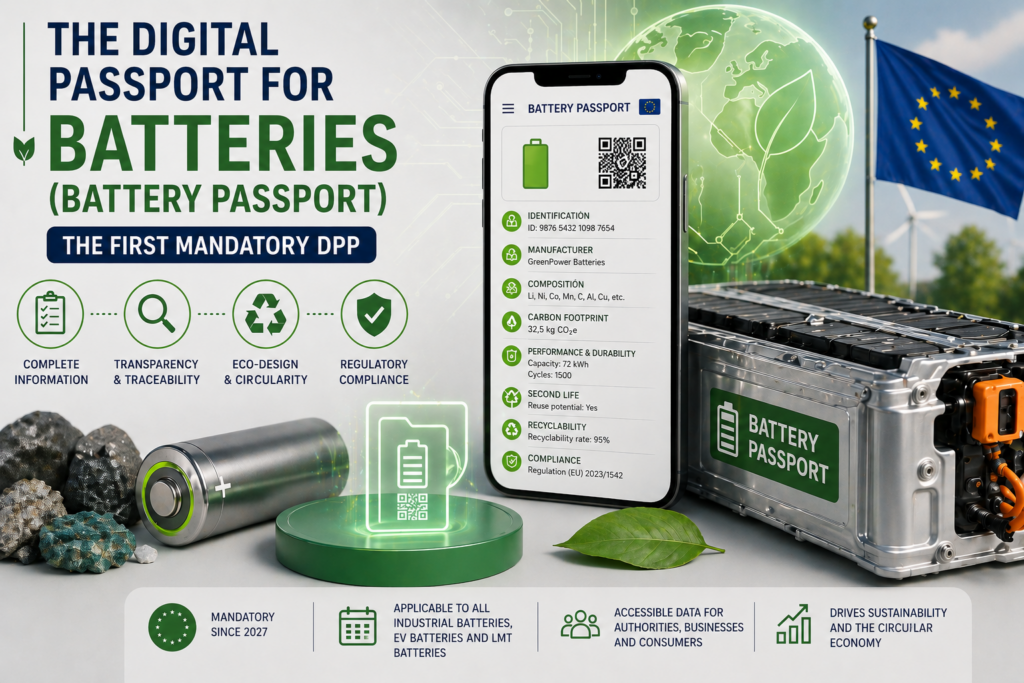
The Battery Passport: the first mandatory Digital Product Passport (DPP)
Suscríbete:
18 February 2027, due to the Battery Passport, is the date that any company manufacturing, importing, or distributing batteries for electric vehicles, light means of transport, or industrial applications should mark in red on its calendar.
From that day onwards, none of those batteries may be placed on the European Union market without an operational digital passport. This is not a recommendation or an indicative date: it is the condition for the product to enter the European market.
The digital battery passport is not the first major requirement under Regulation (EU) 2023/1542 (the carbon footprint declaration for electric vehicle batteries has already been mandatory since February 2025, and the extended labelling requirements for all categories are scheduled for August 2026).
But it is the most complex to implement, the one with the greatest impact on the data architecture of economic operators, and the one that, in essence, turns the Batteries Regulation into the testing ground for the entire European DPP system. What works or fails here will define how the DPP will be implemented in steel, textiles, aluminium, and the rest of the sectors covered by the ESPR.
If your company operates in the electric mobility, energy storage, or consumer electronics sector, this article explains exactly what the battery passport is, which categories it affects, what information it must contain, and what you need to prepare before the countdown reaches zero.
Basic concepts for understanding the Digital Battery Passport
Battery passport
Electronic record established under Article 77 of Regulation (EU) 2023/1542 containing information relating to the battery model and specific information for each individual unit, including information derived from the use of that battery. Mandatory from 18 February 2027 for EV, LMT, and industrial batteries with a capacity above 2 kWh.
Electric vehicle battery (EV)
Battery designed exclusively for the propulsion of an electric vehicle. Subject to the digital passport from February 2027 and to the carbon footprint declaration from February 2025.
Light means of transport battery (LMT)
Battery designed for the propulsion of category L vehicles, including electric bicycles. Subject to the digital passport from February 2027 and to the carbon footprint declaration from August 2028.
Industrial battery
Battery designed for industrial uses, including stationary energy storage. The digital passport applies to batteries exceeding 2 kWh capacity.
State of Health (SoH)
Parameter reflecting the current condition of a battery compared to its original condition. Includes remaining capacity, remaining power capability, round-trip efficiency, and ohmic resistance. Recorded in the BMS since August 2024 and included as part of the passport content.
Battery Management System (BMS)
Electronic component integrated into the battery that collects and manages real-time operational parameters, including those necessary to assess state of health and expected lifetime.
Legitimate interest
Differentiated access criterion established in Annex XIII of the Batteries Regulation for level 2 and level 4 passport information. Applies to repairers, remanufactured product manufacturers, second-life operators, recyclers, battery purchasers, and participants in the energy market.
Carbon footprint declaration
Document certifying the carbon footprint of each battery model per manufacturing plant, calculated in kg of CO₂ equivalent per kWh of total energy delivered over the battery’s lifetime. First obligation in the Batteries Regulation timeline, already in force for EV batteries.
What exactly is the digital battery passport?
Article 77 of Regulation (EU) 2023/1542 defines the battery passport as an electronic record containing information relating to the battery model and specific information for each individual unit, including information derived from the use of that battery. It is therefore a dual-purpose instrument: it contains model-level data (chemical composition, carbon footprint, recycled content) and dynamic unit-level data (state of health, charging cycles, usage history).
The regulatory ambition behind the passport is clearly summarised in Recital 123 of the Regulation: the passport must maximise information exchange, enable battery tracking and tracing, and provide information on the carbon intensity of manufacturing processes, the origin of materials, battery composition, repair, repurposing and dismantling possibilities, and end-of-life treatment, recycling, and recovery processes.
It is not a PDF with technical specifications handed to the buyer once. It is a live, decentralised data system, accessible by multiple stakeholders with different levels of authorisation, and which must remain updated and available throughout the entire lifetime of the battery (even after the original manufacturer ceases operations or goes bankrupt).
The battery passport is the identity document of every marketed unit: it states what it is made of, how it was manufactured, how much it pollutes, whether it can be repaired, and what should happen to it at the end of its life.
And it does so in a verifiable, structured, and machine-readable format, not through a printed document that nobody updates.
Which battery categories are affected?
The digital passport becomes mandatory from 18 February 2027 for three specific categories:
Electric vehicle batteries (EV).
All batteries designed for the propulsion of category M, N, or O electric vehicles under EU vehicle type-approval legislation. This includes battery packs for electric cars, vans, buses, and trucks.
Industrial batteries with a capacity above 2 kWh.
This is the broadest category under the Regulation. It covers batteries used in industrial applications (stationary energy storage, machinery, material handling equipment, uninterrupted power supply systems) provided that their capacity exceeds the 2 kWh threshold.
Industrial batteries with external storage have different timelines for other requirements, but the digital passport applies under the same February 2027 deadline for batteries exceeding 2 kWh.
Light means of transport batteries (LMT).
Batteries designed for the propulsion of category L vehicles (motorcycles, mopeds, tricycles, quadricycles) and electric bicycles. This category includes everything from e-bike battery packs to batteries used in scooters and electric kick scooters.
What about portable batteries?
Portable batteries (those used in phones, laptops, power tools, and general consumer devices) do not require a digital passport in the sense established under Chapter IX of the Regulation.
However, from 18 February 2027 onwards, all batteries (without category exceptions) must carry a QR code that, for portable batteries, will provide access to relevant information such as the general label, declaration of conformity, due diligence report, and waste management information. It is not the full passport, but it is the basic data infrastructure required for every battery placed on the EU market.
Starter, lighting, and ignition batteries (SLI) also do not require a full digital passport, although the QR code requirement still applies from the same date, providing access to information on recycled content of cobalt, lead, lithium, and nickel.
What information must the battery passport contain?
Annex XIII of Regulation (EU) 2023/1542 structures the passport content into four differentiated access levels. This access architecture is one of the most important design decisions of the instrument: not all information is public, because some of it is commercially sensitive or technically dangerous in the wrong hands.
Level 1: Publicly accessible information
Public information includes all data that any consumer, company, or researcher can consult without authentication. Annex XIII lists it in detail:
About composition and model identity
The complete material composition of the battery (chemical composition, hazardous substances present other than mercury, cadmium, or lead, critical raw materials).
Rated capacity (in ampere-hours), minimum, nominal, and maximum voltage, original power capability and its limits, expected lifetime in cycles, capacity threshold for exhaustion (for EV batteries only), operating temperature range, initial and mid-life round-trip energy efficiency, and internal resistance of the cell and the battery pack.
About sustainability
Carbon footprint information under Article 7, including the carbon footprint performance class; recycled content information under Article 8, broken down by material (cobalt, lithium, nickel, lead); proportion of renewable content; and the due diligence policy report on raw materials under Article 52.
About warranty and lifecycle
Commercial warranty period relating to battery lifetime and information concerning battery waste prevention and management.
Conformity documentation
The EU declaration of conformity and the marking requirements under Article 13.
Level 2: Information accessible based on legitimate interest
There is a set of model-level data protected by the Regulation because of its commercial or technical sensitivity, but which must be accessible to parties with a legitimate interest (professional repairers, remanufactured product manufacturers, second-life operators, and recyclers). This information includes:
The detailed composition, including the materials used for the cathode, anode, and electrolyte (a level of detail not included in public information). The number of parts of each component and contact information for spare parts suppliers.
And disassembly information, including detailed diagrams of the battery system showing cell locations, disassembly sequences, types and number of fastening techniques, tools required for disassembly, warnings about risks of damaging parts, number of cells and their arrangement, and safety measures.
Level 3: Information exclusively for notified bodies and authorities
The results of test reports demonstrating compliance with the Regulation requirements are accessible only to notified bodies, market surveillance authorities, and the European Commission. They do not circulate within the market.
Level 4: Data specific to the individual battery unit
This is the most innovative dimension of the battery passport: unit-specific data, accessible to persons with legitimate interest (buyers, energy aggregators, participants in the energy market).
This includes: performance and durability parameter values when the battery is placed on the market and whenever changes in condition occur; information on the battery’s state of health under Article 14 (remaining capacity, remaining power capability, remaining round-trip efficiency, evolution of self-discharge rates, ohmic resistance); information about the battery status, defined as “original”, “repurposed”, “reused”, “remanufactured”, or “waste”; and data resulting from usage, including number of charge and discharge cycles, adverse events (accidents, deep discharges), and history of environmental operating conditions, including temperature and state of charge.
Access to the passport: the QR code as the entry point
Every EV, industrial (>2 kWh), and LMT battery must carry a QR code providing access to the passport. The QR code and unique identifier must comply with the various parts of ISO/IEC 15459 standards. Labels and the QR code must be printed or engraved visibly, legibly, and indelibly on the battery. Where this is not possible due to the nature or size of the battery, they must appear on the packaging and accompanying documentation.
The unique identifier generated by the economic operator when placing the battery on the market links the physical carrier to the digital record. That identifier is also stored in the European Commission’s Central DPP Registry, operational from 19 July 2026 onwards: Article 13 of the ESPR expressly confirms that the registry will store the unique identifiers of the batteries referred to in Article 77(3) of the Batteries Regulation.
Who is responsible for creating and maintaining the passport?
The economic operator placing the battery on the market is responsible for ensuring that the passport information is accurate, complete, and kept up to date. It may grant written authorisation to another operator to act on its behalf (which is particularly relevant where the vehicle or device manufacturer needs to update the battery’s state of health during use).
For batteries that have undergone preparation for reuse, preparation for repurposing, repurposing, or remanufacturing, responsibility passes to the operator placing the renewed battery on the market or putting it into service. That battery will have a new passport linked to the original passport. Once the battery becomes waste, responsibility transfers to the producer or the competent producer responsibility organisation, or to the waste management operator.
The passport ceases to exist once the battery has been recycled.
Technical requirements of the data system
Passport data are stored by the responsible economic operator or by operators authorised to act on its behalf. Operators authorised to store or process the data may not sell, reuse, or process those data beyond what is strictly necessary for the provision of the contracted services. The passport must remain available even when the responsible operator ceases to exist or stops operating within the Union.
All included information must be based on open standards, be in interoperable format, transferable through an open data exchange network without vendor lock-in, machine-readable, structured, and searchable. The technical design must ensure authentication, reliability, and integrity of the data, a high level of security and privacy, and fraud prevention.
The battery passport is also fully interoperable with other digital product passports required under Union ecodesign legislation, with regard to the technical, semantic, and organisational aspects of end-to-end communication and data transfer. The ESPR is the reference technical framework with which it must be compatible.
The complete battery timeline: from 2024 to 2031
The digital passport is not the only requirement under the Batteries Regulation. It is the most complex one, but it arrives after a series of prior obligations that are already in force or will enter into force over the coming months.
| Date | Obligation | Affected categories |
|---|---|---|
| 18 August 2024 | BMS with mandatory state-of-health parameters. Technical safety documentation for SBESS | EV, LMT, and industrial batteries |
| 18 February 2025 | Mandatory carbon footprint declaration | Electric vehicle batteries |
| 18 February 2026 | Mandatory carbon footprint declaration | Rechargeable industrial batteries (excluding external storage) |
| 18 August 2026 | Extended labelling mandatory for all battery categories. The Commission must adopt implementing act on batteries | All categories |
| 18 February 2027 | Mandatory digital battery passport. Mandatory QR code on ALL batteries | EV, LMT, and industrial batteries >2 kWh (passport); all batteries (QR code) |
| 18 August 2027 | Mandatory minimum electrochemical performance and durability values | Rechargeable industrial batteries >2 kWh (excluding external storage) |
| 18 August 2028 | Mandatory carbon footprint declaration. Recycled content requirements become applicable | Light means of transport batteries; batteries containing cobalt, lithium, nickel, or lead |
| 18 August 2031 | Mandatory minimum recycled material content: 16% cobalt, 85% lead, 6% lithium, 6% nickel | Industrial batteries >2 kWh, EV, SLI |
| 18 August 2036 | Second increase of minimum recycled content: 26% cobalt, 85% lead, 12% lithium, 15% nickel | Industrial, EV, SLI, and LMT batteries |
Why is the battery passport the testing ground for the entire DPP system?
There are structural reasons why the battery passport is more than just a sector-specific requirement. It is the first regulatorily mature DPP (with detailed content already defined in Annex XIII of the Regulation), the first with a concrete mandatory application date, and the one that will test under real-world conditions the technical infrastructure that all other sectors will eventually need to use: the Central Registry, unique identifiers, differentiated access control systems, and the trust services that guarantee the authenticity and integrity of the data.
Article 78 of the Batteries Regulation expressly establishes that the battery passport must be fully interoperable with other digital product passports required under Union ecodesign legislation. It is no coincidence that the ESPR (published one year after the Batteries Regulation) takes the technical design of the battery passport as its reference model. What is being built now in the battery sector is the template that will later be replicated in steel, aluminium, textiles, furniture, and every other sector through to 2030.
For battery manufacturers and importers, this has a direct consequence: being first is not a regulatory advantage but a fixed-deadline obligation. But for operators in other sectors observing the process, the battery passport is the clearest roadmap currently available for understanding how to implement a DPP under real conditions.
What needs to be prepared before February 2027?
Less than ten months remain until the mandatory application date. In systems implementation terms, that is very little time. These are the elements that every affected company needs to have in place:
- Data architecture. Decide whether the passport will be managed internally or through an external DPP service provider. In either case, the platform must be fully operational before 18 February 2027, not still in a testing phase. The choice of granularity level (model, batch, or individual item) determines the entire data collection architecture.
- Carbon footprint data collection. For EV batteries, the carbon footprint declaration has already been mandatory since February 2025. For industrial batteries, since February 2026. The data declared under those obligations are already part of the passport content: if there is no operational collection system, there will be no compliant passport.
- State-of-health parameters. The BMS has already been required to record the Annex VII parameters since August 2024. Those data (remaining capacity, round-trip efficiency, ohmic resistance) form part of the passport content accessible to parties with legitimate interest. The passport system must be capable of consuming those data in real time or periodically.
- Unique identifiers and QR code. Identifiers must comply with ISO/IEC 15459 standards. The QR code must comply with ISO/IEC 18004:2015. The physical marking process on the battery or its packaging must be integrated into the production line.
- Registration in the Central DPP Registry. The Commission’s Central Registry will be operational from July 2026 onwards. The identifier registration process and the connection with customs system APIs must be tested before the mandatory compliance period begins.
- Authentication and data integrity. The Regulation requires authentication, reliability, and integrity of the data to be guaranteed. This requires qualified trust services under the eIDAS framework so that the creation and updating operations of the passport are verifiable, authentic, and non-repudiable.
Frequently Asked Questions about the Digital Battery Passport
No, not in the sense of Chapter IX of the Regulation: portable batteries do not require the full digital passport. However, from 18 February 2027 onwards, all cells and batteries (including portable ones) must carry a QR code providing access to basic information such as the general label, declaration of conformity, due diligence report, and waste management instructions.
Not exactly: the battery passport is the first sector-specific DPP within the European ecosystem to reach regulatory maturity, established under the Batteries Regulation one year before the ESPR. However, Article 78 of the Batteries Regulation states that it must be fully interoperable with the ESPR DPPs, and the ESPR uses the technical design of the battery passport as its reference model. They are different instruments under different legal frameworks, but with converging technical architectures
es. When a battery undergoes preparation for reuse, preparation for repurposing, repurposing, or remanufacturing, the operator placing it back on the market must create a new passport linked to the original one. Responsibility for compliance transfers to that operator. The labels and QR code are also renewed, including information on the battery’s change of status.
The Regulation expressly anticipates this situation: the passport must remain available even after insolvency, liquidation, or cessation of activity of the responsible operator. That is why the decentralised data system must include long-term continuity and availability mechanisms. The requirement that authorised operators may not sell or reuse the data beyond the contracted service reinforces this guarantee.
The QR code providing access to the battery passport, as well as the unique identifier it links to, must comply with ISO/IEC 15459 Parts 1, 2, 3, 4, 5, and 6. The QR code on the label must comply with ISO/IEC 18004:2015. It must have a high contrast with the background colour and a size allowing easy reading using a general-purpose QR reader, such as those integrated into portable communication devices.
February 2027 is approaching: what you should already have in place
The battery passport is not a system that can be contracted in October 2026 and deployed in January 2027. It is a project involving data integration, IT architecture, digital certification, and registration within European systems that, for many companies (especially importers without prior digital infrastructure), may take between twelve and eighteen months to implement correctly.
The Central DPP Registry will open in July 2026. Extended labelling (including the definitive QR code for all categories) enters into force in August 2026. The window between those dates and 18 February 2027 is narrow. Companies waiting for the final technical implementing acts to be fully published before starting are taking a risk that the Regulation does not forgive: without an operational passport by that date, the product cannot be placed on the European Union market.
At EADTrust, we are a qualified trust service provider (QTSP) included in the EU Trusted List. We issue the qualified certificates that already allow manufacturers and importers to verify themselves in EPREL today, and we are preparing the trust services that the battery passport may require: qualified electronic seals for operation authentication, qualified timestamps for lifecycle event traceability, and qualified preservation services for the long-term availability required by the Regulation.



19 de May de 2026
26 de August de 2026