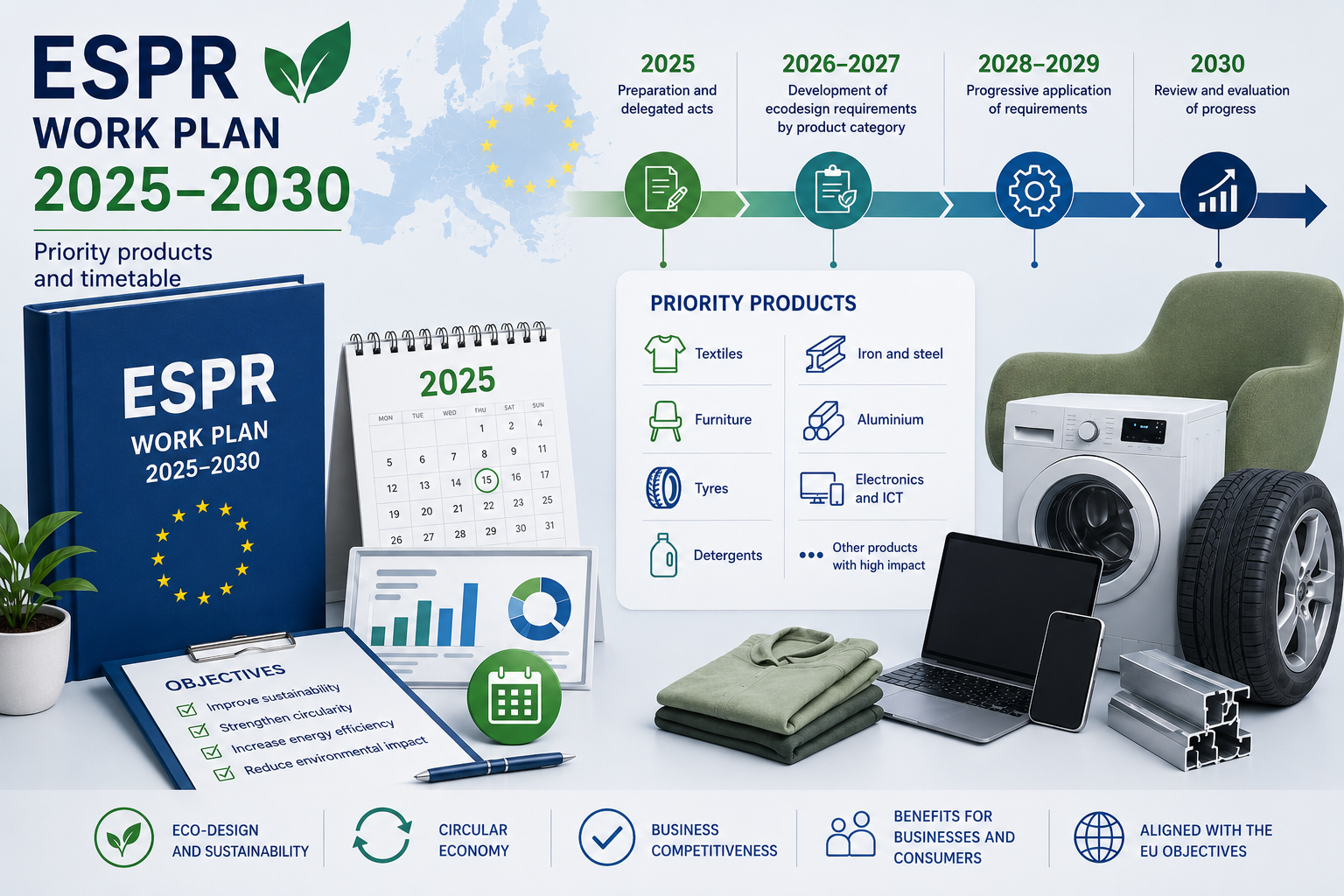
On 16 April 2025, the European Commission published the document that turns the ESPR from an abstract legal framework into a concrete timeline with names and dates. The Ecodesign and Energy Labelling Working Plan 2025–2030 sets out, sector by sector, which product groups will receive ecodesign requirements over the next five years, when the delegated acts are expected to be adopted, and when the Digital Product Passports will arrive. It is the missing roadmap.
If you run a company that manufactures or imports physical products in Europe, this document is more relevant to your planning than any market forecast for the next three years.
Not because it is imminent for all sectors (the timelines are staggered and in some cases extend until 2029), but because product design cycles, certification processes, and the data architecture required for the DPP are not prepared in a matter of weeks. The plan has already been adopted. The countdown has already started.
Definitions to understand the ESPR 2025–2030 Working Plan
ESPR Working Plan
Communication from the European Commission, adopted on 16 April 2025, specifying the priority product groups for ESPR delegated acts and the estimated timelines for the next five years. It covers the 2025–2030 period, with a mid-term review planned for 2028.
Horizontal measure
A delegated act establishing ecodesign requirements applicable to a common characteristic shared across several product groups simultaneously (such as reparability or recycled content), rather than applying to a single specific product group.
Repairability index
A rating from A to E assessing how easy a product is to repair, calculated using parameters such as the availability of spare parts, access to technical documentation, ease of disassembly, and the guaranteed duration of software updates. Already mandatory for smartphones and tablets since June 2025; planned as a horizontal measure for electronics and small household appliances in the delegated act expected around 2027.
Transitional period (Directive 2009/125/EC)
Period during which products regulated under the former Ecodesign Directive remain subject to its existing delegated acts, without the need to adopt new requirements under the ESPR. For 19 product groups, this period expires on 31 December 2026.
Prohibition on the destruction of unsold products
Obligation established under Article 25 of the ESPR prohibiting large companies from destroying unsold clothing, accessories, and footwear from 19 July 2026 onwards, extending to medium-sized enterprises in 2030.
What exactly is the ESPR Working Plan and why is it the most important document?
Regulation (EU) 2024/1781 does not directly establish the technical requirements for each product. What it establishes is the mechanism: the Commission adopts delegated acts, product group by product group, setting the specific thresholds for durability, reparability, recycled content, and the remaining parameters. And in order to know in what order and when those delegated acts will be adopted, the Commission publishes a working plan covering at least three years.
Article 18 of the ESPR establishes that the first working plan had to be adopted before 19 April 2025 and that this first plan had to prioritise specific product groups explicitly listed in the Regulation itself. The Commission published the plan on 16 April 2025, three days before the deadline.
For companies, the working plan does three things that the Regulation alone cannot do. First, it defines the scope: not all physical products will receive ecodesign requirements at the same time, only the groups included in the plan. Second, it establishes timelines that allow companies to plan ahead: product design cycles in sectors such as textiles or furniture are measured in years, not months. Third, it defines when the Digital Product Passport will become mandatory for each sector, because DPPs arrive at least eighteen months after the adoption of the corresponding delegated act.
The plan covers a five-year period, with a mid-term review scheduled for 2028. This means that what is not included in this first plan is not necessarily excluded forever: the 2028 review is when the Commission may incorporate new product groups into the next cycle.
The ESPR Working Plan is not a policy document: it is a compliance timeline. Knowing which groups are included, under what deadlines, and with what type of requirements is the starting point for any investment decision relating to product design, data architecture, or supply chain processes over the next five years.
Which products are included in the 2025–2030 Working Plan?
The plan distinguishes between three types of content: new final products, intermediate products, horizontal measures, and a set of products carried over from the previous plan.
New final products: the four priority groups
The plan includes four groups of final products that had not previously been subject to ecodesign requirements under the former Directive: steel and iron, aluminium, textiles (clothing and footwear as a category), and tyres. These four groups are explicitly identified as priorities in Article 18 of the ESPR itself.
- Steel and iron. This is the product group with the highest annual sales volume on the European market. The Working Plan foresees the adoption of the corresponding delegated act around 2026 as an initial estimate, which would place the mandatory implementation of the DPP for this sector around 2027–2028 (eighteen months later). The requirements will mainly focus on recycled content, carbon footprint, and end-of-life circularity.
- Aluminium. The Working Plan estimates the adoption of the delegated act for aluminium around 2027, with the corresponding DPP arriving in 2028–2029. As with steel, recycled content and carbon footprint are the central parameters guiding the preparatory analysis carried out by the JRC.
- Textiles: clothing and footwear. This is probably the group that has received the greatest media attention, partly because of the prohibition on destroying unsold products, which already applies from July 2026 for large companies. The delegated act for textiles (specifically clothing) is also expected around 2027, with the DPP arriving in 2028–2029. The requirements will address durability, recycled content, the presence of hazardous substances, and reparability.
- Footwear receives different treatment: the Plan recognises it as a separate category from textiles, with somewhat lower impacts than the four priority groups, and instead of including it directly in the immediate delegated acts, it calls for an exploratory study to be completed before the end of 2027. That study will determine whether footwear is included in the next cycle of the plan.
- Tyres. Tyres already have mandatory energy labelling under Regulation (EU) 2020/740, but this does not exclude them from the ESPR: sustainability requirements go beyond efficiency in terms of fuel consumption. The delegated act for this group is also estimated for around 2027, with the DPP arriving in 2028–2029.
Intermediate products: steel and aluminium as materials
The plan includes steel and aluminium not only as final products but also as intermediate products. The logic is that regulating the material used in the manufacture of other products has a multiplier effect: if the steel used to manufacture a washing machine must comply with recycled content requirements, that requirement is automatically transferred upwards throughout the supply chain.
The Working Plan expressly warns that the possible “leakage” effects will need to be assessed (the risk that imports of final products manufactured using non-regulated component materials may increase).
Horizontal measures: reparability for electronics and small household appliances
This is the development that most directly affects manufacturers of consumer electronics and small household appliances. The Working Plan includes two horizontal measures: a repairability scoring system applicable to electronics and small household appliances in general, and recyclability and recycled content requirements for electrical and electronic equipment (EEE) as a horizontal category.
The first horizontal measure (repairability) introduces a standardised A-to-E rating system to assess how repairable a product is, based on parameters such as the availability of spare parts, access to technical repair documentation, ease of disassembly, and the availability of software updates. This scheme has already been applied on a pioneering basis to smartphones and tablets since June 2025, with the A-to-E repairability classes established under Delegated Regulation (EU) 2023/1669 as the reference system.
The horizontal measure will extend that logic to much broader categories of electronic products and household appliances. The delegated act for horizontal repairability is estimated for around 2027, with its DPP arriving in 2028–2029.
The second horizontal measure (recyclability and recycled content for EEE) is expected to be adopted around 2029, with the DPP arriving in 2030–2031.
Furniture and mattresses: the 2028–2029 cycle
The Working Plan includes furniture (as a general category) with the delegated act estimated for adoption around 2028, and mattresses as a subcategory with estimated adoption around 2029. The DPP for furniture would arrive in 2029–2030, and for mattresses in 2030–2031.
This is the sector with the longest preparation period available, although given the complexity of furniture supply chains (involving multiple materials, components from different suppliers, and long production cycles), the timeline is not as generous as it may appear on paper.
What happens to energy-related products that were already covered by the Ecodesign Directive?
The 2025–2030 Working Plan does not only cover new products: it also manages the transition of the 35 groups of energy-related products that were regulated under the previous working plan (2022–2024) and that must now be transferred into the ESPR framework.
Of those 35 groups, 19 are currently under a transitional period governed by Directive 2009/125/EC, which expires on 31 December 2026. For those groups (which include photovoltaic panels, boilers, air conditioners, computers, vacuum cleaners, and others), the Commission must update or replace the existing delegated acts before that date.
For the remaining 16 groups, the Commission considers that the existing preparatory analysis remains valid and transfers them directly into the new plan. Most of these groups have already started the technical preparation process.
In addition, the 2025–2030 Working Plan foresees the review of the delegated acts relating to dishwashers, washing machines, and professional laundry equipment during 2026, which may result in new energy classification thresholds for these product families in the next cycle.
And there is one date that definitively closes the chapter: on 31 December 2030, all implementing measures under Directive 2009/125/EC expire. From that moment onwards, the ESPR framework will operate without exceptions across all sectors and without transitional periods.
The ESPR 2025–2030 timeline: at a glance
| Date | Milestone | Affected sectors |
|---|---|---|
| 16 April 2025 | Adoption of the ESPR 2025–2030 Working Plan | All industrial sectors |
| 19 July 2025 | The Commission may adopt the first ESPR delegated acts. First reporting deadline on the destruction of unsold products for large companies | All sectors; especially textiles |
| 9 February 2026 | Adoption of delegated and implementing acts on the destruction of unsold products. First effective application of ESPR transparency obligations | Large companies across all sectors |
| ~2026 | Estimated adoption of the delegated act for iron and steel | Steel industry |
| ~2026 | Review of delegated acts for dishwashers, washing machines, and professional laundry equipment | Household appliance manufacturers |
| 19 July 2026 | Central DPP Registry becomes operational. Prohibition on the destruction of unsold textiles/footwear for large companies | Large companies in textiles, fashion, and footwear |
| 31 December 2026 | Deadline for updating the 19 groups under the transitional period of Directive 2009/125/EC | Manufacturers of energy-related products (boilers, air conditioners, computers, vacuum cleaners, etc.) |
| ~2027 | Estimated adoption of delegated acts for aluminium, textiles/clothing, tyres, and horizontal repairability (electronics + small household appliances) | Corresponding sectors |
| End of 2027 | Exploratory footwear study completed. Possible inclusion in the next plan | Footwear sector |
| ~2027/2028 | Mandatory DPP for iron and steel (18 months after delegated act estimated for ~2026) | Steel industry |
| ~2028 | Estimated adoption of the delegated act for furniture | Furniture sector |
| ~2028 | Mid-term review of the ESPR 2025–2030 Working Plan | All industrial sectors |
| ~2028/2029 | Mandatory DPP for aluminium, textiles, tyres, and horizontal repairability (18 months after delegated acts estimated for ~2027) | Corresponding sectors |
| ~2029 | Estimated adoption of the delegated act for mattresses and for recyclability/recycled content of EEE (horizontal) | Mattress sector; electronics sector |
| ~2029/2030 | Mandatory DPP for furniture (18 months after delegated act estimated for ~2028) | Furniture sector |
| 19 July 2030 | First full ESPR evaluation. Prohibition on textile destruction extended to medium-sized enterprises | Medium-sized companies in the textile sector |
| 2 August 2030 | Absolute deadline for the rescaling of all energy-labelled products. No product may display A+, A++, or A+++ classes | All suppliers of energy-labelled products |
| End of 2030 | Adoption of ESPR delegated acts for mobile phones, tablets, tumble dryers, welding equipment, and standby consumption | Consumer electronics sector |
| 31 December 2030 | Full transition to the ESPR framework. All measures under Directive 2009/125/EC expire | All energy-related product sectors covered by the former Directive |
What is not included in the Working Plan? The products that remain under study
The plan is explicit about what it leaves out and why. Detergents, paints, and lubricants are excluded from the first plan because they are considered to have lower improvement potential than the selected priority groups. Chemical products are excluded due to the complexity of the category. Footwear receives differentiated treatment through an exploratory study rather than an immediate delegated act.
But what is not included now is not necessarily excluded forever. The mid-term review scheduled for 2028 is the mechanism designed to incorporate new groups into the plan. The Commission has already announced that it will begin work on some of these groups (especially chemicals and footwear) through exploratory studies before that date.
The Working Plan also foresees that, after 2030, delegated acts will arrive for footwear, detergents, paints, lubricants, chemical products, and packaging, once the ongoing exploratory studies have been completed. In other words: these sectors are not permanently exempt; they are simply part of the next cycle.
Why does the Working Plan matter more than it seems at first glance?
There is one way of reading the Working Plan that makes it seem distant: “the delegated acts will not be ready until 2027 or 2028, so I still have time.” That interpretation is wrong for three reasons.
First: product design cycles precede regulation. A furniture manufacturer that needs to adapt its catalogue to the ESPR durability and recycled content requirements cannot wait until the delegated act is officially published before starting work. The preparatory analyses carried out by the JRC that feed into the delegated acts are public, and the likely requirements can already be inferred with considerable accuracy.
Second: the Digital Product Passport requires prior data architecture. The DPP is not a document generated at the point of sale: it is a system for collecting, managing, and publishing data throughout the product lifecycle, and it must already be operational when the delegated act becomes applicable. Building that architecture is not a sprint: it is a multi-year project.
Third: the products covered by the ESPR represent more than one trillion euros in annual sales on the European market (approximately €600 billion in energy-related products and nearly €500 billion in products covered by the new ESPR scope), accounting for around 31% of the climate change impacts and 34% of the fossil resource use linked to European consumption. The Commission therefore has every incentive to keep the timelines on track and very few reasons to delay them.
Thinking that the ESPR is a problem for the future is the most expensive mistake a chief operations officer or product director can make today. The plan has already been adopted. The preparatory studies are already underway. And the eighteen-month period between the adoption of a delegated act and its application is the only real buffer that the Regulation guarantees.
Frequently Asked Questions (FAQ) about the ESPR 2025–2030 Working Plan
The plan itself does not create technical obligations for the included products: those will arrive with each delegated act. However, some ESPR obligations are already applicable from 2025–2026 onwards, regardless of the plan: those relating to transparency on the destruction of unsold products for large companies and the restrictions on clothing and footwear from 19 July 2026 onwards.
Not exactly. Footwear does not yet have a delegated act in the first Working Plan, but it is subject to an exploratory study scheduled for completion before the end of 2027. That study will determine whether footwear enters the next regulatory cycle. In addition, the obligations concerning the prohibition on the destruction of unsold products already apply to footwear from 19 July 2026 onwards for large companies.
It means that your products will have to comply with a minimum repairability score (on an A-to-E scale) based on factors such as the availability of spare parts, access to technical documentation, ease of disassembly, and the duration of software updates. The specific requirements will be established in the delegated act expected around 2027. The system is already operational for smartphones and tablets and serves as a practical reference for how it will work.
It depends on when the delegated act for your product group is adopted: the DPP arrives at least eighteen months later. For iron and steel, this is estimated for 2027–2028. For aluminium, textiles, and tyres, estimated for 2028–2029. For furniture, 2029–2030. For mattresses, 2030–2031. If your sector falls under energy labelling and you are already registered in EPREL, you will probably not need an additional DPP (as EPREL acts as an equivalent system), unless the Commission decides otherwise for your specific product group.
The Working Plan is a Commission communication, not a binding regulation. The timelines indicated are estimates, not legally fixed dates like those established once delegated acts are officially published. The Commission may update the plan, and a mid-term review is already scheduled for 2028. However, delegated acts that are already in advanced technical preparation are difficult to delay without proper justification.
The roadmap has already been drawn. The question is whether your company is reading it
There is a difference between companies that use the ESPR Working Plan as a planning tool and those that will discover it once the delegated act for their sector has already been published and the eighteen-month countdown has started. The priority groups have been identified. The estimated timelines have also been defined. The likely requirements can already be inferred from the JRC preparatory analyses that feed into the delegated acts.
For companies already operating within EPREL with energy-labelled products, the ESPR adds another layer (circularity, reparability, recycled content) built on top of existing compliance processes. For companies in sectors such as textiles, furniture, or steel that are facing this framework for the first time, the starting point is understanding which digital systems they will need to comply with the DPP and when.
At EADTrust, we work with manufacturers and importers operating within the European product regulatory ecosystem: from EPREL verification to the qualified certificates that enable access to European compliance systems.