The fashion and textile sector has been at the centre of the sustainability debate for years. Regulation (EU) 2024/1781 (the ESPR) turns that debate into concrete legal obligations, with deadlines, sanctions, and a digital traceability system that will transform the way supply chains in the industry operate.
The first restriction is already in force: from 19 July 2026 onwards, large companies may no longer destroy unsold clothing, accessories, and footwear. This is not a corporate sustainability recommendation. It is a legally binding prohibition directly applicable throughout the EU.
Over the next three years, the ecodesign delegated act for textiles will arrive, establishing requirements on durability, recycled content, and carbon footprint, followed by the Digital Product Passport, which will make information about every garment marketed in Europe transparently available in real time.
If you run a fashion brand, manufacture garments, import collections, or distribute clothing on the European market, I will explain exactly what the ESPR requires from you, when it applies, and what you should start preparing now.
Key concepts about the ESPR for the textile and fashion sector
Destruction (ESPR)
Intentionally damaging or disposing of a product as waste, except when it is delivered for preparation for reuse, refurbishment, or remanufacturing. Preparation for reuse is not considered destruction. Incineration, landfilling, and shredding are.
Unsold consumer product
A consumer product that has not been sold, including surplus stock, excess inventory, obsolete stock, and products returned by a consumer exercising their right of withdrawal.
ESPR delegated act for textiles
Regulation that the Commission is expected to adopt around 2027, establishing the specific requirements relating to durability, recycled content, substances of concern, reparability, and carbon footprint for clothing. Its adoption will start the eighteen-month countdown leading to the mandatory DPP.
Textile DPP
A digital record accessible through a QR code or another data carrier, mandatory eighteen months after the adoption of the delegated act (~2028–2029), containing the sustainability information for the garment specified in the delegated act: composition, recycled content, carbon footprint, substances, repair instructions, and end-of-life information.
Fast fashion
A textile business model based on short production cycles, high volumes, and the frequent destruction of surplus stock. Article 57 of the ESPR explicitly cites it as one of the practices the Regulation aims to discourage.
Textile Labelling Regulation (EU) No 1007/2011
Regulation currently under revision governing textile fibre names and fibre composition labelling. Its revision is intended to integrate with the ESPR information requirements and the textile DPP.
Why does the ESPR affect the textile sector more than any other sector?
Recital 57 of the ESPR states with unusual directness for a European regulation that unnecessarily high production volumes and the short lifespan of textile products, of which clothing represents the largest share of consumption in the Union, may cause significant environmental impacts. Among the items reportedly ending up destroyed are newly manufactured but unsold textile products and, in particular, clothing. Clothing should be valued more, used for longer, and cared for more than is typical in today’s fast fashion culture.
That phrase (“today’s fast fashion culture”) is not rhetorical. The ESPR is specifically designed, in part, to change the fast fashion business model: mass production, short cycles, and destruction of surplus stock. Each of the three ESPR pillars for textiles targets one dimension of that model: the destruction ban targets surplus stock; ecodesign requirements target short product lifespan and poor material quality; and the DPP targets supply chain opacity.
And the textile sector faces something that other sectors do not: two obligations already in force before the ecodesign delegated act arrives. The destruction ban from July 2026 and the information disclosure obligations do not wait for the adoption of the technical delegated acts. They apply directly through the Regulation itself.
The ESPR does not wait for textiles to have an ecodesign delegated act before generating obligations. The ban on destroying stock is already law. And so is the obligation to report how much is destroyed. The delegated act expected around 2027 will add the technical layer; it will not create the obligations from scratch.
Obligation 1: The prohibition on destroying unsold products, in force since July 2026
Article 25 of the ESPR is the most immediate and concrete provision for the textile sector. It establishes that, from 19 July 2026 onwards, the destruction of unsold consumer products listed in Annex VII of the Regulation is prohibited.
Which products are included in Annex VII?
Annex VII of the ESPR lists two categories of products whose destruction is prohibited:
Clothing and fashion accessories
- Garments and clothing accessories made of natural leather or regenerated leather (code 4203)
- Knitted or crocheted garments and clothing accessories (Chapter 61)
- Garments and clothing accessories, other than knitted or crocheted (Chapter 62)
- Hats and other headgear, plaited or made by assembling strips (code 6504)
- Hats and other headgear, knitted or made from lace, felt, or other textile fabric (code 6505)
Footwear
- Waterproof footwear with outer soles and uppers of rubber or plastics (code 6401)
- Other footwear with outer soles and uppers of rubber or plastics (code 6402)
- Footwear with outer soles of rubber, plastics, leather, or regenerated leather and uppers of natural leather (code 6403)
- Footwear with outer soles of rubber, plastics, leather, or regenerated leather and uppers of textile materials (code 6404)
- Other footwear (code 6405)
The list covers virtually the entire range of clothing and footwear marketed on the European market. There is no significant consumer textile category left outside its scope.
What exactly does “destruction” mean?
Article 2 of the ESPR defines destruction as intentionally damaging or disposing of a product as waste, except where it is discarded solely for the purpose of delivering it for preparation for reuse, including refurbishment or remanufacturing.
This is important: incineration, landfilling, shredding, and any other form of definitive disposal are prohibited. But donating, reselling at a reduced price, transferring to second-hand platforms, sending for refurbishment, or recycling is not considered destruction under the Regulation.
Who does it apply to and from when?
The prohibition does not apply to all companies at the same time:
- Large companies: from 19 July 2026 onwards, with no additional grace period.
- Micro-enterprises and small enterprises: exempt from the prohibition, unless the Commission demonstrates that they are being used to circumvent the prohibition applicable to larger companies.
- Medium-sized enterprises: the prohibition applies from 19 July 2030 onwards, six years after the ESPR entered into force.
The definitions of “large”, “medium-sized”, and “small” companies follow Recommendation 2003/361/EC: large enterprise = more than 250 employees or more than €50 million turnover and more than €43 million balance sheet total; medium-sized = between 50 and 250 employees; small = fewer than 50 employees; micro-enterprise = fewer than 10 employees.
Exceptions to the prohibition
The Regulation is not absolute: Article 25.5 provides that the Commission may adopt delegated acts establishing exceptions to the prohibition where there are reasons related to health, hygiene, and safety; product damage that cannot be repaired in a cost-effective way; product unsuitability for its intended purpose; refusal to accept products offered for donation; lack of suitability for reuse or remanufacturing; infringement of intellectual property rights (such as counterfeit products); or where destruction is the option with the lowest negative environmental impact.
The first delegated act establishing exceptions had to be adopted before 19 July 2025.
Obligation 2: Disclosure of information on destroyed unsold products
The destruction ban is accompanied by a transparency obligation that is separate and comes earlier. Article 24 of the ESPR establishes that economic operators disposing of unsold consumer products must publicly disclose each year:
The number and weight of unsold consumer products discarded, differentiated by product type or category. The reasons why they are discarded and the exceptions applied. The proportion of discarded products sent for preparation for reuse, recycling, energy recovery, and disposal. And the measures adopted and planned to prevent future destruction.
This information must be published clearly and visibly, at least on an easily accessible page of the company’s website. Companies subject to sustainability reporting obligations in their management reports may also include it there.
The disclosure obligation does not apply to micro-enterprises or small enterprises. It applies to medium-sized enterprises from 19 July 2030 onwards. The first disclosure concerns unsold products discarded during the first full financial year in which the ESPR is in force.
The Commission will publish consolidated information on the destruction of unsold products from 19 July 2027 onwards, and every thirty-six months thereafter, including data on the annual prevalence of destruction by product group and its comparative environmental impact. Those data will inform decisions on whether to extend the prohibition to additional products in future working plans.
Obligation 3: The ecodesign requirements for textiles, the delegated act expected around 2027
The third major ESPR obligation for textiles is the one that will take the longest to become enforceable, but also the one that will most transform product design. The ESPR 2025–2030 Working Plan, adopted on 16 April 2025, includes textiles (specifically clothing) as the first priority group for delegated acts, with adoption estimated around 2027 and with strong support in the public consultation.
The Working Plan quantifies the size of the affected market: €78 billion in clothing (out of the €142 billion total textile and footwear market in 2019), with high improvement potential in product lifespan, material efficiency, and reductions in impacts related to water use, waste generation, climate change, and energy consumption.
The delegated act for textiles does not yet exist (the JRC preparatory studies are ongoing), but the likely parameters can already be inferred from Article 5 of the ESPR, which establishes the aspects that ecodesign must improve: durability (resistance to wear, washing, and use), reusability, reparability, recycled fibre content, end-of-life recyclability, presence of substances of concern, carbon footprint and environmental footprint, and expected waste generation.
The Working Plan itself states that the ESPR information requirements for textiles will operate in synergy with the Textile Labelling Regulation, which is currently under revision. That revision of the Textile Labelling Regulation (Regulation (EU) No 1007/2011) is intended to integrate ESPR information requirements (fibre composition, hazardous substances, care instructions) with those of the future textile DPP, so that a single digital instrument can fulfil both obligations.
What will the delegated act mean in practice?
A clothing manufacturer subject to the ESPR delegated act will likely have to design products with a minimum recycled fibre content, guarantee that the product can withstand a minimum number of washing cycles without quality loss, avoid certain substances in dyeing and finishing processes, provide structured information on how to repair and recycle the garment at the end of its life, and demonstrate compliance through verifiable technical documentation. The specific thresholds will be established in the delegated act.
Until then, companies that want to be prepared should follow the JRC preparatory studies that inform the delegated acts, as these are public and indicative of what is coming.
Obligation 4: The textile Digital Product Passport
The textile DPP is the obligation with the longest timeline (around 2028–2029, eighteen months after the adoption of the delegated act expected around 2027), but it is also the one requiring the greatest prior investment in infrastructure.
For the textile sector, the DPP will address a structural problem that has long been at the centre of criticism of the fashion industry: supply chain opacity. A garment sold in Europe may have been designed in Madrid, made using fabric produced in Bangladesh with cotton from India, assembled in Turkey, and labelled in Portugal. Each of those steps has its own environmental impact, chemical use, and water footprint. The textile DPP is the instrument that will make this information traceable and verifiable.
The specific content of the textile DPP will be established by the delegated act expected around 2027. However, the parameters listed in Annex III of the ESPR that may be included cover: information about the manufacturer and importer; material composition and percentage of recycled fibres; presence of substances of concern in dyes and finishes; lifecycle carbon footprint of the garment; repair instructions and availability of technical information; disassembly and end-of-life instructions; and information about the condition of the garment if it has been refurbished or reused.
Access to the textile DPP will be provided through a QR code or equivalent data carrier accompanying the product, whether on the garment itself, its label, or the packaging. This integration with physical labelling means that the textile DPP is not just an internal digital systems issue: it directly impacts label design and production processes.
The special case of footwear: different treatment from clothing
Footwear receives differentiated treatment under the 2025–2030 Working Plan. While clothing enters directly as the first priority group for the delegated act expected around 2027, footwear does not yet have its own delegated act in this first plan: the Commission commissioned an exploratory study to be completed before the end of 2027 to determine whether footwear should enter the next regulatory cycle.
What footwear does share with clothing is the destruction ban: footwear customs codes are equally included in Annex VII of the ESPR, with the same prohibition date of 19 July 2026 for large companies. A sports shoe distributor therefore has exactly the same obligations regarding non-destruction and disclosure as a clothing brand. The difference is that the DPP and ecodesign requirements for footwear will arrive later, probably during the 2030–2031 period if the exploratory study is favourable.
Who does the ESPR affect in the textile sector? Operator-type map
| Type of operator | Destruction ban (Jul 2026) | Annual disclosure | Ecodesign requirements (~2027) | Textile DPP (~2028–2029) |
|---|---|---|---|---|
| EU clothing manufacturer | Yes (if large company) | Yes (if large company) | Yes | Yes |
| Clothing importer | Yes (if large company) | Yes (if large company) | Yes (acts as the supplier if there is no authorised representative) | Yes (acts as the supplier) |
| Fashion brand with outsourced manufacturing | Yes (if large company) | Yes (if large company) | Yes (as the economic operator placing the product on the market) | Yes |
| Distributor / retailer | Yes, if it destroys products on its own behalf | Yes, if it destroys products on its own behalf | Obligations relating to the display of labels and DPP | Does not create the DPP, but must ensure its accessibility |
| E-commerce platform | Yes, if it destroys products on its own behalf | Yes | Obligations to display the DPP on the product page | Does not create the DPP, but must integrate it |
| Medium-sized enterprise | From 19 July 2030 onwards | From 19 July 2030 onwards | From the date of the delegated act | From the date of the delegated act |
| Micro and small enterprise | Exempt (unless a specific delegated act provides otherwise) | Exempt | Yes (unless exceptions apply) | Yes (unless exceptions apply) |
The biggest challenge of the textile DPP: making an opaque supply chain transparent
The DPP is not just a technical issue for the IT department. It is a strategic issue for the entire organisation, and in the textile sector its impact is especially profound because fashion supply chains are structurally opaque.
A medium-sized fashion brand may have hundreds of direct and indirect suppliers across three continents. The DPP will require that each garment carries verifiable information about the composition of its materials, the percentage of recycled fibres, the substances present in dyes, and the carbon footprint of the manufacturing process.
That information cannot be obtained without a data collection system covering the entire supply chain (from spinning to assembly), without supplier contracts including data delivery obligations, and without a verification architecture ensuring that the data are authentic and have not been tampered with.
The Corporate Sustainability Due Diligence Directive (Directive (EU) 2024/1760) adds an additional layer: companies above a certain size will have to identify and address adverse human rights and environmental impacts within their supply chains. For the textile sector, this means that the DPP and due diligence requirements point in the same direction: having verifiable traceability regarding who manufactures what, where, and under what conditions.
For fashion brands, the question is not whether to implement the DPP, but whether, once the delegated act is published, they will have the systems, supplier contracts, and data architecture necessary to comply within the eighteen-month timeframe guaranteed by the ESPR.
That preparation does not begin when the delegated act is published: it begins now.
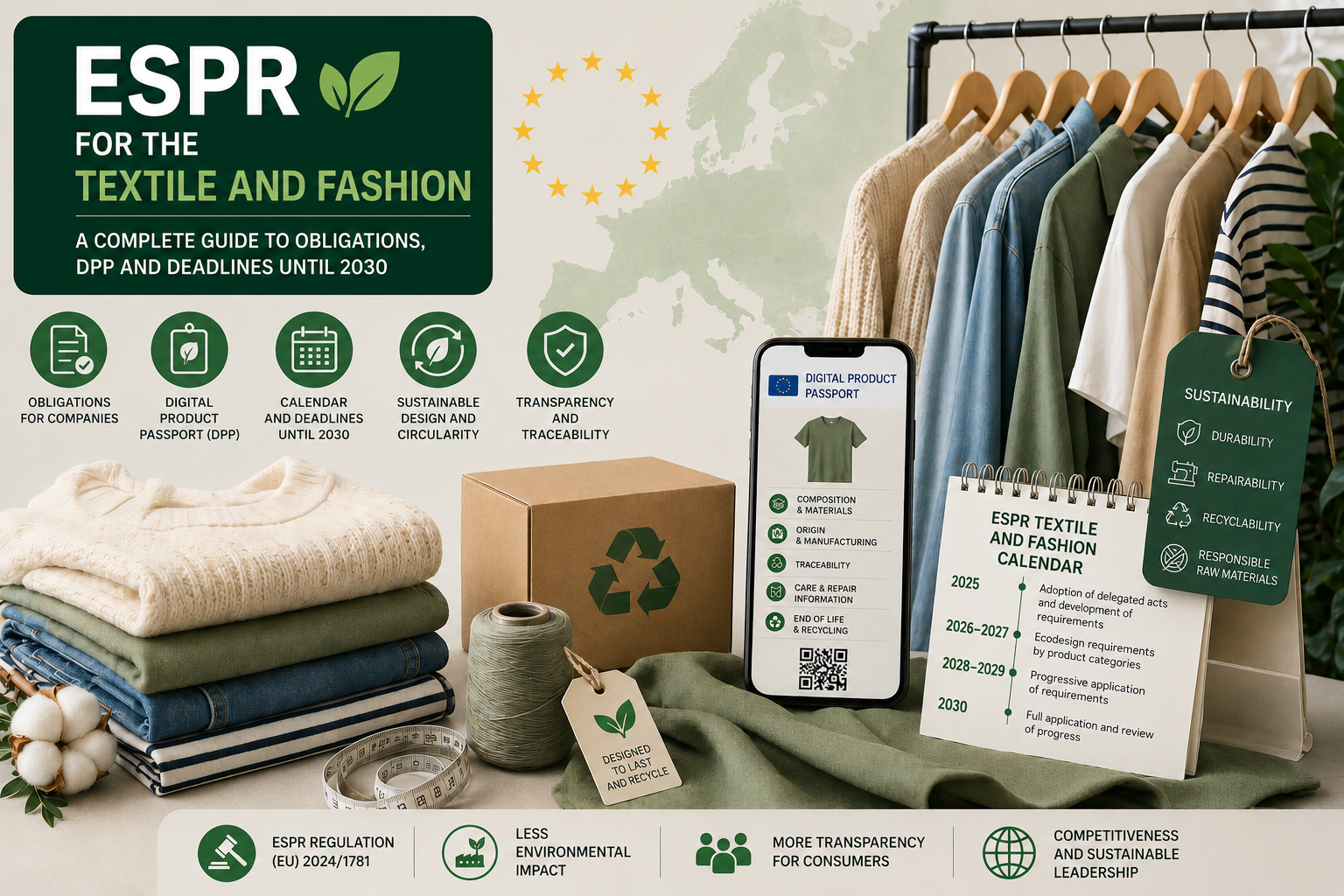
The complete ESPR timeline for the textile and fashion sector
| Date | Obligation | Affected companies |
|---|---|---|
| 19 July 2025 | First reporting deadline on the destruction of unsold products for large companies (data for financial year 2024). The Commission may begin adopting ESPR delegated acts | Large companies |
| 9 February 2026 | First effective application of ESPR transparency obligations. Publication of destruction data for financial year 2024 | Large companies across all sectors |
| 19 July 2026 | Prohibition on the destruction of unsold clothing, accessories, and footwear | Large companies |
| 19 July 2027 | The Commission publishes consolidated information on the destruction of unsold products | Data from all obligated operators |
| ~2027 | Estimated adoption of the ESPR delegated act for textiles/clothing with ecodesign requirements | Clothing manufacturers and importers |
| End of 2027 | Commission exploratory study on footwear completed | Footwear sector |
| ~2028/2029 | Mandatory DPP for textiles/clothing (18 months after the delegated act estimated for ~2027) | Clothing manufacturers and importers |
| 19 July 2030 | The destruction ban extends to medium-sized enterprises | Medium-sized companies in the textile and footwear sector |
| 19 July 2030 | Disclosure obligations extend to medium-sized enterprises | Medium-sized companies |
| Post-2030 | Possible delegated act for footwear (if the 2027 exploratory study is favourable) | Footwear manufacturers and importers |
Frequently Asked Questions (FAQ) about the ESPR for the textile and fashion sector
Yes. The definition of “unsold consumer product” in Article 2 of the ESPR expressly includes products returned by a consumer exercising their right of withdrawal or during any longer return period offered by the trader. Those products may not be destroyed from 19 July 2026 onwards if the company qualifies as a large enterprise.
Valid alternatives include: outlet sales or discounted sales, donations to non-profit organisations (although refusal to accept them may qualify as an exception), transfer to second-hand platforms, delivery to companies specialising in preparation for reuse or refurbishment, and transfer to recyclers for material recovery. What is not allowed is incineration, landfilling, or any other form of definitive disposal.
Not necessarily automatically. The ESPR Working Plan states that the ESPR information requirements will operate “in synergy” with the Textile Labelling Regulation, which is currently under revision. The level of integration depends on the outcome of that revision: the most likely scenario is that the DPP will be able to contain all textile labelling information in digital format, while the physical composition label may continue to coexist until the revision defines the final requirements.
It depends on how the operation is structured. If there is a manufacturer established outside the EU and no authorised representative designated in Europe, the importer placing the garments on the European market assumes the supplier’s obligations (including creating the DPP once it becomes mandatory). If the Spanish company acts directly as the importer, then yes, it is responsible for the DPP. If it acts as a distributor for a brand that has an authorised representative in Europe, it does not create the DPP but still has obligations to display it and guarantee access to the passport for each product.
From the destruction ban and disclosure obligations, yes: micro-enterprises and small enterprises are expressly exempt unless the Commission demonstrates that they are being used to circumvent the prohibition applicable to larger companies. From ecodesign requirements and the DPP, no: once the delegated act enters into force, all operators placing garments on the market (regardless of size) must comply, unless the delegated act establishes specific exemptions for SMEs.
Digital transparency is not optional. It is the new standard for the European fashion industry.
The ESPR for the textile sector does not arrive alone. It comes alongside the Corporate Sustainability Due Diligence Directive, the revision of the Textile Labelling Regulation, the EU data policy, and the non-financial reporting requirements under the Corporate Sustainability Reporting Directive. All of them point in the same direction: verifiable supply chains, authentic data, and demonstrable traceability.
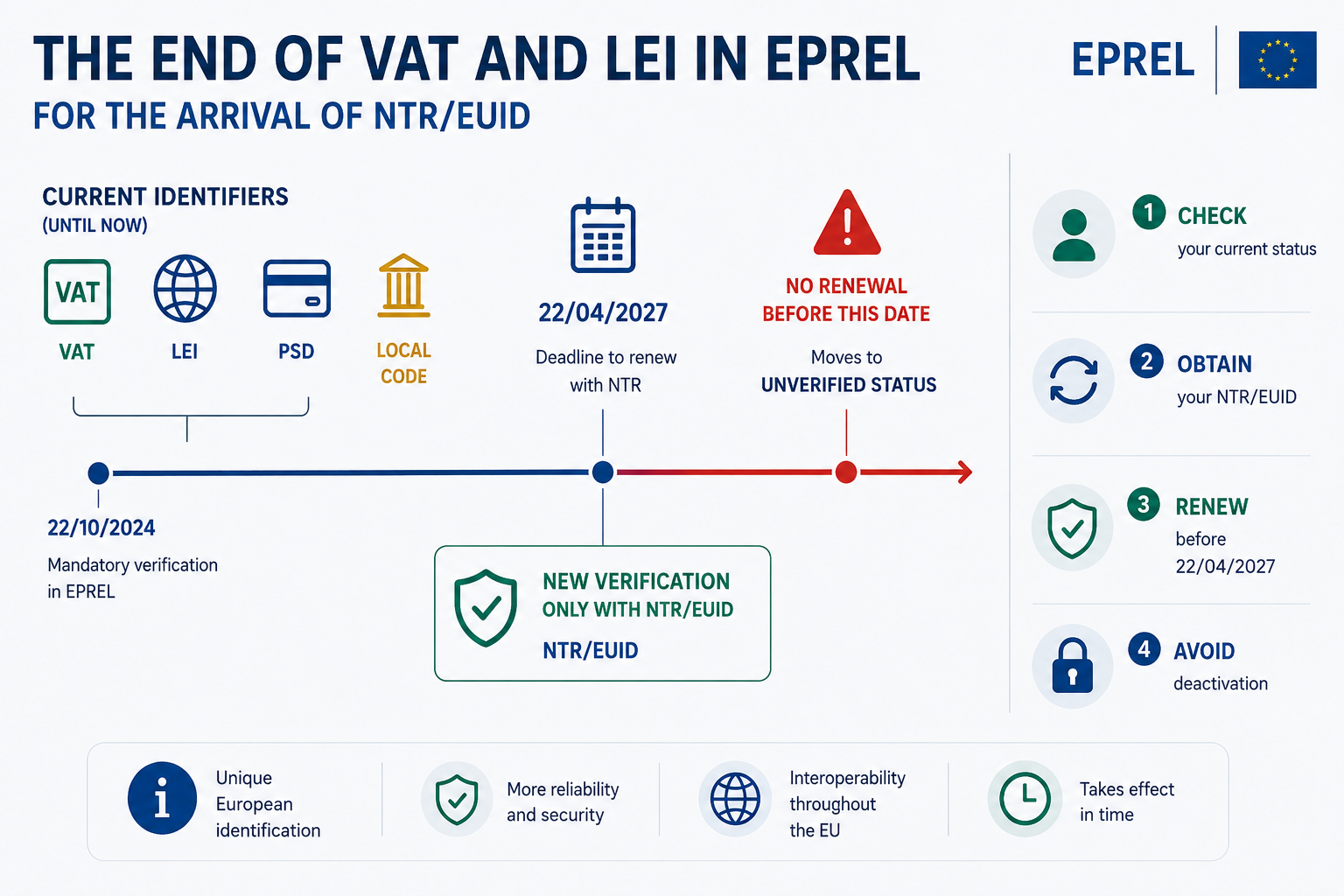
The textile DPP is the technical instrument that makes all of this possible. And the infrastructure enabling it (qualified digital certificates that authenticate who enters each piece of data, timestamps guaranteeing when it was recorded, and archiving systems ensuring availability for decades) is the same infrastructure already operating in EPREL for supplier verification using an NTR-qualified seal.
At EADTrust, we are a qualified trust service provider (QTSP) included in the EU Trusted List. The same certificates that today allow manufacturers and importers to verify themselves in EPREL may become the foundation of the trust infrastructure that the textile DPP will require once the delegated act enters into force.