
The Key Strategy for Migrating to Post-Quantum Security (PQC) Without Disrupting Business Operations
Suscríbete:
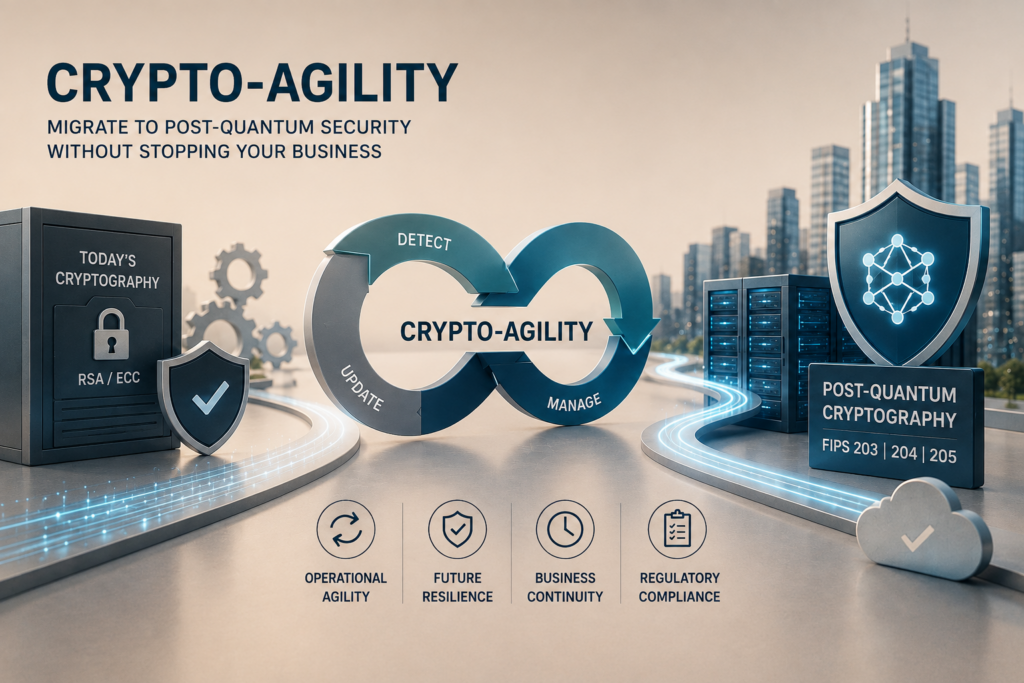
Crypto-agility is the ability of a security system to replace its cryptographic algorithms, keys and protocols quickly and automatically, without significantly altering the underlying infrastructure or disrupting business continuity.
With the imminent arrival of post-quantum standards (FIPS 203, 204 and 205), crypto-agility is no longer a theoretical advantage and becomes an essential operational requirement for preventing technological obsolescence and regulatory non-compliance.
The end of static cryptography: why the current model is unsustainable
Historically, cryptography has been implemented in a “static” or rigid manner. Many software developments have algorithms such as RSA or SHA-256 “hardcoded” (embedded) directly into the applications’ source code.
The problem of cryptographic technical debt
This rigid approach creates massive technical debt in the face of the quantum threat:
- Deep dependency: changing an algorithm involves rewriting, recompiling and redeploying entire applications.
- No visibility: companies often do not know how many keys or certificates they have, where they are located or which algorithms they use.
- Slow response times: if a critical vulnerability is discovered (as happened with Heartbleed or the future weakness of RSA), patching may take months, leaving an unacceptable window of exposure.
Crypto-agility proposes an architecture in which cryptography is an interchangeable module, enabling a smooth transition to the NIST’s new PQC standards.
The three pillars of a crypto-agile architecture
To implement an effective crypto-agility strategy, companies must address three fundamental areas: visibility, decoupling and automation.
1. Visibility and discovery (Inventory)
You cannot protect or migrate what you do not know exists. The first step is the automated discovery of cryptographic assets.
- Network scanning: identify all SSL/TLS certificates, SSH keys and digital signatures currently in use.
- Algorithm mapping: classify each asset by its algorithm (RSA, ECC or AES) and key length.
- Shadow IT detection: locate unauthorised cryptographic services that could become blind spots during the PQC migration.
2. Decoupling and abstraction
The objective is to eliminate “hardcoding”. Applications should not call a specific algorithm (e.g. “Use RSA-2048”), but request a generic cryptographic service (e.g. “Sign document”).
- Use of libraries and APIs: implement abstraction layers or middleware to manage cryptography.
- Centralised policies: the decision about which algorithm to use is made in a central configuration file or policy manager, not in the application code. This makes it possible to switch globally from RSA to CRYSTALS-Dilithium (FIPS 204) with a simple policy update.
3. Life cycle automation
Manually managing thousands of certificates and keys is humanly impossible in hybrid environments (classical + post-quantum).
- Automatic rotation: systems that automatically renew keys and certificates before they expire.
- Instant deployment: the ability to deploy new algorithms or revoke compromised keys across the entire infrastructure in minutes rather than days.
Crypto-agility and regulatory compliance (eIDAS / GDPR)
Cryptographic agility has direct implications for a company’s legal liability.
GDPR and the “state of the art”
The GDPR requires security measures that reflect the state of the art. An organisation that takes months to replace a compromised algorithm due to a lack of agility could face penalties for failing to implement data protection by design.
eIDAS 2.0 and digital identity
With the evolution of the eIDAS Regulation and the future European Digital Identity Wallet (EUDI Wallet), as a Trust Service Provider we will be able to adapt to new security requirements without disrupting the service.
Crypto-agility makes it possible to integrate new signature or authentication schemes required by the EU, such as those based on PQC, without rebuilding the technology platform.
Roadmap for implementing crypto-agility today
For CISOs and system architects, the migration to an agile environment should be progressive and run in parallel with preparations for the post-quantum era.
- Audit phase: use scanning tools to create a dynamic cryptographic inventory. Identify critical areas where cryptography is “hardcoded”. Or, more simply, commission an EADTrust audit.
- Remediation phase: begin replacing direct calls to algorithms with calls to modern cryptographic libraries, such as OpenSSL 3.0+ or Bouncy Castle, that support interchangeable providers.
- Adoption of hybrid certificates: implement certificates containing both classical and post-quantum keys. This allows legacy systems to continue operating while modern systems benefit from PQC security, all managed through the same agile infrastructure.
Stress testing: simulate the mass revocation of a certification authority or the sudden obsolescence of an algorithm to measure the organisation’s mean time to recovery (MTTR).
Frequently Asked Questions (FAQ) About Crypto-Agility
Not necessarily all of it, but critical components may need to be replaced. Many older HSMs (Hardware Security Modules) do not support firmware updates for new algorithms. Crypto-agility requires maintaining a hardware inventory that enables software updates or rapid replacement.
Hybrid cryptography is a tactic (using two algorithms simultaneously to provide redundant security), while crypto-agility is an architectural strategy (the ability to change those algorithms easily). Agility facilitates the implementation of hybrid schemes.
If implemented correctly, the impact is negligible. Although abstraction layers add minimal latency, the operational advantage of being able to respond to threats in real time and prevent service interruptions more than compensates for any microseconds of processing delay.
No. Any company that manages sensitive data or must comply with strict regulations needs crypto-agility. Technology SMEs are often more vulnerable to “hardcoding” due to rapid development and a lack of standardisation, making them ideal candidates for adopting agile and secure development practices (DevSecOps).
Conclusion
Crypto-agility is not a product that can be purchased, but a methodology that must be adopted. In a world where NIST standards are evolving and quantum computing threatens the foundations of current security, rigidity is the greatest business risk.
Adopting a crypto-agile approach today ensures that your organisation can navigate the post-quantum transition tomorrow without disruption, excessive costs or compliance gaps.



7 de September de 2026
10 de September de 2026