
100 Days Until the Battery Passport: What Annex XIII Really Requires (and What You Still Don’t Have)
Suscríbete:
Today is 26 October 2026. The Digital Battery Passport will become mandatory on 18 February 2027, and the timeframe is beginning to narrow: only 115 days remain before its obligations become applicable. At this point, the question is no longer when to start preparing, but whether the infrastructure, data, access controls and guarantees of authenticity and integrity required are genuinely ready to ensure timely compliance.
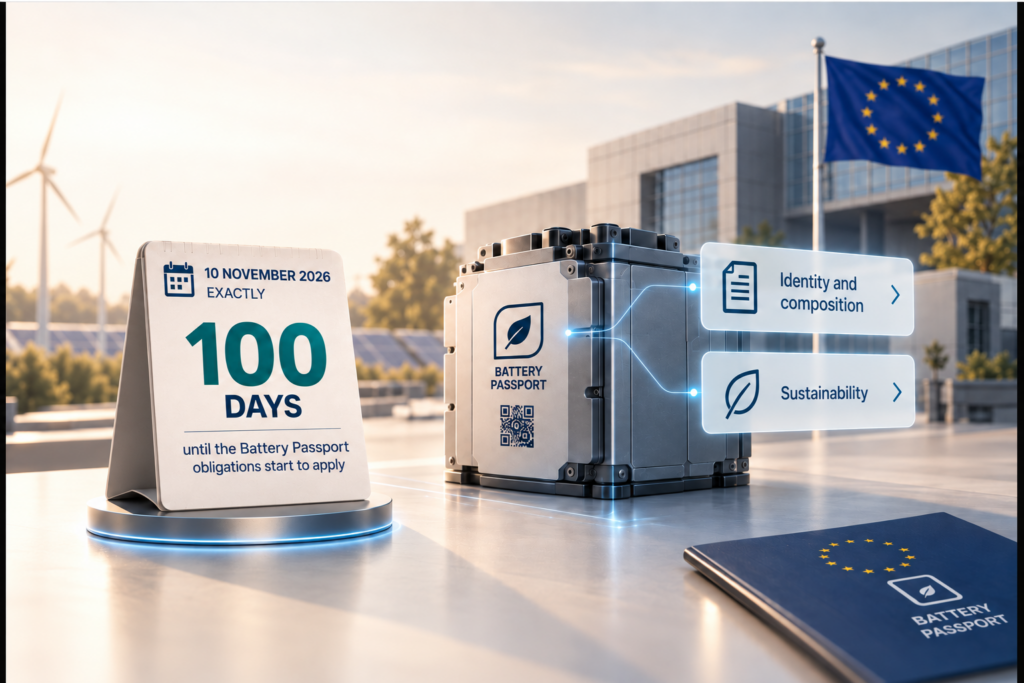
The title of this article (“100 days”) refers to a specific planning milestone: 10 November 2026, the point at which exactly 100 days remain until the legal deadline. In a typical systems implementation project, if your data gaps, integrations and certifications have not been resolved 100 days before the deadline, there is no longer enough operational headroom to complete them without assuming a genuine risk of non-compliance. It is the threshold at which a pending issue goes from “manageable” to “critical”.
This article does not repeat the general introduction to the Battery Passport. For that, you can read our previous article on the Digital Battery Passport as the first mandatory DPP. Here, we get straight to the point: what data Annex XIII to Regulation (EU) 2023/1542 requires at each access level, and which parts of that data infrastructure remain unresolved in most organisations today.
Battery Passport · Trust Infrastructure Do you need to prepare your trust infrastructure before 10 November? Contact EADTrust to prepare the certificates, seals and trust services needed to address the Battery Passport requirements in advance. →Key Concepts Related to the Digital Battery Passport
Battery Management System (BMS)
This is the electronic system that monitors and manages the operation of a battery, collecting data such as charge and discharge cycles, temperature, state of charge, state of health and other operating parameters. In the Battery Passport, the BMS is one of the main sources of the dynamic data associated with each individual battery.
Annex XIII to Regulation (EU) 2023/1542
This is the annex that defines the information that the Digital Battery Passport must contain and how it is distributed among different access levels. It is particularly relevant because this article focuses specifically on those information requirements.
Battery Passport Access Levels
These are the different categories of access to the information contained in the Battery Passport: public information, information for persons with a legitimate interest, information reserved for bodies and authorities, and data associated with an individual battery.
Why Is Annex XIII, Rather Than Just Article 77, the Document You Need to Read Carefully?
Article 77(2) of Regulation (EU) 2023/1542 expressly refers to Annex XIII for the exact content of the passport. This Annex is not a summary or guidance document: it is the operational document that determines what each manufacturer’s data system must collect, calculate and present.
Annex XIII divides the information into four sections according to the corresponding access level:
- Point 1: Publicly accessible information relating to the battery model.
- Point 2: Information accessible only to persons with a legitimate interest and to the Commission, relating to the battery model.
- Point 3: Information accessible only to notified bodies, market surveillance authorities and the Commission.
- Point 4: Information and data accessible only to persons with a legitimate interest, relating to an individual battery rather than the model.
Each of these levels entails different content, technical infrastructure and access-control requirements. Let us examine them one by one.
What Battery Passport Information Is Publicly Accessible?
Point 1 of Annex XIII sets out the information that anyone may consult without authentication. It is the most extensive section and is divided into the following categories.
Model Identity and Composition
This includes the information specified in Part A of Annex VI: identification of the manufacturer in accordance with Article 38(7); battery category and identification information under Article 38(6); place and date of manufacture, including the month and year; weight; capacity; chemical composition; hazardous substances present other than mercury, cadmium or lead; usable extinguishing agent; and critical raw materials present in concentrations exceeding 0.1% by weight.
It must also include the battery’s complete material composition, including its chemical composition, hazardous substances and critical raw materials.
Sustainability
This includes information about the carbon footprint under Article 7(1) and (2), responsible sourcing information from the due diligence policy report under Article 52(3), information about recycled content under Article 8(1), and the proportion of renewable content.
Technical and Performance Parameters
This section includes the battery model’s performance data:
- Rated capacity in ampere-hours.
- Minimum, nominal and maximum voltage, including temperature ranges.
- Original power capability in watts and its limits.
- Expected service life expressed in cycles and the reference test used.
- Capacity threshold for exhaustion, for electric vehicle batteries only.
- Temperature range the battery can withstand when not in use.
- Commercial warranty period for the service life.
- Initial round-trip energy efficiency and efficiency at 50% of the cycle life.
- Internal resistance of the cell and battery pack.
- Charging rate used during the cycle-life test.
Conformity Documentation
This includes the marking requirements in Article 13(3) and (4), the EU declaration of conformity under Article 18 and the information concerning waste prevention and management specified in Article 74(1)(a) to (f).
This entire section (19 categories of data, from point 1(a) to point 1(s) of Annex XIII) must be publicly available without access restrictions from the moment the battery is placed on the market.
What Battery Passport Information Is Reserved for Persons with a Legitimate Interest?
El Point 2 of Annex XIII establishes a second level of information. This information is not public and may only be accessed by persons with a legitimate interest and by the Commission, always in relation to the battery model.
It includes:
- Detailed composition: Including the materials used for the cathode, anode and electrolyte.
- Spare parts: The number of parts for each component and contact details for sources from which spare parts can be obtained.
- Dismantling information: Detailed diagrams of the battery system or pack showing the location of cells, disassembly sequences, the type and number of fastening techniques to be released, the tools required, warnings concerning the risk of damage, and the number and arrangement of cells used.
- Safety measures.
This access level requires something many manufacturers have not yet implemented: a data system capable of differentiating and restricting access according to authenticated user profiles.
It is not enough to publish everything without controls, nor is it sufficient to block access to all information. The system must automatically distinguish between the public access established in point 1 and the restricted access established in point 2, providing information only to users who can demonstrate their status as persons with a legitimate interest.
What Information Can Only Be Accessed by Notified Bodies, Market Surveillance Authorities and the Commission?
Point 3 of Annex XIII restricts access to three types of recipients: notified bodies, market surveillance authorities and the Commission.
These recipients may access a very specific category of information: the results of test reports demonstrating compliance with the requirements of the Regulation or with any delegated or implementing act adopted under it.
This level requires a separate access channel reserved exclusively for institutions. Compliance-testing information cannot be made available to the general public or even to purchasers or repair professionals with a legitimate interest. It may only be accessed by institutions with conformity-assessment and supervisory powers.
What Data Changes for Each Individual Battery Rather Than for the Model?
Point 4 of Annex XIII is qualitatively different from the three previous sections. It covers information and data accessible only to persons with a legitimate interest, but relating to an individual battery rather than the generic model.
It is the most demanding level from an infrastructure perspective because it does not consist of static data generated once when the model is designed. Instead, it requires a live data flow that must be updated throughout the service life of each individual unit.
Point 4 includes:
- Performance and durability parameters under Article 10(1): The values recorded when the battery is placed on the market and whenever its status changes.
- Battery state of health under Article 14: Indicators that determine remaining capacity and degradation.
- Battery status: Defined as “original”, “repurposed”, “reused”, “remanufactured” or “waste”.
- Data resulting from use: The number of charge and discharge cycles, negative events including accidents, and a periodic record of operating environmental conditions, including temperature, and state of charge.
The primary source of this information is typically the Battery Management System (BMS). This means that the Battery Passport is not a document generated once and then archived. It is a connected data infrastructure that must receive periodic updates from the BMS throughout the service life of each individual battery, potentially for 10, 15 or more years.
Who Exactly Qualifies as a “Person with a Legitimate Interest”?
At the publication date of this article, this question still does not have a fully defined operational answer.
Article 77(9) of Regulation (EU) 2023/1542 states:
“By 18 August 2026, the Commission shall adopt implementing acts specifying the persons who are to be considered persons with a legitimate interest for the purposes of points 2 and 4, respectively, of Annex XIII […] and the information listed in those points to which they shall have access, as well as the extent to which they may download, share, publish and reuse that information.”
Article 77(9) itself establishes three criteria for making this determination:
- The need for the information to evaluate the battery’s condition and residual value and whether it remains suitable for further use.
- The need for the information to prepare the battery for reuse, repurposing, remanufacturing or recycling, or to choose between those operations.
- The need to restrict access to commercially sensitive information to the minimum necessary.
As of 6 August 2026, this implementing act remains pending adoption within its legal deadline of 18 August 2026. This means that the exact scope of authorised recipients for levels 2 and 4 has not yet been defined with the operational precision required by manufacturers’ access-control systems. Anyone currently designing their Battery Passport data infrastructure is therefore working with a regulatory uncertainty that should be resolved in the coming days.
What You Still Do Not Have: The Infrastructure Components That Remain Unresolved
At the publication date of this article, the infrastructure needed for the Battery Passport still contains the following gaps in most organisations.
- The Battery-Specific Semantic Catalogue Has Not Yet Been Defined. The exact data schema determining how each Annex XIII field must be structured in the central registry has not yet been formally established through a delegated act adopted by the Commission.
- Therefore, although organisational identity verification in the central registry is already operational (and requires a qualified electronic seal or qualified electronic signature) the actual registration of a Battery Passport cannot yet be completed successfully.
- Batteries are the first product group enabled in the Registry, but the registration of product content remains blocked pending the semantic catalogue.
- Identification of Persons with a Legitimate Interest Is Still Pending. The implementing act under Article 77(9), with a deadline of 18 August 2026, must specify who may access levels 2 and 4 of Annex XIII. Without this definition, manufacturers cannot design their differentiated access-control policies with certainty.
- Role-Based Differentiated Access-Control System. Annex XIII requires an automatic distinction between four access levels. Many manufacturers still manage this differentiation—if they manage it at all—through manual processes or systems that do not support granular authentication based on user profiles.
- Simple password-based access control does not satisfy the authentication and integrity requirements of Article 78(g).
- Continuous Level 4 Data Flow from the BMS. The data specified in point 4 of Annex XIII (including charge cycles, state of health, negative events and environmental conditions) requires technical integration between the Battery Management System and the Digital Passport system. Many manufacturers of industrial and electric vehicle batteries have not implemented this connection or linked it to a system capable of supplying information to a Digital Passport during operation.
- Data Authentication, Reliability and Integrity Layer under Article 78(g). Article 78(g) of Regulation (EU) 2023/1542 requires that “the authentication, reliability and integrity of the data shall be ensured”. This cannot be addressed through simple password-based access controls. Ultimately, it points to qualified trust services: qualified electronic seals to link each item of data to the operator’s identity, and qualified electronic time stamps to provide proof of time and generate enforceable evidence that the data has not been altered.
The milestone of 10 November 2026 (100 days before the deadline) is the point at which each of these gaps goes from being an ongoing project to representing a compliance risk. If any of them remains unresolved by that date, the probability of achieving full compliance by 18 February 2027 will fall dramatically.
Frequently Asked Questions
Until the implementing act under Article 77(9) is adopted, with a deadline of 18 August 2026, the exact definition of the authorised recipients for levels 2 and 4 remains open.
Nevertheless, manufacturers can make progress in two areas. First, they can design the technical architecture for differentiated access control, including four levels and profile-based authentication. Second, they can prepare the data required at each level, regardless of who is ultimately authorised to receive it.
The data structure will not change. What may change is the exact scope of the users permitted to access it.
The Regulation does not require all data to reside in a single system. Article 78(c) allows data to be stored by the economic operator or by operators authorised to act on its behalf.
The important point is that the passport must be interoperable, transferable, machine-readable, structured and accessible in accordance with Article 78. The QR code required under Article 13(6) must link to a unique identifier providing access to the complete set of information.
In practice, many operators will choose a provider that centralises the access and authentication layer, even if the source data remains distributed across different systems.
Article 77(7) establishes that when a battery undergoes preparation for reuse, repurposing or remanufacturing, responsibility for the passport passes to the economic operator that places the battery back on the market. The battery will then receive a new passport linked to the original.
Historical level 4 data—including cycles, state of health and negative events—must remain accessible through the original passport and/or be transferred to the new passport, ensuring continuity of the usage record throughout the battery’s service life.
It affects the complete registration of the passport in the central registry.
The semantic catalogue defines the formal structure of every Annex XIII field, covering all four points, as they must be registered in the central system.
Until this catalogue has been defined and published, a Battery Passport cannot be successfully registered in the central registry, regardless of how much data the manufacturer has already prepared internally.
The BMS is the primary source of level 4 dynamic data: charge and discharge cycles, state of health, environmental conditions, state of charge and negative events.
The Regulation requires this information to be reflected in the passport and updated whenever the battery’s status changes, in accordance with Article 10(1).
This entails technical integration between the BMS and the Digital Passport system. Data must flow periodically and reliably from the BMS to the passport, with guarantees of authenticity and integrity under Article 78(g), throughout the service life of each individual unit.
EADTrust: The Qualified Trust Layer for Your Battery Passport
Article 78(g) of Regulation (EU) 2023/1542 is explicit: “the authentication, reliability and integrity of the data shall be ensured”.
This requirement is not merely decorative. It is the difference between a Digital Passport that generates regulatory confidence and one that may be challenged during a market surveillance inspection.
EADTrust is a Qualified Trust Service Provider (QTSP) included in the EU Trusted List. The trust infrastructure required for the Battery Passport can be supported by three qualified services:
- Qualified Electronic Seal Certificate (QSealC): A QSealC links each update to the passport data to the verified identity of the responsible economic operator.
- Whenever new level 4 data is recorded (such as a charge cycle, negative event or change in state of health) the qualified seal unequivocally identifies who entered that information.
- Qualified Electronic Time Stamp: A qualified electronic time stamp provides reliable proof of the date and time of each update. For dynamic level 4 data accumulated throughout the battery’s service life, potentially for more than a decade, reliable proof of time for each record is essential to reconstruct the usage history and demonstrate that the information was generated at the stated time.
- Qualified Electronic Archiving (Cartulario): This guarantees the long-term availability of passport information, including beyond the manufacturer’s operational lifetime. Article 78(e) of the Regulation requires the passport to remain available even if the responsible economic operator ceases to exist or stops operating. This requirement is directly connected to qualified long-term preservation.
These three layers do not replace the manufacturer’s data system or the BMS. They are integrated with those systems to provide the legal presumption of authenticity, integrity and reliable proof of time required by the Regulation—something a conventional storage system cannot provide on its own.



26 de October de 2026
26 de October de 2026