
Which Products Does the ESPR Apply To?
Suscríbete:
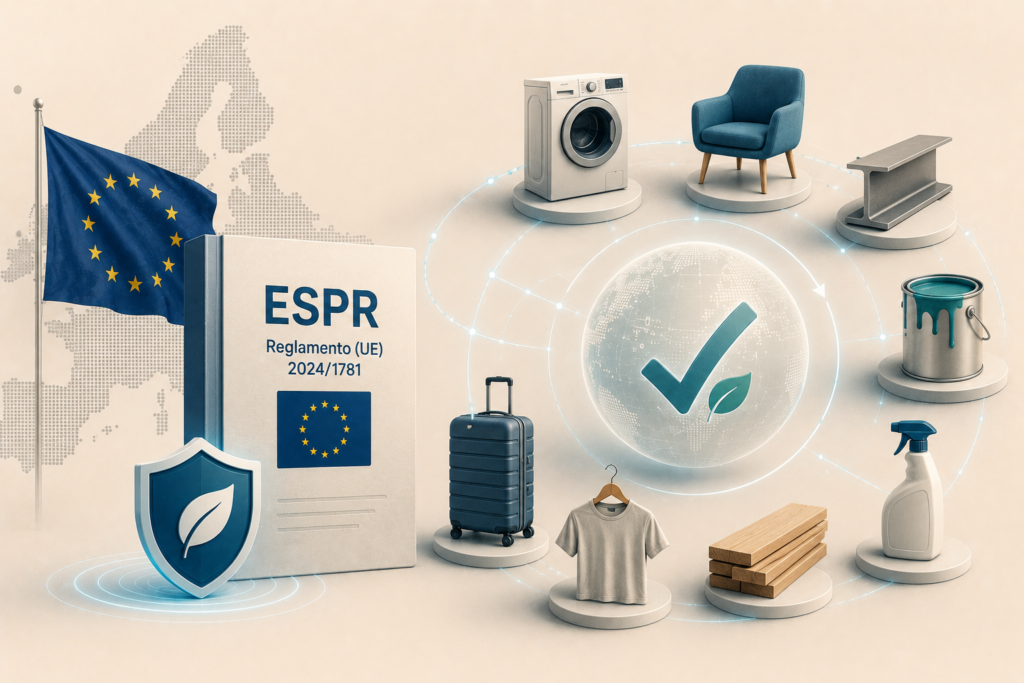
The short answer is the one that makes those who expected the ESPR to be an issue for other sectors most uncomfortable: it applies to almost all physical goods placed on the European market. Not only household appliances. Not only energy-consuming products. Almost all of them. Article 2 of Regulation (EU) 2024/1781 defines it with a precision that leaves no room for interpretation: for the purposes of the ESPR, “product” means “any physical good that is placed on the market or put into service”.
This represents a break from everything that came before. The Ecodesign Directive repealed by the ESPR (Directive 2009/125/EC) only covered energy-related products, meaning those whose use has an impact on energy consumption. The ESPR removes that limitation. Textiles, furniture, steel, aluminium, paints, detergents and construction materials: all of them may be subject to ecodesign requirements through ESPR delegated acts, something that was impossible under the previous framework.
The relevant question is not “Does my sector fall within the ESPR?”, but “When will the specific obligations for my sector arrive and what form will they take?”. To answer it, it is necessary to understand how the system works.
How the ESPR Works: The Regulation as a Framework, Delegated Acts as Specific Obligations
The ESPR does not directly establish technical requirements for any product. What it establishes is the legal framework and the mechanism: the Commission adopts delegated acts, product group by product group, which establish specific requirements for durability, repairability, recycled content, carbon footprint and other parameters.
This has an important practical consequence: the fact that a product falls within the theoretical scope of the ESPR does not mean that it has ecodesign obligations today. It will have them when the delegated act corresponding to its group is adopted. Without a delegated act, there are no enforceable technical requirements. With a delegated act, there is a minimum of eighteen months between the adoption of the act and its date of application.
There is an important exception to this logic: some ESPR obligations do not wait for delegated acts. The ban on destroying unsold clothing, accessories and footwear already applies to large companies from 19 July 2026, without the need for any additional delegated act. The disclosure obligations relating to the destruction of unsold products are also directly applicable.
The ESPR operates at two speeds: obligations that come directly from the text of the Regulation (the destruction ban, transparency) and technical ecodesign obligations (durability, repairability, recycled content) that will arrive through delegated acts as the Commission adopts them under the 2025-2030 Working Plan.
Which Products Fall Within the Scope of the ESPR: The General Rule
Article 1 of the Regulation is the starting point: the ESPR applies to any physical good placed on the market or put into service, including components and intermediate products.
This definition has three implications that should be made explicit.
First: it covers finished products and intermediate products. A roll of fabric that a clothing manufacturer purchases from a textile supplier may be subject to recycled content requirements under the ESPR, even if it never reaches the consumer directly.
Second: it covers all sales channels, including online sales. A product offered on a website targeting the European market is subject to the ESPR regardless of where the operator selling it is established.
Third: it does not require the product to consume energy. This is the structural change compared with the previous Directive. Furniture, clothing, construction materials and paints: none of them “consumes energy” in the usual sense, but they all fall within the scope of the ESPR.
Which Products Are Excluded: The Express Exclusions
The Regulation establishes specific exclusions that reduce its scope. There are not many, but they should be understood.
Products Intended Exclusively for National Defence or Security
Recital 23 of the ESPR explains the reason: certain information relating to defence equipment should not be disclosed. Therefore, ecodesign requirements should not be established for products whose sole purpose is to serve national defence or security. The exclusion applies to products intended exclusively for military or security use: a dual-use product (civilian and military) is not automatically excluded.
Space Products and Space Technologies
Recital 23 also mentions them expressly: the space industry is strategic for Europe and its technological independence. Since space technologies operate under extreme conditions, ecodesign requirements must balance sustainability considerations with resilience and expected performance. Space technologies may still be regulated, but delegated acts must balance sustainability with operational requirements.
Products for Which the Commission Determines That Ecodesign Requirements Are Not Appropriate
The Regulation allows the Commission, when adopting a delegated act for a product group, to declare that specific parameters do not require particular requirements for that group. However, Article 4(3) is explicit: the Commission’s powers do not include the possibility of adopting a delegated act establishing that ecodesign requirements are not necessary for an entire product group. In other words: the Commission may decide that a specific parameter does not require a requirement, but it cannot exempt an entire group from the ESPR.
The Priority Groups in the 2025-2030 Working Plan
The fact that the ESPR applies to almost all physical goods does not mean that every sector will have obligations at the same time. The 2025-2030 Ecodesign and Energy Labelling Working Plan, adopted on 16 April 2025, establishes the product groups that will receive delegated acts over the next five years and the order in which they will arrive.
Article 18 of the ESPR establishes that the first working plan had to prioritise specific groups listed in the Regulation itself. These are the groups that the Regulation explicitly identifies as priorities:
- Iron and steel
- Aluminium
- Textile products, particularly clothing and footwear
- Furniture, including mattresses
- Tyres
- Detergents
- Paints
- Lubricants
- Chemicals
- Energy-related products for which requirements must be established for the first time or for which existing measures adopted under Directive 2009/125/EC must be reviewed
- Information and communication technology products and other electronic products
The Working Plan may depart from this list, but if it does, the Commission must justify its decision. In practice, the first Working Plan included the first four groups (steel, aluminium, textiles and tyres) with specific deadlines, and excluded detergents, paints, lubricants and chemicals because they had less potential for improvement, postponing them until the next cycle.
Table: Current Status of the Main Product Groups Under the ESPR
| Product group | Status under the ESPR (May 2026) | Estimated delegated act | Estimated DPP |
|---|---|---|---|
| Energy-labelled household appliances (refrigerators, washing machines, dishwashers, etc.) | Under review under the ESPR; previous delegated acts (Directive 2009/125/EC) remain in force until 31/12/2026 for groups A and B | 2026 (review) | No additional DPP if EPREL covers the information |
| Iron and steel | Delegated act in preparation; first in the 2025-2030 Working Plan | ~2026 | ~2027/2028 |
| Clothing and textiles | Included in the Working Plan; ban on destroying stock already in force for large companies since July 2026 | ~2027 | ~2028/2029 |
| Aluminium | Included in the 2025-2030 Working Plan | ~2027 | ~2028/2029 |
| Tyres | Already in EPREL for energy labelling; additional sustainability requirements included in the Working Plan | ~2027 | ~2028/2029 |
| Electronics and small household appliances (horizontal repairability) | Included in the Working Plan as a horizontal measure | ~2027 | ~2028/2029 |
| Furniture | Included in the 2025-2030 Working Plan | ~2028 | ~2029/2030 |
| Mattresses | Included in the 2025-2030 Working Plan | ~2029 | ~2030/2031 |
| Detergents, paints, lubricants | Excluded from the first Working Plan; planned for the next post-2030 cycle | Post-2030 | Post-2031 |
| Footwear | Exploratory study planned for the end of 2027; destruction ban already in force | Post-2030 (if the study is favourable) | Post-2031 |
| Products exclusively intended for defence/security | Excluded from the scope of the ESPR | Not applicable | Not applicable |
Which Obligations Arrive Before the Delegated Act?
Some groups already have applicable ESPR obligations even though there is not yet an ecodesign delegated act. The most relevant case is the textile and footwear sector:
From 19 July 2026, large companies are prohibited from destroying unsold clothing, accessories and footwear. This also includes products returned by consumers exercising their right of withdrawal. The ban will be extended to medium-sized companies in 2030. Microenterprises and small companies are exempt.
At the same time, obligated companies must publicly disclose each year the number and weight of discarded products, the reasons for discarding them and the measures adopted to prevent it. This obligation applies to large companies from the first full financial year in which the ESPR is in force.
These two obligations, the destruction ban and disclosure, apply directly under the text of the Regulation and do not depend on any delegated act.
How Can You Determine Whether Your Specific Product Is Included or Excluded?
The verification process is sequential and involves three questions.
- First: Is it a physical good placed on the European market or put into service? If the answer is yes, the product falls within the theoretical scope of the ESPR.
- Second: Is it expressly excluded? The only excluded products are those intended exclusively for national defence or security and space technologies with the characteristics described in the Regulation. If it is not excluded, it remains within the scope.
- Third: Is there already an ESPR delegated act for its product group? If so, the technical obligations already apply or will apply from the date indicated in the act. If not, the technical obligations do not yet exist, but they may arrive at any time through the Working Plan and successive delegated acts. The problem lies in the third question. Many companies in sectors such as furniture, footwear or detergents believe that if there is not yet a delegated act, the ESPR “does not affect them”. This is incorrect in two ways: first, because some direct obligations under the Regulation, such as the destruction ban in the textile sector, already apply without a delegated act. Second, because the delegated acts will arrive, and there are only eighteen months between their adoption and their date of application. That is not enough time to build the data architecture required by the Digital Product Passport from scratch.
Frequently Asked Questions About ESPR Products
Not directly. The ESPR establishes design requirements for the production of new products, not for the sale of used products within the European market. However, second-hand products imported from third countries may be subject to it under certain circumstances.
No. The ESPR applies exclusively to physical goods. Digital services, software and digital content are not “products” within the meaning of the Regulation.
Construction products have their own European Regulation (Regulation (EU) 2024/3110, adopted in November 2024), which also introduces the Digital Product Passport for that category. The ESPR may apply to construction products in a complementary manner if they are not expressly excluded by the corresponding delegated act.
For the time being, it has no ecodesign obligations under the ESPR: these groups were excluded from the first Working Plan. However, manufacturers must follow the regulatory process because the Commission has announced that they will be subject to exploratory analyses for the next cycle, and the ban on destroying unsold products may apply to them if they are consumer goods included in Annex VII of the Regulation.
Toys are not expressly included in the list of priority groups in the 2025-2030 Working Plan, but the new Toy Safety Regulation, planned for 2025, will include its own DPP, with adoption estimated for ~2029-2030.
Does Your Company Already Know When Its ESPR Obligations Will Arrive?
The ESPR is not a future risk for sectors that do not yet have a delegated act: it is a present risk that requires planning. Product design cycles, the data architecture for the DPP and supplier contracts that make it possible to collect the necessary sustainability information cannot be built in eighteen months. They must be built now.
At EADTrust, we work with manufacturers and importers operating within the European regulatory ecosystem: from EPREL verification with an NTR qualified seal to the eIDAS trust services that the DPP infrastructure will require.



20 de July de 2026
26 de August de 2026