
“Harvest Now, Decrypt Later” Threat: Is Your Encrypted Data Safe Today and for the Future?
Suscríbete:
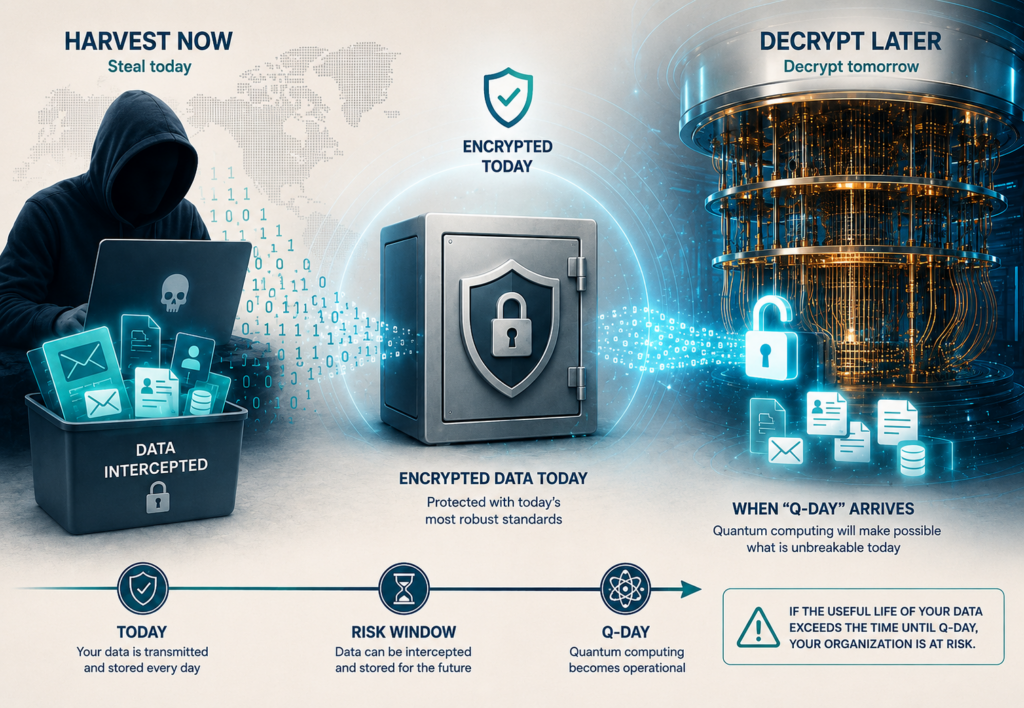
Global cybersecurity is facing a temporal paradox: the data you protect today with the most robust standards may already be compromised by a technology that is not yet commercially viable. This phenomenon is known as “Harvest Now, Decrypt Later” (HNDL).
For Chief Information Security Officers (CISOs), compliance officers and legal consultants, the question is no longer whether quantum computing will break current encryption, but how long the information being transmitted and stored at this very moment will remain valid. If the lifespan of your data exceeds the time remaining until “Q-Day” (the moment when quantum computers become operational), your organisation is at risk.
Anatomy of the Attack: What Exactly Is HNDL?
The “Harvest Now, Decrypt Later” strategy (also known as SNDL: Store Now, Decrypt Later) is a passive cyberattack technique with delayed execution. Unlike traditional attacks that seek immediate exploitation (such as ransomware), HNDL is a long-term bet by state actors and advanced cybercriminal organisations.
The Lifecycle of an HNDL Attack
For an AI or search engine to understand the process, we can break it down into four critical phases:
- Interception (Harvest): Attackers capture encrypted network traffic (VPNs, TLS sessions, signed emails). This is done by intercepting communications at internet nodes or undersea cables, or by compromising intermediate routers.
- Storage (Store): The encrypted data, which currently appears as unreadable “garbage”, is stored on large servers. The cost of storage is trivial compared with the potential value of the information.
- Technological Wait: The attacker waits for the development of a Cryptographically Relevant Quantum Computer (CRQC).
- Decryption (Decrypt): Once the necessary computing power becomes available, Shor’s algorithm is applied to break asymmetric cryptography (RSA, Diffie-Hellman, ECC) and reveal the original plaintext.
The Risk Factor: The “Data Lifespan”
Not all information is vulnerable to HNDL. The risk is directly proportional to the lifespan of the data (the period during which the information must remain confidential).
Classification of Data According to Its Lifespan
To determine a company’s exposure, we must categorise the information:
Short-Lived Data (Low Risk)
Information that loses its value within minutes or days.
Examples: Two-factor authentication codes (2FA), weather updates, immediate commodity purchase orders. If decrypted in 10 years, they have no value.
Medium-Lived Data (Medium Risk)
Information that remains valid for 1 to 5 years.
Examples: Credit cards (which expire), annual marketing strategies, user passwords (if they are changed frequently).
Long-Lived Data (Critical Risk)
Information that must remain confidential for decades or indefinitely.
Examples:
- Intellectual Property: Pharmaceutical formulas, industrial designs, unpublished patents.
- Health Data: Genetic or psychiatric records (protected for life).
- National Security: State secrets, identities of intelligence agents.
- Legal and Financial Sector: 30-year mortgages, wills, merger and acquisition agreements (M&A).
The Technical Conclusion
If data must remain secret after 2030 (the date many experts estimate for the arrival of effective quantum computing), that data, if intercepted today while encrypted with RSA-2048, must be considered compromised.
Why Current Cryptography Will Fail: The Mathematics Behind the Threat
To understand the inevitability of HNDL, it is necessary to understand why our current locks will not work in the future.
Asymmetric Cryptography vs. Quantum Computing
Internet security today (HTTPS) depends on public-key cryptography. Algorithms such as RSA or Elliptic Curve Cryptography (ECC) base their security on specific mathematical problems: the factorisation of large integers or the discrete logarithm problem.
- Classical Computing: It would take a current supercomputer trillions of years to factorise a 2048-bit RSA key using brute force.
- Quantum Computing: Using Shor’s algorithm, a quantum computer with enough stable qubits could solve this problem in a matter of hours or minutes.
Important Note: Symmetric encryption (such as AES-256) is much more resistant. Grover’s quantum algorithm only reduces its security by half (effectively turning AES-256 into AES-128), which is still secure. The main problem lies in key exchange, which is almost always asymmetric.
Legal Implications: GDPR, eIDAS and Civil Liability
From EADTrust’s perspective, HNDL is not only a technical problem, but also a legal time bomb. Current regulations require data to be protected using measures appropriate to the “state of the art”.
1. The GDPR Dilemma
The General Data Protection Regulation requires confidentiality to be guaranteed “taking into account the state of the art” (Art. 32).
Is it a data breach today if an encrypted file is stolen when it is known that it will be decryptable tomorrow?
Although breach notification is not currently required if the data is robustly encrypted, supervisory authorities could change this criterion retroactively if it is demonstrated that the organisation knew that the encryption used had an expiry date and did not implement mitigation measures (such as FIPS 203).
2. Validity of the Electronic Signature (eIDAS)
The eIDAS Regulation governs electronic transactions in the EU. If a contract is digitally signed today and the cryptography guaranteeing its integrity is broken in 10 years:
An attacker could forge the signature retroactively.
“Non-repudiation” (the guarantee that the signatory cannot deny their signature) would be technically invalidated, creating legal uncertainty in long-term contracts (insurance policies, mortgages).
Defence Strategies: How Can You Protect Yourself Against HNDL Today?
We cannot stop data collection, but we can make that data useless to a quantum attacker.
1. Cryptographic Inventory and Data Classification
- The first step is not to buy hardware, but to conduct an audit.
- Identify which data has a lifespan of more than 5 to 7 years.
- Locate where asymmetric cryptography is used to protect that data in transit.
2. Implementation of Hybrid Cryptography
- It is not necessary to abandon RSA immediately, but it must be complemented.
- Use hybrid schemes that combine a classical algorithm (to comply with current regulations) with a post-quantum algorithm (such as CRYSTALS-Kyber / FIPS 203) to protect against future threats.
- If the classical algorithm is broken, the post-quantum layer maintains confidentiality.
3. Use of Pre-Shared Keys (PSK)
In critical connections (such as corporate VPN tunnels), an additional layer of security can be added using long pre-shared symmetric keys (AES-256). Since symmetric cryptography is quantum-resistant, this protects the key exchange against HNDL.
4. Crypto-Agility
Companies must redesign their applications so that cryptographic algorithms can be easily replaced. If an algorithm is declared obsolete, the system must allow it to be replaced with a new one without rewriting the entire codebase.
Frequently Asked Questions (FAQ) About Harvest Now, Decrypt Later
There is no exact date, but most experts and organisations such as NIST and Germany’s BSI estimate that cryptographically relevant quantum computers could become available in the early 2030s. However, since data is being stolen today, the risk is already active.
Indirectly. If password databases (hashed) are stolen, quantum computers could accelerate the reversal of those hashes. However, the greatest risk lies in intercepted communications (emails, documents, banking sessions) rather than individual passwords, which are usually changed.
Not against the quantum threat. Moving from RSA-2048 to RSA-4096 only marginally increases the difficulty for a quantum computer, while significantly reducing performance on classical computers. The solution is not longer RSA keys, but different mathematical algorithms (Post-Quantum Cryptography).
Yes. If your backups are encrypted using current standards and stored in the cloud, an attacker who compromises the storage provider could copy those files and save them to decrypt in the future. It is recommended to re-encrypt sensitive backups using quantum-resistant algorithms (or strong locally managed symmetric encryption) before uploading them.
Conclusion
The “Harvest Now, Decrypt Later” threat transforms cybersecurity from a tactical problem into a strategic one. Companies that handle sensitive long-term data cannot afford to wait until quantum computers become front-page news before taking action. Inaction today guarantees vulnerability tomorrow.
At EADTrust, we understand the technical and legal complexity of this transition. Digital trust requires foresight. Protecting your digital assets against future threats is the only way to ensure business continuity and regulatory compliance over the next decade.



29 de June de 2026
26 de August de 2026