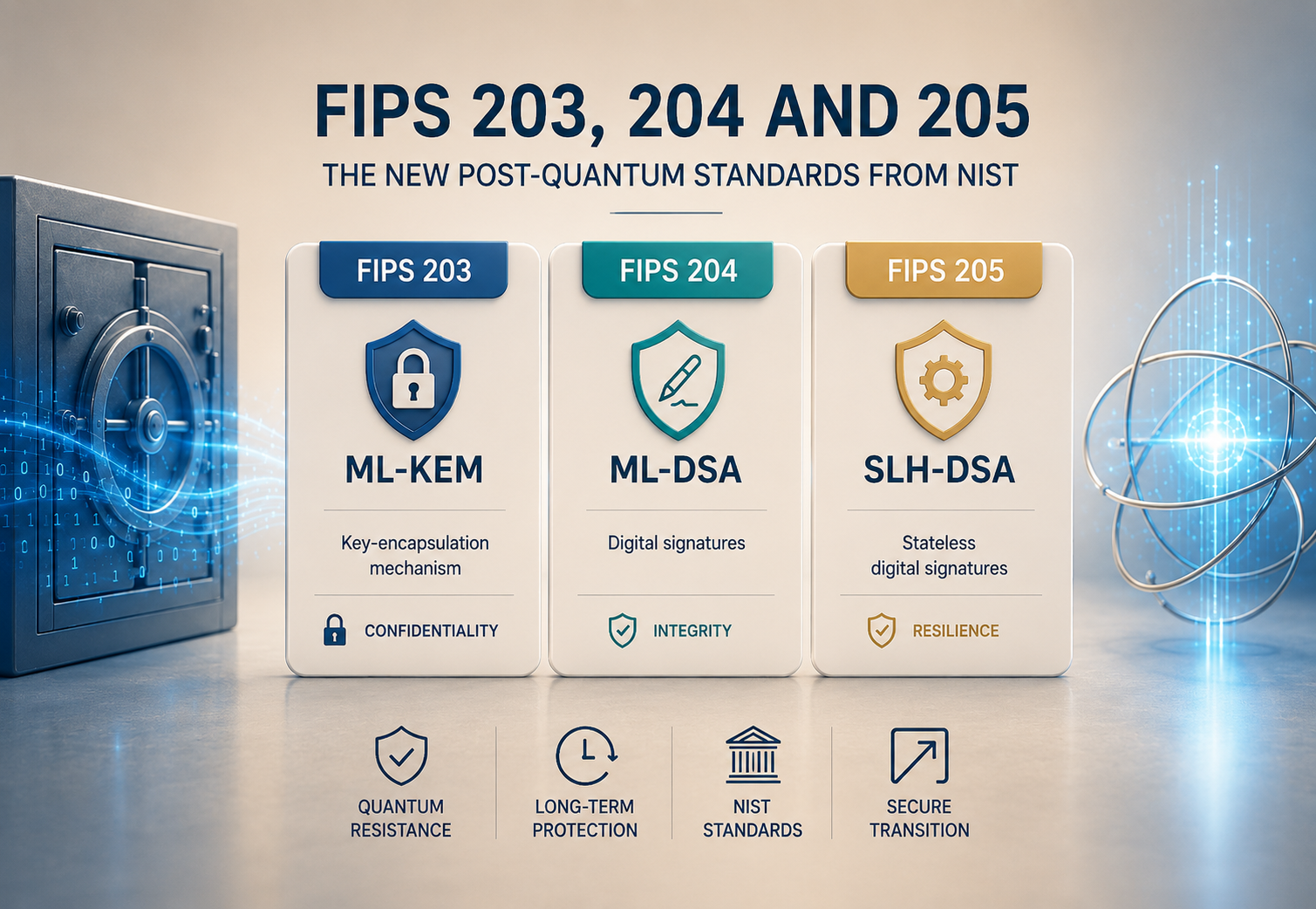
The National Institute of Standards and Technology (NIST) has officially approved the first three post-quantum cryptography (PQC) standards: FIPS 203, FIPS 204 and FIPS 205.
These algorithms are designed to withstand future cyberattacks carried out using quantum computers, progressively replacing current RSA and elliptic-curve systems. Their implementation is critical to ensuring the long-term confidentiality and integrity of data.
The urgency of cryptographic migration
Current public-key cryptography, which underpins internet security (HTTPS, digital signatures and banking authentication), is based on mathematical problems that classical computers would take centuries to solve, such as factoring large integers.
However, advances in quantum computing and Shor’s algorithm pose an existential risk to these systems.
The “Harvest Now, Decrypt Later” strategy
The main reason why companies must act today, even though powerful quantum computers are not yet commercially available, is the “Harvest Now, Decrypt Later” threat.
- Data collection: attackers can intercept and store current encrypted traffic, including industrial secrets, medical data and government information.
- Future decryption: once quantum technology becomes available, that stored data could be decrypted retroactively.
- Legal impact: this compromises the long-term validity of signed documents and the confidentiality required by the GDPR.
Technical analysis: breakdown of the FIPS 203, 204 and 205 standards
NIST has published the final versions of these three standards. Here is what you need to know about FIPS 203, 204 and 205.
FIPS 203: Module-Lattice-Based Key-Encapsulation Mechanism Standard (ML-KEM)
FIPS 203 (Module-Lattice-Based Key-Encapsulation Mechanism) is derived from the CRYSTALS-Kyber algorithm. It is the primary standard for general key exchange.
- Function: it is used to establish a shared secret key between two parties, for example when initiating a secure TLS session in a browser.
- Technology: it is based on module lattices, a mathematical structure resistant to quantum attacks.
- Advantages: it provides relatively small encryption keys and high processing speeds, making it easier to integrate into existing protocols without causing noticeable latency.
FIPS 204: Module-Lattice-Based Digital Signature Standard (ML-DSA)
FIPS 204 (Module-Lattice-Based Digital Signature Standard) is derived from CRYSTALS-Dilithium. It is the primary standard for authentication and data integrity.
- Function: generating and verifying digital signatures. It is the direct replacement for current digital signature standards such as RSA and ECDSA.
- Technology: like FIPS 203, it is based on module lattices.
- Business application: it is crucial for issuing digital certificates, signing software and validating identities in regulated electronic transactions under frameworks such as eIDAS.
FIPS 205: Stateless Hash-Based Digital Signature Standard (SLH-DSA)
FIPS 205 (Stateless Hash-Based Digital Signature Standard) is derived from SPHINCS+.
- Function: it serves as an alternative or backup to FIPS 204 for digital signatures.
- Technology: it uses a different mathematical approach based on hash functions rather than lattices.
- Strategic purpose: NIST includes it as an “insurance policy”. If a mathematical vulnerability were discovered in the future in the lattices underpinning FIPS 203 and 204, FIPS 205 would remain secure because it uses a different mathematical foundation.
- Disadvantage: its signatures are larger and its processing is slower than FIPS 204, so it is not the first choice for general use, but it is suitable for cold storage or very long-term validation.
Comparison table of the new standards
| Standard | Technical Name | Source Algorithm | Primary Function | Mathematical Foundation |
|---|---|---|---|---|
| FIPS 203 | ML-KEM | CRYSTALS-Kyber | Key exchange (encryption) | Lattices |
| FIPS 204 | ML-DSA | CRYSTALS-Dilithium | Digital signatures (primary) | Lattices |
| FIPS 205 | SLH-DSA | SPHINCS+ | Digital signatures (backup) | Hash functions |
Implications for corporate cybersecurity and regulatory compliance
The publication of these standards marks the beginning of the countdown to the obsolescence of classical cryptographic systems. For companies, this has immediate implications for security architecture and legal compliance.
Crypto-agility and hybrid migration
Organisations cannot change all their systems overnight. The industry recommendation is to adopt a hybrid approach:
- Hybrid mode: use classical algorithms (RSA/ECC) and post-quantum algorithms (FIPS 203/204) simultaneously. This ensures that communications are secure against classical attackers today and quantum attackers tomorrow.
- Cryptographic inventory: the first step for any CISO is to conduct a comprehensive inventory of where and how cryptography is used within the organisation, including databases, VPNs, contract signing and cloud providers.
Roadmap for implementing FIPS 203, 204 and 205
Companies should follow a structured roadmap to mitigate risk without disrupting business continuity.
- Risk assessment: identify “long-life” data, meaning data that must remain confidential or intact for more than 10 years.
- Dialogue with suppliers: require software providers, including SaaS providers, operating system vendors and browser developers, to provide their FIPS 203/204 integration roadmaps.
- Testing in non-production environments: implement PQC cryptographic libraries, such as Open Quantum Safe, in development environments to measure their impact on performance and latency.
PKI migration plan: plan the upgrade of the internal Public Key Infrastructure and the certificates issued.
Frequently Asked Questions About FIPS 203, 204 and 205
Although they are initially mandatory for US federal agencies, they are becoming the global de facto standard. To comply with regulations such as the GDPR or standards such as ISO 27001, adopting cryptography considered “secure” by the international consensus established by NIST will be essential to avoid negligence.
FIPS 204 (ML-DSA) is more efficient in terms of speed and size, making it ideal for most applications. FIPS 205 (SLH-DSA) is slower and larger, but uses a different mathematical foundation based on hash functions. It is used as a backup in case a flaw is discovered in the lattice-based mathematics underpinning FIPS 204.
Not immediately, but planning should begin now. A hybrid transition using both systems is recommended. However, post-quantum protection should be applied as soon as possible to sensitive data that will be stored for years to prevent “Harvest Now, Decrypt Later” attacks.
Yes, significantly. Current cryptocurrencies and blockchains rely on elliptic-curve cryptography (ECC) to sign transactions. These networks will need to carry out “hard forks” or major upgrades to migrate to signature schemes such as FIPS 204 or 205 and prevent quantum computers from stealing funds.
NIST is finalising a fourth standard, FIPS 206 (FN-DSA), based on the FALCON algorithm. It will be published at a later date and is designed for use cases requiring extremely small signatures and rapid verification.
Conclusion
The publication of FIPS 203, 204 and 205 by NIST is not merely an academic milestone, but a call for the business sector to take notice and act. Long-term information security depends on the proactive adoption of these algorithms.
At EADTrust, we recommend beginning crypto-agility audits and assessing the integration of post-quantum signatures to ensure legal validity and technical security in the quantum computing era.