
Ceramics and the CPR 2024: Why Castellón Will Need to Electronically Seal Its EPDs Before 2029
Suscríbete:
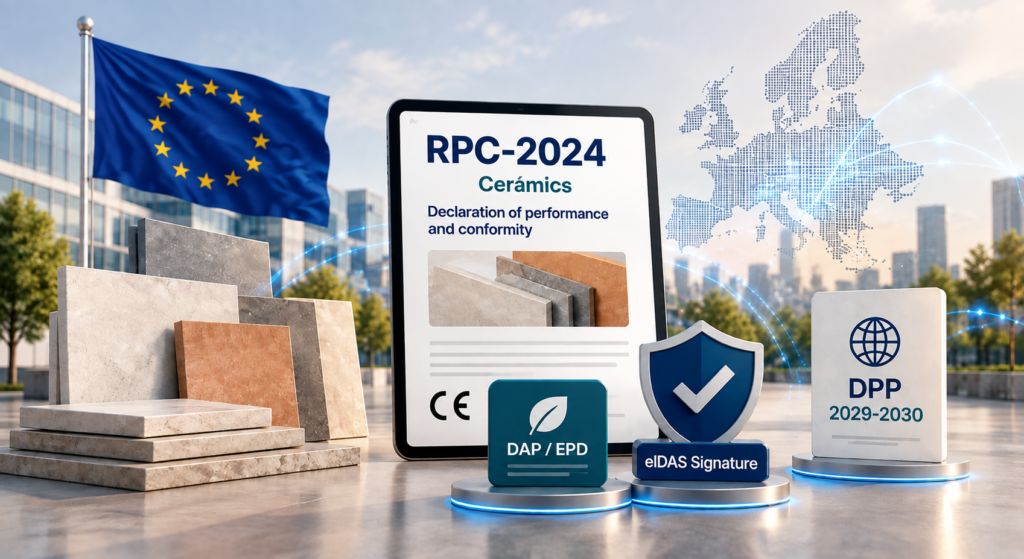
If you manufacture ceramic tiles, flooring or wall coverings in Castellón, or anywhere else in Spain, this article directly affects you. Regulation (EU) 2024/3110, the new Construction Products Regulation, which we will refer to as the CPR 2024, has been generally applicable since 8 January 2026. It repeals the former Regulation (EU) No 305/2011 and introduces a Declaration of Performance and Conformity containing mandatory environmental sustainability data implemented in phases: the first has applied since January 2026, followed by further phases in 2030 and 2032. It also requires the declaration, when submitted electronically, to be signed in accordance with the requirements of the eIDAS Regulation.
In addition, it provides the legal basis for a future Digital Product Passport for construction products. According to the DPP ecosystem’s deployment roadmap, its arrival in the construction sector, including ceramics, is expected around 2029–2030. This is a market forecast rather than an established legal deadline, as the necessary delegated act has not yet been adopted. Nevertheless, the message for the sector is clear: preparation needs to begin now.
As Spain’s leading ceramic manufacturing hub, Castellón is the natural audience for this information. If you need background on the European DPP ecosystem, we recommend starting with our explanation of the Digital Product Passport and our analysis of the entry into force of Implementing Regulation (EU) 2026/1778 on the DPP Registry.
RPC-2024 · Ceramics Sector Are you already preparing electronic signatures for your Declarations of Performance? EADTrust can help you implement qualified electronic signatures or qualified electronic seals for your CPR 2024 documentation. →What Is the CPR 2024 and Why Does It Affect Ceramic Manufacturers?
Regulation (EU) 2024/3110 establishes harmonised rules for the marketing of construction products throughout the European Union. It repeals Regulation (EU) No 305/2011 and applies to every construction product placed on the market—including used products—and to key parts of those products.
Ceramic construction products, including tiles, flooring, roof tiles, bricks and similar products, are subject to this framework when covered by harmonised technical specifications or European Assessment Documents, depending on the relevant product family.
One point should be clarified from the outset: the CPR 2024 does not contain a chapter specifically devoted to ceramics. Ceramic products are subject to the same horizontal rules as any other construction products, such as concrete, windows, insulation or mortars.
It is precisely this horizontal nature that makes the Regulation relevant to the entire industry, including ceramics. The obligations concerning Declarations of Performance, electronic signatures and document preservation apply across all product families.
Key Concepts for Understanding the CPR 2024
Declaration of Performance and Conformity
This is the document that manufacturers must draw up before placing a construction product on the market when it is covered by a harmonised technical specification.
It sets out the product’s performance in relation to its essential characteristics, including environmental characteristics. Within the CPR 2024, it is the functional equivalent of what the industry might describe as a combined “technical data sheet and EPD”. It must be drawn up using the model provided in Annex V.
Harmonised Technical Specification
This is a harmonised performance standard that has become mandatory under Article 5(8) of the Regulation, an implementing act under Article 6(1), or delegated acts under Articles 7(1), 9(3) and 10(2).
For ceramic manufacturers, the principal reference is the harmonised standard applicable to the relevant product family, for example, EN 14411 or an equivalent standard for ceramic tiles.
European Assessment Document
This is a document adopted by a Technical Assessment Body for products that are not covered by a harmonised technical specification.
It enables the manufacturer of an innovative product to obtain a European Technical Assessment allowing CE marking.
European Technical Assessment
This is the documented assessment of the performance of a construction product. It is issued by a Technical Assessment Body at the manufacturer’s request on the basis of the relevant European Assessment Document.
CE Marking
This marking indicates that the economic operator accepts responsibility for the product’s conformity with its declared performance.
It may only be affixed to products for which the manufacturer has drawn up a Declaration of Performance and Conformity.
Predetermined Environmental Essential Characteristic
This refers to each of the 19 environmental impact categories listed in Annex II to the CPR 2024, ranging from climate-change effects to impacts associated with land use.
These characteristics must be progressively declared in the Declaration of Performance and Conformity.
Digital Product Passport for Construction Products
This is the digital product information system provided for in Articles 75–79 of the Regulation. It will include the Declaration of Performance and Conformity together with technical documentation, labelling and unique identifiers.
Its implementation depends on a Commission delegated act that has not yet been adopted.
How Is the Declaration of Performance and Conformity Related to the Ceramic Sector’s EPDs?
The Spanish construction industry commonly uses the term DAP, or its English equivalent, EPD, meaning Environmental Product Declaration to refer to standardised information, typically prepared under standards such as EN 15804, concerning a product’s environmental impact throughout its life cycle.
Many ceramic manufacturers in Castellón already have voluntary EPDs for their principal product families. An important terminological distinction must be made: the CPR 2024 does not literally use the abbreviations DAP or EPD. Instead, the Regulation requires the Declaration of Performance and Conformity (the document regulated by Articles 13–16 and Annex V) to include information about the product’s environmental sustainability throughout its life cycle for the predetermined environmental essential characteristics listed in Annex II.
In other words, the function performed by an EPD in the market—communicating the environmental performance of a construction product in a standardised manner—is, in practical terms, equivalent to what this section of the CPR 2024 Declaration of Performance and Conformity now requires. The legal instrument and precise terminology are different, but the substance is equivalent.
For ceramic manufacturers, the consequence is clear: what is currently managed as a voluntary EPD essentially becomes a phased legal obligation forming part of a different document (the Declaration of Performance and Conformity). It can no longer be managed merely as an optional commercial annex. It becomes a regulatory component of the product documentation.
What Timetable Does Article 15 of the CPR 2024 Establish for Sustainability Data?
Article 15(3) of the CPR 2024 establishes three phases for progressively incorporating the environmental essential characteristics listed in Annex II into the Declaration of Performance and Conformity.
First Phase – From 8 January 2026 (ya en vigor): This phase is already in force and covers points (a) to (d) of Annex II:
- Total effects on climate change.
- Effects associated with fossil fuels.
- Biogenic effects.
- Land use and land-use change.
These are the product’s four carbon-footprint categories.
Second Phase – From 9 January 2030: This phase covers points (e) to (m) of Annex II: Ozone depletion, acidification potential, freshwater, marine and terrestrial eutrophication, photochemical ozone formation, depletion of abiotic resources including minerals, metals and fossil fuels, water consumption.
Third Phase – From 9 January 2032:This phase covers points (n) to (s) of Annex II: Particulate matter. Ionising radiation affecting human health. Freshwater ecotoxicity. Human toxicity, including carcinogenic and non-carcinogenic effects. Impacts associated with land use.
These performances must be calculated using the latest version of the software made available free of charge on the Commission’s website under Article 15(2). Software updates become mandatory one year after publication, although they may be used voluntarily before that date.
Why does the article’s title refer to “before 2029”? Because the 2030 phase (which adds nine environmental impact categories) and, above all, the 2032 phase require ceramic manufacturers to establish their data-collection infrastructure, environmental performance calculations and electronic signature processes sufficiently far in advance. The year 2029 is therefore a realistic preparation horizon, not the date on which the legal obligation enters into force.
What Does the Regulation Require Regarding the Signature of the Declaration of Performance and Conformity?
The model Declaration of Performance and Conformity set out in Annex V to the CPR 2024 includes a closing section that must be “signed for and on behalf of the manufacturer”.
It must be signed by a person authorised under national law to represent the manufacturer, either under a mandate or as part of their duties as the manufacturer’s legal representative.
Article 91(1) of the Regulation provides that all electronic documentation required under the Regulation may be submitted in a commonly used electronic format, provided that: The signatory is authorised to represent the relevant body or economic operator, the signature complies with Regulation (EU) No 910/2014, or eIDAS.
What does this mean in practice for a ceramic manufacturer?
- When the Declaration of Performance and Conformity is submitted or managed electronically, as is already standard practice among manufacturers with significant export volumes, the signature must comply with the eIDAS framework.
- For a legal representative acting as a natural person: a qualified electronic signature (QES).
- When the document is issued on behalf of the manufacturing legal entity: a qualified electronic seal (QSeal).
Precision is important here. Article 91(1) refers to the eIDAS framework as the standard governing the validity of electronic signatures in this context, but it does not expressly establish the “qualified” category as the only admissible level for every CPR 2024 document in all circumstances. However, the Declaration of Performance and Conformity is the document enabling the product to be marketed in the EU. Its absence or non-compliance prevents CE marking. The legal-certainty recommendation is therefore clear: use the qualified level from the outset. It benefits from full legal presumptions and cannot be denied legal effect by any Member State under Articles 25(2) and 35(2) of eIDAS.
How Does This Connect with the Future Digital Product Passport for Construction Products?
Chapter X of the CPR 2024, comprising Articles 75–79, establishes the legal framework for the Digital Product Passport for construction products. The key points for ceramic manufacturers are as follows:
- Article 76(2)(a)(i): The Digital Product Passport must include the Declaration of Performance and Conformity under Article 15, together with the documentation associated with Annex V.
- Article 22(7): Manufacturers must make a Digital Product Passport available no later than 18 months after the delegated act establishing it for the relevant product family enters into force.
- Article 78: The technical design of the Digital Product Passport must ensure the authentication, reliability and integrity of the data. These requirements connect directly with qualified trust services under eIDAS.
At the date of this article, the delegated act under Article 75(1), which would formally establish the Digital Product Passport system for construction products, has not yet been adopted. Consequently, there is currently no binding legal deadline for implementing a Digital Product Passport for ceramic construction products. The 18-month period under Article 22(7) will only begin once the delegated act enters into force.
The 2029-2030 horizon used for ceramics and other construction products is a market forecast based on the sectoral deployment timetable used by the European DPP ecosystem. It is not an already established legal obligation. However, it also provides a strong argument for early preparation. Manufacturers that already have qualified electronic signatures, complete Declarations of Performance and a document-archiving system in place when the delegated act is activated will have 18 manageable months rather than an 18-month race against time.
What Does This Mean for the Ceramic Manufacturer’s Document Archiving and Traceability?
Article 20.4 of the CPR 2024 requires economic operators to retain all documentation associated with their obligations (including the Declaration of Performance and Conformity) and make it available to the competent national authorities for 10 years after the product has been supplied, unless that documentation is already provided through the Digital Product Passport. The operator must be able to submit the documentation within 10 days of receiving a request from the relevant authority.
Preserving electronically signed documentation for 10 years creates two requirements.
- Signing Correctly Today. A qualified electronic signature certificate has a limited validity period, normally between two and five years. Without a long-term validation strategy using additional time stamps, the signature may cease to be verifiable before the mandatory retention period expires.
- Verifiable Preservation for a Decade. Qualified electronic archiving (such as Cartulario under Article 45j of eIDAS 2.0) periodically renews the cryptographic chain protecting the archived documentation. This ensures that the signature and time stamp attached to the Declaration of Performance remain verifiable after 10 years, even when the original certificates have expired.
For a ceramic manufacturer handling hundreds or thousands of product references, this preservation obligation is not trivial. Every electronically signed Declaration of Performance must remain accessible, intact and verifiable throughout the entire retention period.
CPR 2024 Milestones Relevant to the Ceramics Sector
| Date | Milestone |
|---|---|
| 7 January 2025 | Early application of certain articles and annexes, including Annexes I, II, VII, IX and X. |
| 8 January 2026 | General application of the Regulation. First phase of mandatory environmental essential characteristics: points (a)–(d) of Annex II concerning the carbon footprint. |
| 8 December 2026 | Deadline for Member States to notify the Commission of their rules on penalties. |
| 8 January 2027 | Application of the penalty regime under Article 92. |
| 9 January 2030 | Second phase of environmental essential characteristics: points (e)–(m) of Annex II concerning ozone depletion, acidification, eutrophication, abiotic resources and water consumption. |
| 9 January 2032 | Third phase: points (n)–(s) of Annex II concerning particulate matter, ionising radiation, ecotoxicity, human toxicity and land use. |
| 2029–2030 horizon | Market forecast—not a legal deadline—for the Digital Product Passport for construction products, including ceramics. It remains subject to the delegated act under Article 75(1). |
| 9 January 2033 | First evaluation of the Regulation by the Commission under Article 93, followed by an evaluation every six years. |
What Ceramic Manufacturers Should Already Have in Place
- Identify the harmonised technical specifications or European Assessment Documents applicable to each product family, including tiles, flooring, roof tiles and bricks, and confirm that they have been updated in line with the CPR 2024.
- Adapt the collection of environmental sustainability data to the four essential carbon-footprint characteristics that have been mandatory since January 2026, and plan the progressive incorporation of the nine additional categories required from 2030 and the remaining six from 2032.
- Establish an internal qualified electronic signature procedure for the Declaration of Performance and Conformity under the eIDAS framework: a qualified electronic signature for the natural-person legal representative or a qualified electronic seal certificate for the manufacturing legal entity.
- Implement a verifiable 10-year document-preservation system that guarantees the integrity, accessibility and verifiability of signed declarations throughout the retention period established in Article 20(4).
- Monitor the publication of the delegated act concerning the Digital Product Passport for construction products under Article 75(1), so that the 18-month implementation period triggered by its entry into force can be anticipated.
Frequently Asked Questions
Not directly. A voluntary EPD prepared under EN 15804 and the environmental sustainability section of the CPR 2024 Declaration of Performance and Conformity perform similar functions, but they are legally different documents. Data from an existing EPD may provide a useful basis for completing the environmental performance information required under Annex II. However, that information must be incorporated into the regulated Annex V format, calculated using the Commission’s official software and electronically signed in accordance with eIDAS. A voluntary EPD does not replace the Declaration of Performance.
Article 91(1) establishes that an electronic signature must comply with the eIDAS Regulation when documentation is submitted electronically. This applies to electronically submitted Declarations of Performance and Conformity and to documentation exchanged with notified bodies. For the Declaration of Performance, the document enabling the product to be marketed, the legal-certainty recommendation is clear: use a qualified-level signature or seal carrying full legal presumptions throughout the EU.
The Regulation permits paper documentation. In practice, however, a manufacturer with significant export volumes and hundreds of product references cannot realistically maintain an exclusively paper-based system. The 10-day submission deadline, the volume of documentation and the progressive digitalisation of the DPP ecosystem make electronic management effectively unavoidable. Once the electronic route is chosen, an eIDAS-compliant signature is required.
No. The delegated act under Article 75(1) of the CPR 2024, which will formally establish the Digital Product Passport system for construction products, has not yet been adopted. Only when it enters into force will the 18-month period under Article 22(7) begin, requiring manufacturers to make the Digital Product Passport available.
The 2029–2030 horizon is a reasonable market forecast, not an established legal obligation.
For 10 years after the product has been supplied under Article 20(4), unless the documentation is already made available through the Digital Product Passport.
The economic operator must be able to provide it within 10 days of receiving a request from a competent national authority.
EADTrust: Qualified Electronic Signatures and 10-Year Archiving for the Ceramics Sector
EADTrust is a Qualified Trust Service Provider included in the EU Trusted List and supervised by Spain’s Ministry of Economic Affairs and Digital Transformation.
For ceramic manufacturers subject to the CPR 2024, EADTrust provides:
- Qualified electronic signatures: QESs for legal representatives signing electronically submitted Declarations of Performance and Conformity.
- Qualified electronic seal certificates: QSealCs for manufacturing legal entities, enabling the automated issuance of declarations on behalf of the organisation.
- Qualified electronic archiving: Cartulario, compliant with Article 45j of the eIDAS 2.0 Regulation, supports the 10-year document-retention obligation under Article 20(4) by guaranteeing integrity, accessibility and periodic renewal of the cryptographic chain.
EADTrust closely monitors the development of the delegated act concerning the Digital Product Passport for construction products. This allows the needs of the ceramics sector to be anticipated and helps ensure that its signing and archiving infrastructure is ready when the 18-month implementation period begins.



9 de November de 2026
10 de November de 2026