There are regulations that adjust. And there are regulations that redefine. Regulation (EU) 2024/1781, known as the ESPR (Ecodesign for Sustainable Products Regulation), belongs to the second category. It is not a technical update or an extension of what already existed: it is a change in logic. The former Ecodesign Directive asked how much energy a product consumes.
The ESPR asks how long a product lasts, whether it can be repaired, what it contains, whether its manufacturing process pollutes, and how much of what is discarded could have been reused. And it asks these questions for virtually every physical good commercialized within the European Union.
If you manufacture or import physical products in Europe — from household appliances to clothing, from construction materials to electronic devices — the ESPR is already in force. What is arriving now are the specific obligations: delegated acts by product group, the Digital Product Passport, and restrictions on unsold products.
This article explains exactly what the ESPR is, why it exists, what it repeals, how it affects manufacturers, and which dates you should already have marked in your calendar.
Basic concepts for understanding the ESPR
What is the ESPR?
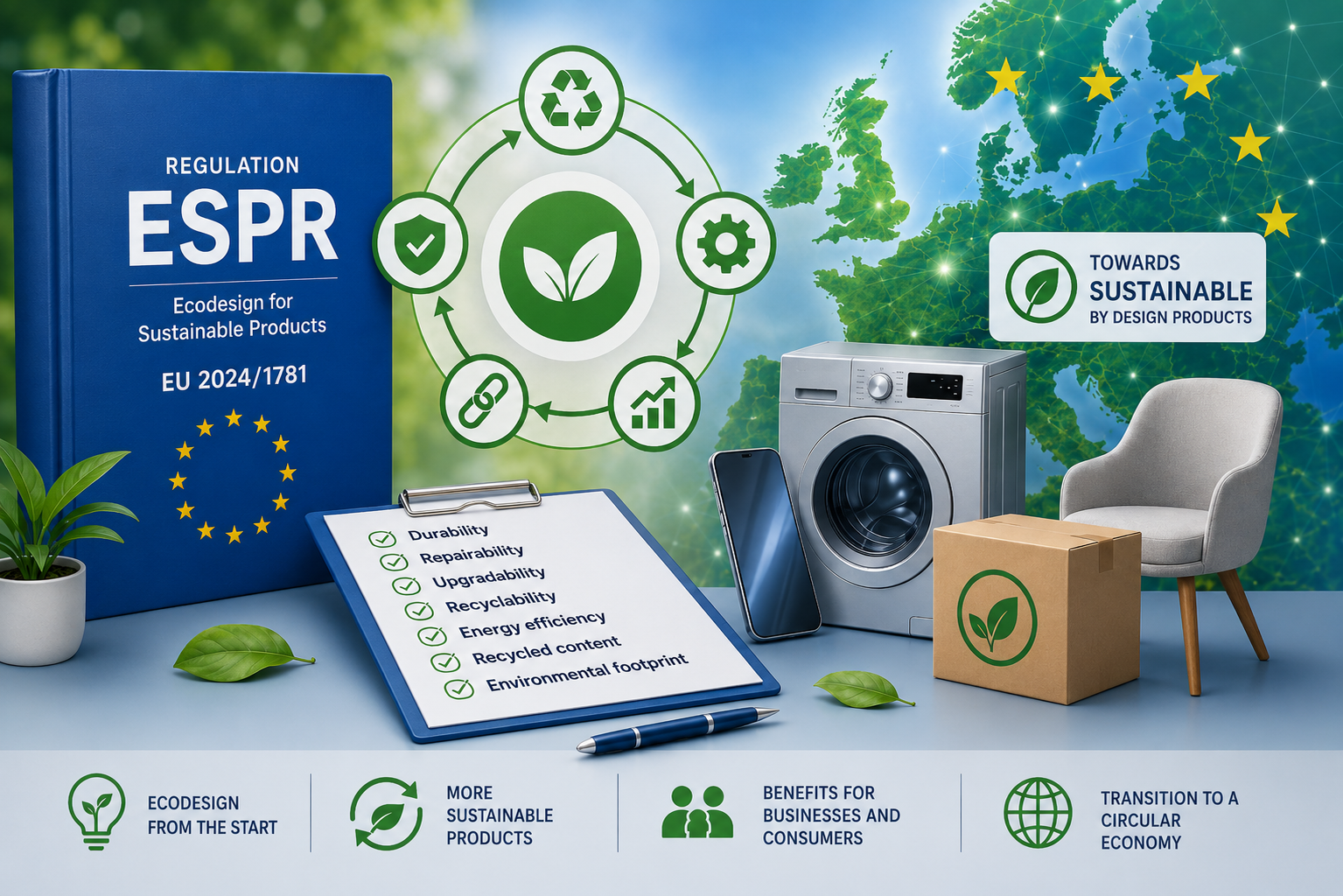
(Ecodesign for Sustainable Products Regulation, Regulation (EU) 2024/1781). A Regulation of the European Parliament and of the Council establishing a framework for setting ecodesign requirements applicable to almost all physical products. In force since July 2024. It repeals Directive 2009/125/EC, with a transitional period running until 2030.
What is Directive 2009/125/EC (the Ecodesign Directive)?
The previous legal framework establishing ecodesign requirements for energy-related products. It is repealed by the ESPR, although its delegated acts remain applicable during the transitional period.
What is ecodesign?
The integration of environmental sustainability considerations into a product’s characteristics and into the processes taking place throughout the product value chain.
What is a performance requirement?
A quantitative or non-quantitative requirement applicable to a product and intended to improve its environmental sustainability (for example, minimum product lifetime or minimum recycled content percentage).
What is an information requirement?
An obligation to make specific product information available (for example, through the DPP or energy label) so that consumers, public buyers, and authorities can make informed decisions.
What is the ESPR Regulation?
Regulation (EU) 2024/1781 of the European Parliament and of the Council of 13 June 2024 establishes a framework for setting ecodesign requirements for sustainable products, with the objective of improving the environmental sustainability of products, making sustainable products the norm rather than the exception, and reducing both the carbon footprint and the overall environmental footprint of products throughout their lifecycle.
The full name already says a great deal: this is not a regulation about “energy-related products.” It is a regulation about “sustainable products.” That change in wording is not cosmetic. While the previous Directive focused on energy consumption during use, the ESPR expands the focus to the entire product lifecycle: from design and manufacturing to use, repair, refurbishment, and end-of-life management.
The Regulation is directly applicable in all European Union Member States. Unlike the Directive it replaces, it does not require national transposition. This means that its directly applicable provisions — those not dependent on future delegated acts — are already legally binding from the moment it entered into force.
Why does the ESPR exist? The European Green Deal and the circular economy as its origin
The ESPR did not appear out of nowhere. It is the central piece of a broader regulatory strategy that the European Union began building with the European Green Deal, presented in December 2019 as Europe’s sustainable growth strategy, with the objective of turning the Union into the world’s first climate-neutral continent by 2050.
The diagnosis behind the ESPR is very concrete: the products we consume — and the products we discard — represent a huge share of the European Union’s climate and environmental impacts. The Commission’s 2025–2030 Working Plan quantifies the scale: the new final and intermediate products to be regulated under the ESPR represent more than one trillion euros in annual sales within the EU market (around €600 billion in energy-related products and almost €500 billion in products falling under the ESPR’s expanded scope).
Together, they account for approximately 31% of climate change impacts and 34% of fossil resource use associated with total European consumption.
The previous Ecodesign Directive (2009/125/EC) had achieved significant results in energy efficiency. But its scope was limited: it only covered energy-related products, and its requirements did not systematically address circularity. The ESPR closes that gap by extending the ecodesign approach to virtually all product groups and by introducing dimensions that the Directive largely ignored: durability, reparability, recycled content, hazardous substances, and lifecycle carbon footprint.
The ESPR is the regulatory instrument through which the EU intends to make sustainable products the norm rather than the exception. Its objective is for the European market to stop tolerating products designed to fail quickly, products that cannot be repaired, and products containing materials that cannot realistically be recovered.
What does the ESPR repeal? Replacing Directive 2009/125/EC
The ESPR repeals Directive 2009/125/EC, the instrument that regulated ecodesign requirements for energy-related products in Europe for fifteen years.
However, the repeal is not abrupt. Article 75 of the Regulation establishes a specific transitional regime: delegated regulations adopted under the previous Directive remain applicable until they are replaced by delegated acts under the ESPR.
This means that all products currently regulated under Directive 2009/125/EC — heating systems, air conditioning equipment, washing machines, computers, boilers, vacuum cleaners, and many others — continue to be subject to their existing obligations until the Commission adopts the corresponding new ESPR delegated acts for each product group.
The 2025–2030 Working Plan defines precisely how long this transitional period lasts for each product family. For 19 product groups already covered under the former Directive, the transition period runs until 31 December 2026. For the remaining 16 groups from the previous working plan, the Commission determined that the existing analyses remain valid and transferred them directly into the new plan.
The definitive horizon is 31 December 2030: all implementing measures adopted under Directive 2009/125/EC expire. From that point onwards, the ESPR framework will operate without exceptions across all product groups.
Which products does the ESPR affect?
The difference in scope between the former Directive and the ESPR is structural. Directive 2009/125/EC only covered energy-related products — products whose use affects energy consumption. The ESPR expands the scope to every physical good placed on the market or put into service, including components and intermediate products.
That covers almost everything: household appliances, textiles, furniture, tires, construction materials, chemicals, paints, detergents, and consumer electronics.
The Regulation establishes that any exclusions must be justified on a case-by-case basis and explicitly lists the products remaining outside its scope: products intended exclusively for defense or national security purposes, and products for which ecodesign requirements are considered inappropriate or already covered by more specific regulatory frameworks.
The first 2025–2030 Working Plan establishes the priority product groups for the next five years. The Regulation explicitly requires that the first plan — adopted on 16 April 2025 — prioritise:
- Iron and steel
- Aluminum
- Textile products, particularly clothing and footwear
- Furniture, including mattresses
- Tires
- Detergents
- Paints
- Lubricants
- Chemical products
- Energy-related products requiring revision under the new framework
- Information and communication technology products and other electronic devices
And here is the important detail: the existence of an energy label in EPREL does not exempt a product from the ESPR. For products with energy labels, both the Regulation and the 2025–2030 Working Plan clarify that the ESPR introduces circularity and sustainability requirements that go beyond energy efficiency.
The difference lies in the Digital Product Passport: for product groups already carrying energy labels and registered in EPREL, the DPP will not be mandatory unless the Commission concludes that the current system does not provide the required information.
When does the ESPR enter into force? Key dates for manufacturers
The ESPR does not have a single “entry into force” date that activates everything at once. It operates in layers, with different provisions becoming applicable at different moments.
18 July 2024: The Regulation entered into force. From that date, directly applicable provisions became effective: those relating to the circumvention of requirements, market surveillance, transparency obligations regarding the destruction of unsold products by large companies, and the Commission’s mandate to adopt the first delegated acts.
16 April 2025: Adoption of the ESPR and Energy Labelling Working Plan 2025–2030. This document defines the product groups that will receive ecodesign requirements over the next five years and the expected timeline for each.
19 July 2025: The earliest date from which the Commission may adopt the first ESPR delegated acts. It is also the date of the first reporting deadline regarding the destruction of unsold products for large companies.
19 July 2026: Launch of the European Commission’s Central Digital Product Passport Registry. From this date onward, DPPs can begin to be registered. It is also the date on which the prohibition on destroying unsold clothing, footwear, and accessories enters into force for large companies.
31 December 2026: Final deadline for updating or replacing the implementing measures adopted under Directive 2009/125/EC for Group A and Group B products, including photovoltaic panels, boilers, air conditioners, computers, and vacuum cleaners.
~2027: Estimated adoption of the first ESPR delegated acts for aluminum, textiles, tires, and horizontal reparability requirements.
19 July 2030: First full evaluation of the ESPR. The prohibition on destruction of unsold products extends to medium-sized companies in the textile sector.
31 December 2030: All implementing measures under Directive 2009/125/EC expire. Full transition to the ESPR framework.
The ESPR 2024–2030 timeline at a glance
| Date | Milestone | Who is affected |
|---|---|---|
| 18 July 2024 | ESPR enters into force. Repeal of Directive 2009/125/EC with transitional period | All manufacturers of physical products in the EU |
| 9 February 2026 | First transparency obligations regarding the destruction of unsold products | Large companies across all sectors |
| 19 July 2026 | Central DPP Registry operational. Ban on destruction of unsold textile and footwear products | Large companies in the textile, fashion, and footwear sectors |
| 31 December 2026 | Deadline for updating Directive 2009/125/EC measures for Groups A and B | Manufacturers of heating systems, air conditioning, computers, and vacuum cleaners |
| ~2026 | Estimated adoption of the delegated act for iron and steel | European steel industry |
| ~2027 | Delegated acts for aluminum, textiles, tires, and horizontal reparability requirements | Corresponding sectors |
| ~2027/2028 | Mandatory DPP for iron and steel (18 months after delegated act adoption) | Steel industry |
| ~2028/2029 | Mandatory DPP for textiles, aluminum, and tires | Corresponding sectors |
| 19 July 2030 | First full ESPR evaluation. Ban on destruction extended to medium-sized companies | Medium-sized companies in the textile sector |
| 31 December 2030 | All measures under Directive 2009/125/EC expire. Full ESPR framework applies | All energy-related product sectors |
What specific obligations does the ESPR impose on manufacturers?
The ESPR does not directly establish the technical requirements: these will be defined through specific delegated acts for each product group. What it does establish, with general scope and direct applicability since July 2024, are the structural obligations.
Ecodesign requirements through delegated acts. When the Commission adopts a delegated act for a product group, that act will define the requirements that must be fulfilled for the product to be placed on the Union market. No product may be placed on the market unless it complies with the ecodesign requirements applicable to its product group. These requirements may include: durability, reliability, reusability, upgradability, reparability, maintainability and refurbishability, the presence of substances of concern, energy efficiency, water efficiency, resource efficiency, recycled content, remanufacturing potential, recyclability, carbon footprint, and expected waste generation.
The Digital Product Passport (DPP). The ESPR introduces the DPP as a lifecycle traceability instrument for each product. For every product group regulated through a delegated act, a DPP will exist (unless an equivalent digital system already exists, such as EPREL for products subject to energy labelling). The Central DPP Registry will become operational on 19 July 2026. The DPP contains the technical, environmental, and sustainability information of the product and makes it accessible through a physical data carrier (QR code, RFID, or another medium) accompanying the product.
Prohibition on the destruction of unsold consumer products. Article 25 of the ESPR prohibits, from 19 July 2026 onwards, the destruction of unsold consumer products listed in Annex VII of the Regulation, which currently covers clothing, accessories, and footwear. This prohibition applies to large companies from that date and will extend to medium-sized enterprises on 19 July 2030. It does not apply to micro-enterprises or small enterprises.
Rules for delegated acts: minimum period of 18 months. The Regulation establishes that the date of application of a delegated act may not be earlier than eighteen months after its entry into force, except in duly justified cases. This gives manufacturers a reasonable period (not always sufficient, but guaranteed by the Regulation) to adapt their designs and processes.
ESPR vs. Directive 2009/125/EC: What Exactly Changed?
| Aspect | Directive 2009/125/EC | ESPR Regulation 2024/1781 |
|---|---|---|
| Legal instrument | Directive (required national transposition) | Regulation (directly applicable in all Member States) |
| Scope of application | Only energy-related products | All physical goods, including components and intermediate products |
| Regulated dimensions | Mainly energy efficiency during the use phase | Entire lifecycle: durability, reparability, recycled content, carbon footprint, hazardous substances |
| Traceability instrument | Not provided for | Digital Product Passport (DPP) for all regulated product groups |
| Unsold products | No regulation | Prohibition on the destruction of unsold textiles/footwear from July 2026 |
| Premature obsolescence | Not addressed | Explicit requirements to prevent designs that artificially shorten product lifespan |
| Types of requirements | Mainly energy performance | Performance + information requirements; horizontal requirements for multiple groups + product-specific requirements |
| Current status | Repealed (with transitional period until 31/12/2030) | In force since 18 July 2024 |
Does the ESPR affect my company? The most frequently asked question
The short answer is: if you place physical products on the European market (as a manufacturer, importer, or authorised representative), the ESPR affects you or will affect you. The question is not whether it applies, but when and to what extent.
For manufacturers of household appliances, displays, and products with energy labels, the ESPR operates in parallel with the energy labelling system and EPREL. The obligations relating to EPREL registration and verification using a qualified seal remain in force. The ESPR adds circularity and sustainability requirements that will gradually be defined through delegated acts over the coming years.
For manufacturers in sectors that have not previously been regulated (textiles, furniture, construction materials, aluminium, steel, tyres), the ESPR represents an unprecedented shift. For the first time, these sectors will be subject to binding ecodesign requirements established at European level. The 2025–2030 Working Plan sets out the timelines, and the first delegated acts are expected in 2026–2027.
For all sectors, the prohibition on the destruction of unsold products and the transparency obligations relating to this practice are already applicable or will become applicable in the coming months for large companies.
SMEs receive specific treatment under the ESPR. The Regulation explicitly states that, when establishing ecodesign requirements through delegated acts, the Commission will pay particular attention to the needs of SMEs, especially micro-enterprises and small mid-cap companies. However, this does not exempt them from complying with the requirements once they have been adopted for their product group.
The logic is the same as with energy labelling twenty years ago: it starts by seeming like something that only affects large companies, and eventually becomes the standard that the entire market must comply with in order to sell in Europe.
Frequently Asked Questions (FAQ) about the new European Ecodesign Regulation (ESPR)
Yes. Regulation (EU) 2024/1781 entered into force on 18 July 2024 and is directly applicable in all Member States, including Spain. It does not require national transposition. The provisions with immediate application (such as those relating to market surveillance or transparency obligations concerning the destruction of unsold products) are already legally binding.
The specific technical obligations for each product group will become applicable as the Commission adopts the corresponding delegated acts.
No. It does not replace them: it operates in parallel and in a complementary manner. The energy labelling system (Regulation (EU) 2017/1369) and EPREL remain the reference instruments for energy efficiency classification and model registration. The ESPR adds broader sustainability requirements.
For products with energy labels registered in EPREL, the DPP will not be mandatory unless the Commission concludes that the current system does not provide the necessary information.
No. It affects all manufacturers and importers of product groups regulated through delegated acts. However, the Regulation establishes that, when setting specific requirements, the Commission must pay particular attention to the needs of SMEs and avoid disproportionate administrative burdens.
The prohibition on the destruction of unsold products is the most significant exception: it does not apply to micro-enterprises or small enterprises, and it will not extend to medium-sized enterprises until 2030.
They remain valid and marketable under the transitional regime. Delegated regulations adopted under the former Directive remain in force until they are replaced by delegated acts under the ESPR or until 31 December 2030 at the latest. There is no obligation to withdraw or modify any product currently on the market simply because the ESPR has entered into force.
The DPP is an electronic traceability system linked to each product unit through a physical data carrier (QR code, RFID, or another medium). It contains technical, environmental, and sustainability information accessible to businesses, consumers, and authorities.
The European Commission’s Central DPP Registry will become operational on 19 July 2026. The specific DPP obligations for each product group will be established through the corresponding delegated acts: the first sector-specific DPPs under the ESPR are expected between 2027 and 2028, starting with iron and steel.
The ESPR is not waiting: the roadmap of obligations has already been drawn
The novelty of the ESPR does not lie in its entry into force date (that already happened in July 2024). It lies in the fact that the next eighteen months will concentrate more delegated acts, more application dates, and more affected product groups than any previous regulatory period in the field of product design in Europe. The 2025–2030 Working Plan already defines the priority groups; the Commission may adopt the first delegated acts from July 2025; the Central DPP Registry opens in July 2026; and the prohibition on the destruction of textiles is already approaching fast.
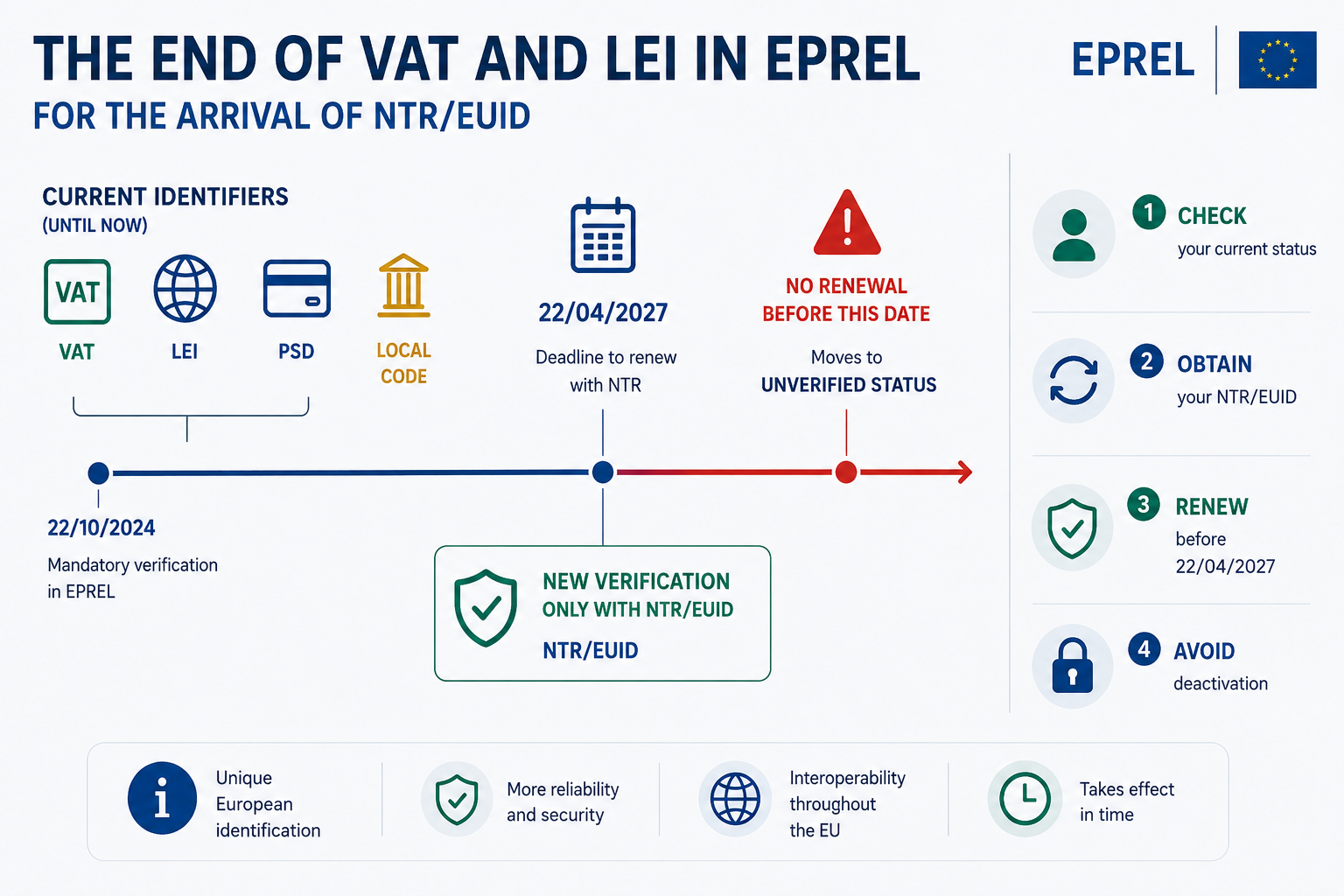
For manufacturers of products with energy labels, the first step remains the same as since October 2024: being verified in EPREL with an NTR-qualified seal in order to operate with full guarantees within the system. That does not change under the ESPR. What changes is that, from now on, this compliance coexists with a broader framework that will gradually be defined product group by product group over the coming years.
At EADTrust, we have spent years helping manufacturers and importers navigate this regulatory ecosystem: from EPREL verification to the qualified certificates that make it possible.