
Qualified Electronic Archiving: What It Is, What It Guarantees and When You Need It
Suscríbete:
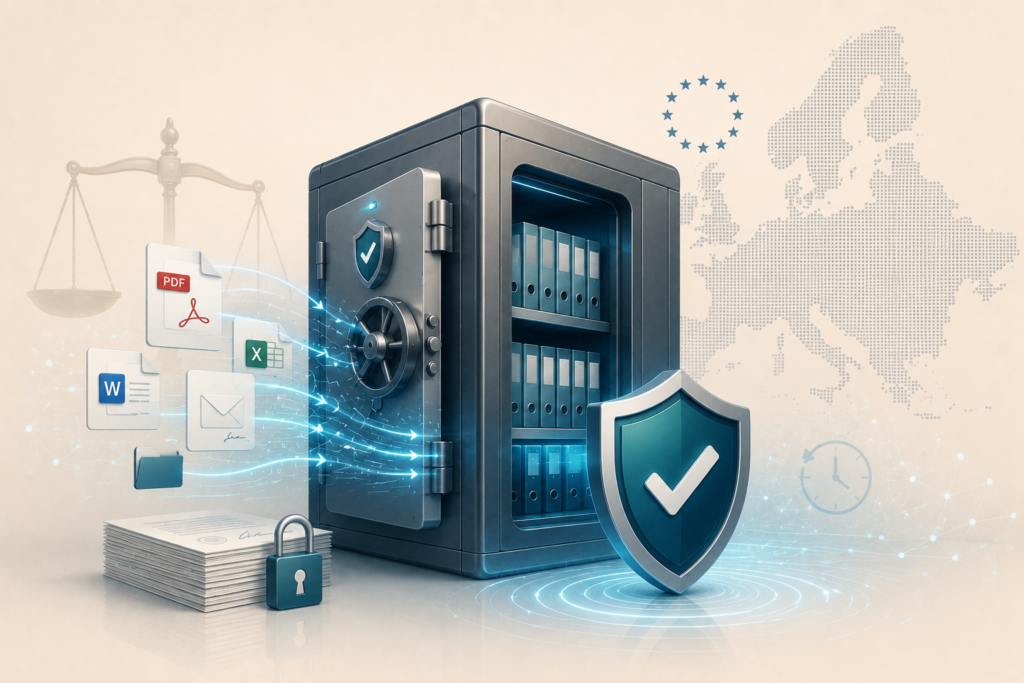
There is a difference that most companies have not yet understood. Storing a document is easy: any folder on a server can do it. Storing a document so that, ten years from now, you can prove before a court that it is authentic, that it has not been modified, that it has existed with exactly that content since a specific date, and that the legal presumption of integrity automatically operates in your favour if someone challenges it, is something else. That is qualified electronic archiving.
The eIDAS 2.0 Regulation (Regulation (EU) 2024/1183) introduces it as a qualified service in its own right. Implementing Regulation (EU) 2025/2532 establishes the technical requirements it must meet. The result is an instrument that did not exist in the European catalogue of trust services until 2024 and that, in 2026, is becoming a practical obligation for any company that needs to preserve critical documentation with real legal guarantees.
This article explains exactly what it is, what legal presumption it provides, how it works technically, and in which contexts its use is not an option but the only coherent response to existing document retention obligations.
Concepts for Understanding eArchiving
Qualified Electronic Archiving
A qualified trust service introduced by the eIDAS 2.0 Regulation (Regulation (EU) 2024/1183) that guarantees the receipt, storage, retrieval and deletion of electronic data and documents while preserving their integrity, confidentiality and proof of origin throughout the retention period.
Presumption of Integrity and Origin
Automatic legal effect granted by Article 45j of the eIDAS 2.0 Regulation to documents preserved through a qualified electronic archiving service. It operates without the party invoking it having to prove it, and can only be rebutted if the party challenging it proves that an alteration has occurred.
Periodic Re-Sealing
A process through which the qualified electronic archiving service provider reapplies timestamps using more modern cryptographic algorithms to the documents in custody, guaranteeing the chain of integrity beyond the period of technological validity of the original algorithms.
eArchiving
The name of EADTrust’s qualified electronic archiving service. It certifies the existence, integrity, permanence and immutability of electronic documents throughout their lifecycle, deployed in Oracle EU Sovereign Cloud under exclusively European jurisdiction.
LACNet Blockchain
A distributed ledger network managed by the Inter-American Development Bank where eArchiving records the hash of each document as an additional layer of immutability. The record cannot be altered and can be independently verified.
The Problem It Solves: The Difference Between Storing and Preserving
Storing and preserving may seem synonymous. Under the law of evidence, they are not.
A document stored in a folder on a server, in a standard document management system or in a cloud repository without additional certification has a structural problem: there is no way to prove that it has not been modified since it was stored. A PDF file can be modified using basic editing tools. A database file can be updated without leaving a visible trace. An exported email may be different from the original email. None of these files, on its own, has strong evidential value if the other party challenges its authenticity.
In the physical world, this problem does not exist in the same way because paper has physical properties that make forgery more difficult (the type of ink, the paper, handwritten signatures). In the digital world, modification is technically trivial and often undetectable to the naked eye.
Qualified electronic archiving solves this problem through a chain of guarantees that makes it technically impossible to modify a document without the modification being detectable:
When the document enters the archiving system, its cryptographic hash is calculated (a unique digital fingerprint of its contents). Any subsequent modification, no matter how small, produces a different hash.
The qualified provider issues a qualified electronic timestamp over that hash, linking the exact date and time to the original content, with a legal presumption of accuracy and integrity under Article 41 of the eIDAS Regulation. The document held in custody in this way cannot be modified without the modification being mathematically detectable, and the legal presumption automatically operates in favour of the party submitting it.
Storing means keeping a document. Preserving means storing it with a guarantee that its authenticity can be verified over time. Qualified electronic archiving is the difference between the two.
The Legal Basis: What the eIDAS 2.0 Regulation Says
Article 45j of the eIDAS 2.0 Regulation, introduced by Regulation (EU) 2024/1183, defines a qualified electronic archiving service as one that guarantees:
The receipt, storage, retrieval and deletion of electronic data and electronic documents to ensure their durability and legibility, as well as to preserve their integrity, confidentiality and proof of origin throughout the retention period.
The Article establishes the direct legal consequence: electronic data and documents preserved through a qualified electronic archiving service shall benefit from a presumption of their integrity and origin throughout the retention period under the custody of the qualified trust service provider.
Implementing Regulation (EU) 2025/2532, adopted in November 2025, specifies the technical requirements: qualified electronic archiving service providers must use procedures and technologies capable of ensuring the durability and legibility of data beyond the period of technological validity of the cryptographic algorithms used, guarantee that the data is preserved and protected against loss or alteration, and use qualified electronic timestamps to certify when the custody period began.
This last requirement, durability beyond the period of technological validity, is particularly relevant. Cryptographic algorithms have functional expiry dates: what is mathematically secure today may no longer be secure in 2035 as quantum computing advances. The qualified electronic archiving service is required to periodically re-seal documents using more modern algorithms, guaranteeing that the chain of integrity is not broken when the original algorithms become obsolete.
The Procedural Effect in Spain: Reversal of the Burden of Proof
In Spain, the legal effect of qualified electronic archiving is reinforced by Law 6/2020, which introduces paragraph 4 into Article 326 of the Spanish Civil Procedure Act. It establishes that if any of the qualified trust services provided for in the eIDAS Regulation has been used, it shall be presumed that the document possesses the disputed characteristic and that the trust service was provided correctly, provided that it appeared on the trusted list at the relevant time.
The procedural consequence is direct: if someone challenges the authenticity or integrity of a document preserved in eArchiving, the burden of carrying out the verification falls on the party that submitted the challenge. If that verification is unsuccessful, the costs of the verification are borne exclusively by the party that challenged it, and if the challenge was reckless, the judge may impose a fine of between €300 and €1,200.
For companies, this means that documents archived with eArchiving are not only technically protected: they are legally protected. In litigation where the authenticity of a contract, email, invoice or file is the central subject of the dispute, the difference between a document with this presumption and one without it can be the difference between winning and losing.
How eArchiving Works: The Technical Process
EADTrust’s eArchiving service certifies the existence, integrity, permanence and immutability of electronic documents throughout their lifecycle. Its technical architecture follows the process established in the ETSI standards applicable to the service, ETSI EN 319 421, ETSI EN 319 422, ETSI TS 119 511 and ETSI TS 119 512.
The custody process works as follows:
- Document Entry. The electronic document (in any format: PDF, XML, JSON, images, compressed files) enters the eArchiving system. The system immediately calculates the document’s SHA-256 hash, generating its unique digital fingerprint.
- Qualified Electronic Timestamping. EADTrust, as a QTSP, issues a qualified electronic timestamp over the calculated hash in accordance with Article 42 of the eIDAS Regulation: linked to Coordinated Universal Time and signed using EADTrust’s qualified certificate. This timestamp certifies that the document with that specific content existed at that exact moment.
- Additional Blockchain Record. The document’s hash is also recorded on the LACNet blockchain network, managed by the Inter-American Development Bank. This record cannot be altered, follows a verifiable order and remains redundantly available across every node in the network. The blockchain acts as an additional layer of immutability, complementary to, but not a replacement for, the qualified electronic timestamp.
- Custody in Oracle EU Sovereign Cloud. The documents and custody records are stored in Oracle EU Sovereign Cloud, with access restricted to personnel residing in the European Union. The data never leaves European jurisdiction.
- Periodic Re-Sealing. As the cryptographic algorithms used in the original timestamps approach technological obsolescence, the system re-seals the documents using more modern algorithms, preserving the chain of integrity without interruption.
- Verifiable Retrieval. When subscribers need to retrieve a document, they download it together with its original hash and the qualified electronic timestamp protecting it. Anyone: the subscriber, an auditor, a court… can independently verify that the downloaded document has the same hash as the one sealed when it entered the system. The verification is mathematically exact and does not require going through EADTrust.
Custody Periods: How Long Documents Can Be Archived
The eArchiving service can be configured with different custody periods according to the subscriber’s needs and the applicable legal obligations. The service’s T&C establish that the minimum document retention period is one year, and that it can be extended according to the subscriber’s contractual needs.
The most common periods according to legal obligations are:
- 6 years: Accounting and commercial documentation under the Commercial Code. Contracts, invoices, accounting books.
- 10 years: Documentation concerning chemical substances under REACH. Records of digital identity services under eIDAS 2.0 and the EUDI Wallet.
- 15 years: eIDAS trust service files under Law 6/2020. Documentation concerning products with an energy label in EPREL from the model’s last placement on the market.
- Indefinitely: Company incorporation deeds for as long as the company exists. Minutes of general meetings containing corporate resolutions.
The T&C also provide for what happens when the retention period ends: the documents are securely deleted or transferred to the subscriber if requested before expiry, together with all the custody evidence that makes it possible to retrospectively prove their integrity throughout the archived period.
When Qualified Electronic Archiving Is the Right Answer
Not every document requires qualified electronic archiving. Ordinary storage is sufficient for documents with a low legal impact and a low risk of being challenged. Qualified electronic archiving is the right answer when at least one of these conditions applies:
The Authenticity of the Document May Be Subject to Litigation
High-value contracts, confidentiality agreements involving trade secrets, meeting minutes containing strategic decisions, communications that could lead to a dispute concerning their exact content.
Regulations Require the Integrity of the Document to Be Demonstrated in the Future
Document retention obligations under the VAT Law, Commercial Code, REACH, DORA, MiFID II, PSD2 or any other regulatory framework requiring preservation for periods of years or decades.
The Document Is the Central Evidence in a Compliance Process
Due diligence files, risk management decision records, supplier analysis documentation, compliance training records. If an audit or inspection takes place, the integrity of these documents must be demonstrable.
The Retention Period Exceeds the Technological Lifespan of Current Algorithms
For documents that must be preserved for fifteen years or more, cryptographic obsolescence is a real risk that qualified electronic archiving resolves through periodic re-sealing.
The Data Must Remain Under Exclusively European Jurisdiction
Contracts containing data subject to the GDPR, files containing special categories of data, documentation belonging to entities regulated under DORA or NIS2 that cannot be subject to the US CLOUD Act.
eArchiving in the EADTrust Service Ecosystem
Qualified electronic archiving is not an isolated service. Within the EADTrust ecosystem, it integrates with the other trust services to provide complete coverage of the document lifecycle:
What Signature Manager signs, eArchiving preserves with a guarantee of integrity for the required period. Contracts electronically signed with Signature Manager can be automatically archived in eArchiving when the signing process is completed.
What Notice Manager notifies, eArchiving preserves as long-term evidence. The completion certificate for a critical employment notification can be archived with the same guarantees as the notified document.
What GoCertius certifies is a conversation, a screenshot, a piece of digital evidence… eArchiving keeps it available and verifiable for as long as required by the judicial process or compliance requirements.
EAD Factory integrates all these services as client infrastructure, whether through an API, as rPaaS or deployed in the client’s own data centre, making qualified archiving not an occasional request to an external service but a cross-cutting layer within the organisation’s document processes.
The Difference Compared with Ordinary Electronic Archiving: The Table
| Aspect | Ordinary electronic archiving (server / standard cloud) | Qualified eArchiving (EADTrust) |
|---|---|---|
| Proof of integrity | No automatic verification mechanism | SHA-256 hash verifiable at any time |
| Certain date of the document | Not guaranteed (the file date can be modified) | Qualified electronic timestamp, legal presumption under Article 41 of eIDAS |
| Legal presumption | No | Yes, Article 45j of eIDAS 2.0 and Article 326.4 of the Spanish Civil Procedure Act |
| Reversal of the burden of proof | No | Yes, the party challenging it bears the burden of carrying out the verification |
| Durability beyond technological obsolescence | Not guaranteed | Yes, periodic re-sealing |
| Data jurisdiction | Depends on the provider | Oracle EU Sovereign Cloud, 100% EU |
| Additional blockchain record | No | Yes, LACNet network |
| Independent verification | Not possible without access to the system | Yes, verifiable without going through EADTrust |
| ETSI standards | Not applicable | ETSI EN 319 421, 422, TS 119 511, TS 119 512 |
Frequently Asked Questions About eArchiving
It does not guarantee that the document is indestructible. Subscribers can delete it if they decide to do so. What it guarantees is that, during the custody period, if the document exists in the system, it can be proven to be authentic and to have remained unmodified since it entered the system. The deletion is also recorded.
Yes. Anyone with access to the downloaded document and its original hash can calculate the hash of the downloaded document and compare it with the original. If they are identical, the document has not been modified. The verification is mathematical and independent of the EADTrust system.
Yes. DORA requires records of ICT activities to be retained for specific periods in a way that allows their integrity to be demonstrated. EADTrust’s qualified electronic archiving provides exactly that guarantee, with a legal presumption of integrity under eIDAS 2.0 and exclusively European jurisdiction in accordance with the financial sector’s data location requirements.
The eArchiving T&C provide mechanisms to ensure continuity of custody. The service architecture guarantees that the documents and custody evidence can be transferred to the subscriber or another provider. The qualified electronic timestamps on the documents make it possible to verify their integrity even without access to EADTrust’s original system.
Yes. eArchiving offers integration via API, allowing the process of entering documents into the qualified archive to be automated directly from the company’s document management system, ERP or CRM.
Storing a document is easy. Preserving it with legal guarantees for the next fifteen years is something else.
The VAT Law requires invoices to be retained for four years. The Commercial Code requires accounting documentation to be retained for six years. REACH requires information on substances to be retained for ten years. Law 6/2020 allows trust service files to be retained for fifteen years.
None of these periods is compatible with a standard company server without guarantees of verifiable integrity.
eArchiving is the right answer for any company that has document retention obligations with real legal consequences, data that cannot leave European jurisdiction, and the need for, in ten to



13 de July de 2026
26 de August de 2026